Ronald Brownstein: Trump's Iran war will compound his affordability woes
Published in Op Eds
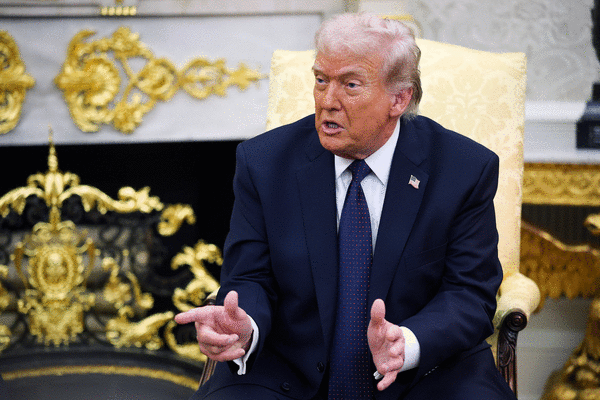
The war with Iran is burning the clock on President Donald Trump’s chances for a reset with voters on the economy. And that increases the odds that his 2026 messaging will focus on disqualifying Democrats with polarizing wedge issues — a strategy that has mostly, though not entirely, failed for other presidents.
As the midterm primaries get underway, the biggest problem for Republicans is that most voters don’t believe Trump has made much progress, or even sufficiently focused, on the problem they elected him to solve: high prices. In national polls, Trump’s approval rating on the economy usually runs around 40% or below. That’s a stark contrast from his first term, when it rarely fell below 50% after his first few months.
Indeed, during his first term, Trump’s approval rating on the economy almost always exceeded his overall job rating; it was a floor lifting him, no matter what other controversies engulfed him. Now attitudes about his economic performance almost always lag his overall rating, meaning it is an undertow pulling him down.
Trump’s advisers recognize this vulnerability and have put him in settings to allay voters’ economic anxieties. But Trump’s heart doesn’t seem to be in it. The most prominent example was last month’s State of the Union. Rather than acknowledging Americans’ concerns about affordability, he took a victory lap, insisting that inflation was “plummeting” and the nation had entered a “golden age.”
Trump did fleetingly discuss a few proposals aimed at bringing costs down, such as requiring artificial intelligence data farms to supply their own electrical power and banning corporate ownership of housing. But these bite-sized ideas were overshadowed by his insistence that he would revive his unpopular tariff policy despite the Supreme Court’s decision against it. For voters, “the economic consequences of the tariffs overwhelm all those other more modest ideas,” says GOP pollster Whit Ayres.
The Iran War compounds Trump’s economic challenge in two respects. The swift increase in oil prices is sure to worry voters about costs at the pump — which have been central to Trump’s claim that he’s solved inflation. The war also represents an enormous opportunity cost: As the calendar flips closer to November, each week Trump spends explaining the war is a week he’s not delivering an economic message.
If Trump is unable or unwilling to mount a sustained campaign to rebuild confidence in his economic management, how will he and the GOP contest the midterm? His State of the Union offered a clear signal. Trump came to life only when he unspooled a greatest-hits revival of his sharpest culture-war arguments from 2024, painting Democrats as both weak and extreme. “These people are crazy,” Trump insisted while taunting Democrats over immigration, crime and transgender rights.
But historically, views of the out-of-power party have not influenced midterms nearly as much as assessments of the incumbent president. In 2018, national polls showed voters saw Republicans almost as favorably as Democrats, but the GOP still lost 41 House seats. In 2010, polls showed virtually no difference between the public’s ratings for the two sides — and Republicans won 63 House seats. Both of those wave elections were driven by majority disapproval of the president’s performance — Trump’s in 2018 and Barack Obama’s in 2010.
Last year’s gubernatorial elections in Virginia and New Jersey upheld these patterns. Exit polls showed that nearly half of voters in each state viewed the Democratic Party unfavorably; in Virginia, the exits showed that exactly half of voters said support for transgender rights had gone too far. Yet Democrats Abigail Spanberger in Virginia and Mikie Sherrill in New Jersey each won double-digit victories, with over 90% of voters who disapproved of Trump supporting them. Culture-war issues “are not what the election is about this time,” says Democratic pollster Geoff Garin. “We ran that experiment in Virginia and New Jersey.”
The most encouraging precedent for Trump may be the 2022 midterm. Democrats lost control of the House that year, but despite widespread disapproval of President Joe Biden’s performance, the party limited its losses in federal and state races by portraying Republicans as extreme on social issues following the Supreme Court’s decision overturning Roe v. Wade. That was an especially effective tactic for Democrats with college-educated suburban voters.
It’s not unreasonable for Trump to hope his cultural offensive offers similar protection for Republicans among the GOP’s base — White voters without a college degree — who respond most strongly to those messages. And those blue-collar White voters are overrepresented in most of the competitive Senate races, as well as the bulk of the contested House districts — the low-diversity, low-education districts in states such as Iowa, Ohio, Pennsylvania and Wisconsin that my Bloomberg colleague Carolyn Silverman and I have identified as the populist periphery.
The big difference from 2022, as Democratic pollster Evan Roth Smith points out, is that there is no single issue to shift voters’ focus from the economy toward their cultural allegiances, as the Supreme Court did that year with its abortion decision. Absent such a seismic event, Smith says, “it’s hard for me to see” voters who have abandoned Trump over the economy returning to the GOP because he inflames their doubts about Democrats on other fronts. “I think you have to win a voter back the way you lost them,” Smith says.
Which means that whatever the outcome in Iran, the decisive electoral battlefield for Trump almost certainly will remain the economy.
____
This column reflects the personal views of the author and does not necessarily reflect the opinion of the editorial board or Bloomberg LP and its owners.
Ronald Brownstein is a Bloomberg Opinion columnist covering politics and policy. He is a CNN analyst and the author or editor of seven books.
©2026 Bloomberg L.P. Visit bloomberg.com/opinion. Distributed by Tribune Content Agency, LLC.


















































Comments