Commentary: Trump's deportation rhetoric reveals a culture of state punishment
Published in Op Eds
“’I love the smell of deportations in the morning…’ Chicago is about to find out why it’s called the Department of WAR.” President Donald Trump, September 6, 2025
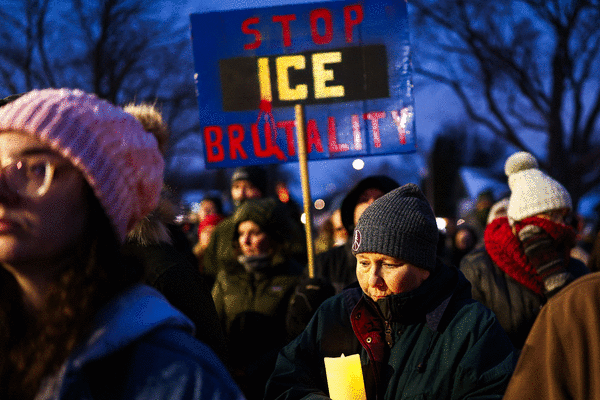
This statement, made by President Donald Trump on Truth Social, referencing protests against ICE and mass deportation, draws attention to a problem that is not discussed often enough -- the politics and culture of punishment in our country. The administration’s central use and public celebration of punishment is alarming and highlights the harms of centering punishment as policy.
It's no secret that the Trump administration aggressively punishes those seen as its opponents. Perhaps at the top of the list is its weaponization of federal authority to punish immigrants, asylum seekers and refugees. As of Jan. 26, more than 70,000 immigrants were being held in detention, separating families and disrupting local and national economies. The extent of the sweeps should be no surprise, given the unprecedented billions of dollars of funding directed to building and filling new detention centers -- which, should they outlast the current administration, will be filled with the bodies of others deemed undesirable.
The rush to publicly punish also extends to those deemed to hold views contrary to the administration. This has taken the form of high-profile legal actions for damages and criminal penalties, for example, against cities that limit cooperation with federal immigration authorities in order to preserve the safety of all residents. The administration has similarly leveraged threats against prominent law firms, institutions of higher education, the media, public officials and even states that voted in disfavored ways.
Although punishment has been used by our government throughout history, the public and revelatory manner in which the government metes out punishments is something we’ve not seen from the highest ranks of government in recent history.
The president’s post on deportation quoted above illustrates the point. The first segment, “I love the smell of deportations in the morning,” delights in the success of the punishment and invites the country to join the appreciation. This shared joy in punishing people in harsh and public ways elevates punishment to the level of a cultural value: We carry out the punishment with the raised arms of victory!
The second part of the statement,“Chicago about to find out why it’s called the Department of WAR,” has the appeal of a line you might shout at a sporting event. You want your side to annihilate the opponent. But we should ask ourselves, what does it mean that our federal government has named its citizens as adversaries, or even enemies, when they exercise their right to protest? The specter of the president publicly and proudly threatening to punish the exercise of free speech should shock the conscience of all who believe in democracy.
The elevation of state-sponsored public humiliation has always been -- and must continue to be -- a red flag. Think about what rings true in the punishment scenes portrayed in any dystopian novel you might have read. "The Hunger Games," in which the government controls every facet of people’s lives and environments, comes to mind. Gallows take pride of place in the center of every district, and whipping posts are scattered throughout the towns. Those fictional details are drawn from American history, from the Puritan use of stocks to hangings on the Boston Common, to public lynchings throughout the antebellum South. Are we really willing to move back toward those chilling scenarios?
We know from other countries that dangerous changes follow once cultures begin to celebrate punishment. On a policy level, if we are busy celebrating the downfall of those cast as unworthy, we aren’t paying attention to the effects of punishment-centered governance on the country as a whole.
For example, the loss of due process in immigration enforcement and detention proceedings sets precedents for loss of due process in other contexts. And these precedents are poised to diminish rights most people in our country take for granted. As warrantless search and seizures proceed on a new and dangerous interpretation of the Fourth Amendment, and shootings of targeted individuals, protesters, and bystanders rise, our progression toward a dystopian reality becomes ever more evident.
Government reliance on punishment negatively impacts our lives in many ways. To name but a few:
· High incarceration or policing costs divert funds from other areas, like education, healthcare, and infrastructure budgets.
· Public punishment sows fear; because of it, people stay closer to home, spend less money, and the economy wanes, often felt first by small businesses.
· Punitive policies erode trust in government, leading people to disengage from the political process, when engagement is key to a thriving democracy.
· Punishment doesn’t work as a means of accountability or deterrence; if we are truly concerned with addressing violence and harm in our communities, instead of exacting revenge and performing political theatre, we should expand and support the many effective alternatives to detainment and punishment that are making a difference.
This administration’s reliance on punishment should raise alarms in every community. While it may seem familiar because it builds on our country’s history and practice of punishment and detention, this moment gives us an opportunity to see it even more clearly and to critically consider its impact.
Governments can and should do more than threaten, punish, and harm. We need to name governance by punishment for what it is and press our legislators to adopt policies that demand safety rather than terror in our country.
____
Charlene Allen Esq. is an author, activist, and Lawyers Defending American Democracy volunteer. She works with community-based organizations to build new approaches to justice that center healing, accountability, and human connection.
Julie Goldscheid is Professor of Law Emerita at CUNY School of Law and an Adjunct Professor of Law at NYU School of Law. She teaches courses on gender violence and has taught courses including civil procedure, legislation, gender equality and lawyering. She is a volunteer with Lawyers Defending American Democracy.
____
©2026 The Fulcrum. Visit at thefulcrum.us. Distributed by Tribune Content Agency, LLC.





















































Comments