Commentary: How to safeguard the DOJ against the next Trump
Published in Op Eds
The Trump administration has taken a wrecking ball to the Department of Justice, dismantling the traditional barrier between prosecutorial independence and partisan politics.
Career prosecutors have retired or resigned rather than compromise their integrity. Judges have complained about DOJ lawyers’ shoddy work, accused them of defying court orders, and engaging in unprofessional conduct.
Restoring the Department’s integrity and public confidence after President Donald Trump leaves office will require not just rebuilding. It will require fundamental reimagining.
Simply returning to business as usual will not safeguard the Justice Department from future abuses. Now that Trump has shown how an executive can abuse its power, we need to take affirmative steps to prevent a repeat performance.
In just a year, the DOJ has become unrecognizable to those of us who devoted our legal careers to its service. Attorney General Pam Bondi has transformed it from an agency that pursues justice without fear or favor into an instrument of Trump’s retribution.
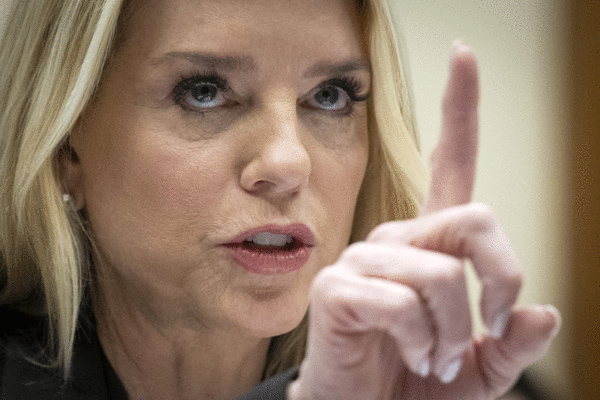
In a combative and defiant appearance before the House Judiciary Committee on Wednesday, Bondi complained that “liberal activist judges” are hampering the president’s agenda. “America has never seen this level of coordinated judicial opposition to a presidential administration,” Bondi said.
Perhaps that’s because America has never seen this level of lawlessness from a presidential administration.
Bondi has used the power of her office to obtain baseless indictments against Trump’s perceived political enemies, including James Comey, the former FBI director who refused to drop the investigation into Russian interference in the 2016 presidential election, and New York Attorney General Letitia James, who won a civil fraud case against the president and the Trump Organization.
Just last week, the DOJ sought indictments against six Democratic members of Congress for making a video stating — accurately — that military service members have a duty to refuse unlawful orders.
These efforts were thwarted by the courts and grand juries. But simply being targeted for criminal investigation can be oppressive.
The DOJ has also trained its sights on other Trump targets, including Federal Reserve Chair Jerome Powell, Minnesota Governor Tim Walz, and Minneapolis Mayor Jacob Frey. The US attorney in Miami — a Trump loyalist — is reportedly probing the origins of the investigation into Russian interference in the 2016 election, despite prior inquiries by special counsel Robert Mueller, the DOJ inspector general, and the Senate Intelligence Committee. And earlier this month, the FBI seized ballots and voting rolls at the Fulton County elections office in Georgia based on previously debunked claims of fraud advanced by election deniers.
The Justice Department has not only worked to punish Trump’s enemies, but has also rewarded his allies, dispensing pardons like candy to the defendants who attacked the US Capitol on Jan. 6, 2021. Last week, it moved to erase the criminal conviction of former Trump adviser Steve Bannon, who was found guilty of contempt of Congress for refusing to testify before the Jan. 6 committee. It pulled the plug on a successful conviction for no apparent reason other than Bannon’s loyalty to Trump.
The next administration, whether Republican or Democrat, cannot be allowed to repeat these abuses of the system. This administration’s manipulation of the Justice Department is an unpatriotic betrayal of our country and the rule of law. The next administration must take decisive steps to safeguard the only cabinet agency named for a virtue.
First, prosecutors must be prevented from abusing their authority before grand juries. Congress should pass legislation requiring courts to hire counsel to serve as legal advisers to the panels. When Lindsey Halligan, the former insurance lawyer and White House aide, secured the Comey indictment, a magistrate judge said Halligan appeared to have misstated the law regarding the evidence and Comey’s obligation to testify. As the Halligan episode demonstrates, prosecutors have an inherent conflict of interest in both seeking a grand jury indictment and serving as its legal adviser. That problem could be remedied by appointing an independent lawyer who works for the court rather than the prosecution. Just as a judge instructs a trial jury about the law, a lawyer who works for the court should instruct grand jurors. This reform would be a simple fix to protect against politically motivated or legally baseless charges.
Second, we must restore the Department’s ability to attract the best and brightest lawyers and investigators — professionals of the highest integrity who will undertake their work free from political considerations. Trump’s purge has made the job far less attractive than it used to be, and one must wonder who is being hired to replace those who have left.
Even if the next president governs with integrity, what about the one after that? Devoting one’s career to government service has suddenly become a risky proposition. To ensure that presidents respect our professional civil service, federal employees must be protected from removal without just cause. If the Supreme Court continues to embrace the once-fringe unitary executive theory — which holds that the president embodies all executive power and therefore may hire and fire any federal employee at will — we may ultimately need a constitutional amendment to clarify what Congress believed it had achieved in 1883 with the passage of the Pendleton Act. That law was meant to replace the political spoils system with a workforce of career professionals.
Third, the Principles of Federal Prosecution should be codified into law. These principles prohibit prosecutors from making charging decisions based on partisan politics. Currently, they exist as part of the Justice Manual, a set of policies that can be rewritten with the stroke of a pen or violated without external consequence. Codifying them in the Code of Federal Regulations would require that any changes go through the public notice-and-comment process. The code could also include a provision that violations trigger a referral to the attorney’s licensing authority for possible disciplinary action, including disbarment.
Finally, to prevent political meddling in case decisions, communications between the president and the Justice Department should be formally restricted. Traditionally, such limits have existed based on voluntary agreements between the attorney general and the White House counsel. Of course, some communication is necessary. The White House, for example, might need a heads-up that a foreign national is about to be indicted to avoid harming diplomatic interests. But one way to avoid improper influence would be to require that such communications be reported confidentially to Congress. Any irregularities could then be subject to oversight. Such transparency would not only prevent political influence in criminal cases but also enhance public trust by avoiding even the appearance of impropriety.
Of course, you can’t completely “Trump-proof” every institution of democracy. Checks and balances can help to reduce the risks of abuse of power, but our institutions are made up of the people who run them. The best reform the American people can make to ensure that the Department of Justice serves the interests of the people is to elect a president with integrity and who respects the rule of law.
____
This column reflects the personal views of the author and does not necessarily reflect the opinion of the editorial board or Bloomberg LP and its owners.
Barbara McQuade is a professor at the University of Michigan Law school, a former US attorney and author of the forthcoming book, "The Fix: Saving America from the Corruption of a Mob-Style Government."
©2026 Bloomberg L.P. Visit bloomberg.com/opinion. Distributed by Tribune Content Agency, LLC.


















































Comments