Commentary: Why were men so angry at an International Women's Day protest?
Published in Op Eds
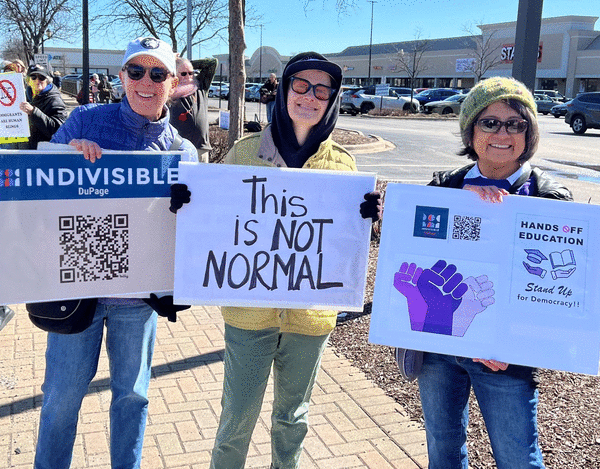
On a cool, bright afternoon in Glen Ellyn, Illinois, in suburban Chicago, roughly 100 to 150 men, women and even a few children gathered along Roosevelt Road for a pop-up peaceful protest marking International Women’s Day. At one of the suburb’s busiest intersections, people lined the sidewalks holding handmade signs and banners as traffic rolled steadily past. Our message was simple but powerful: Together we stand in solidarity as we seek peace, justice and equality.
In a community where civic demonstrations are relatively rare, the gathering stood out.
We stood for values most Americans claim to share: transparency, accountability and human dignity. Protesters called for an end to war, the release of files about convicted sex offender Jeffrey Epstein and protection of bodily autonomy. What should have been a visible exercise of civic engagement, however, quickly revealed something darker simmering beneath the surface of public life.
At first, the energy felt familiar. Cars drove by and many drivers honked their horns in support, waving or raising fists through open windows in solidarity. Public protest always carries a quiet optimism — the belief that democracy still breathes through the willingness of ordinary people to show up and speak out.
Then, as if on cue, the mood shifted.
A man approached our group, not to join us, but to confront us. He shouted that women should “get a passport” if they wanted to vote. He accused us of hypocrisy, claiming we supported some victims connected to the Epstein files while ignoring others. His words were angry and often incoherent, but the hostility behind them was unmistakable. His voice was loud, aggressive and relentless. A rage meant not simply to disagree, but to intimidate.
As many drivers continued to honk in support, others rolled through with a different message. Several leaned out of their windows to shout insults or raise middle fingers. The louder they became, the clearer the pattern seemed: Most of the hostility, both on foot and behind the wheel, came from men.
Standing there, I found myself asking a simple question: Why were they so angry at what we were protesting?
War? Equality? The right of women and girls to live free from abuse? The expectation that leaders be held accountable before starting wars? These are not radical ideas. They are the basic cornerstones of a humane society.
I have attended many protests over the years, and disagreement is nothing new. But that afternoon, for the first time, I felt something unfamiliar: a quiet sense of vulnerability. Not because our group had done anything provocative, we were standing calmly with signs, but because the level of rage directed toward us felt unpredictable. It wasn’t simply disagreement. It was fury at the very act of peaceful dissent.
That kind of hostility raises troubling questions about the cultural moment we are living in. When empathy is framed as weakness and equality as provocation, anger becomes a reflex. The result is that even the simple act of standing peacefully with a sign, calling for women’s rights, accountability and peace, can provoke resentment strong enough to spill into public intimidation.
International Women’s Day is meant to celebrate progress while acknowledging how much work remains to be done. The protest I attended reflected that spirit: People of different ages and backgrounds showing up together because they believe compassion, justice and equality are still worth fighting for. But the reactions we received also served as a reminder of how fragile those values can feel in the public square.
Yet even in the face of hostility, hundreds of us stayed. We stood shoulder to shoulder along Roosevelt Road, holding our signs as traffic moved past and choosing solidarity over silence.
Solidarity, it turns out, is not the absence of hostility, it’s what endures despite it.
____
Jodi Bondi Norgaard is the creator of the award-winning Go! Go! Sports Girls brand and the author of “More Than a Doll: How Creating a Sports Doll Turned into a Fight to End Gender Stereotypes.” She worked with the White House Gender Policy Council under the Joe Biden administration and the Geena Davis Institute on Gender in Media.
___
©2026 Chicago Tribune. Visit at chicagotribune.com. Distributed by Tribune Content Agency, LLC.

















































Comments