Commentary: The Fourth Amendment will no longer protect you
Published in Op Eds
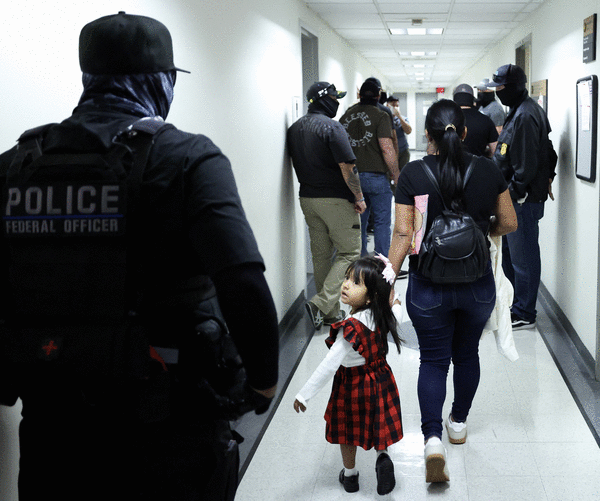
In September, the Supreme Court rendered obsolete the Fourth Amendment’s prohibition on suspicionless seizures by the police. When the court stayed the district court’s decision in Noem v. Vasquez Perdomo, it green-lighted an era of policing in which people can be stopped and seized for little more than how they look, the job they work or the language they speak.
Because the decision was issued on the Supreme Court’s “shadow docket,” the justices’ reasoning is unknown. All we have is Justice Brett M. Kavanaugh’s solo concurrence defending law enforcement’s use of race and ethnicity as a factor in deciding whom to police, while at the same time playing down the risk that comes with every stop — prolonged detention, wanton violence, wrongful deportation and sometimes even death. As Justice Sonia Sotomayor said in her impassioned dissent (joined by Justices Elena Kagan and Ketanji Brown Jackson): “We should not live in a country where the Government can seize anyone who looks Latino, speaks Spanish, and appears to work a low wage job.” But now, we do.
The practical effect of this decision is enormous. It strips away what little remained of the guardrails that prevented police (including agents of Immigration and Customs Enforcement) from indiscriminately seizing anyone with only a flimsy pretext.
Now there is no real limit on police seizures. History teaches us that people of color will bear the brunt of this policing regime, including the millions of immigrants who are already subject to police roundups, sweeps and raids.
This decision is no surprise for those of us who study the Fourth Amendment. The police have long needed very little to justify a stop, and racial profiling is not new. Yet prior to the Vasquez Perdomo order in most instances, police had to at least articulate a non-race-based reason to stop someone — even if as minor as driving with a broken taillight, not stopping at a stop sign long enough, or walking away from the police too quickly.
Now, police no longer need race-neutral person-specific suspicion (pretextual or real) to seize someone. Appearing “Latino” — itself an indeterminate descriptor because it is an ethnicity, not defined by shared physical traits — along with speaking Spanish and appearing to work a low-wage job is enough, even if you have done nothing to raise suspicion.
Some might believe that if you have nothing to hide there is no reason to fear a police stop — that if you just show police your papers or offer an explanation you can go on your way. Even if that were the case, this sort of oppressive militarized police state — where anyone can be stopped for any reason — is exactly what the Fourth Amendment rejected and was meant to prevent.
Moreover, ICE agents and police are not in the business of carefully examining documents (assuming people have the right ones on them) or listening to explanations. They stop, seize and detain — citizens and noncitizens alike. If lucky, some people are released, but many are not — including citizens suspected of being in the country illegally, or individuals whose only alleged crimes are often minor (and the product of poverty) or living peacefully (often for years) in the United States without legal status. And as evidenced by plaintiffs in this case, even if eventually released, a single stop can mean harassment, violence, detention or a life permanently upended.
Even if the Fourth Amendment doesn’t prevent them, can’t race-based discrimination and police violence often be addressed through civil rights lawsuits? U.S. Code Section 1983 allows individuals to sue officials who violate their rights. But the reality plays out differently. In a recent decision, this Supreme Court dramatically limited class-action lawsuits, the primary vehicle that would allow widespread relief. The court has created a world in which law enforcement can largely act with impunity under the doctrine of qualified immunity. And there is likely no recourse if a federal official such as an ICE agent violates one’s constitutional rights, as the Supreme Court has sharply limited the ability to sue federal officials for money damages even if they commit a clear constitutional wrong.
The recent decision virtually declaring that the Fourth Amendment allows police to engage in express racial profiling may not be the final word on the matter. We hope it isn’t. But longstanding court doctrine had already allowed racial profiling to flourish under the guise of seemingly neutral language of “reasonable suspicion” and “consent.” By allowing a further erosion of the limits on seizures, the Court entrenches a system in which the scope of one’s constitutional rights depends upon the color of one’s skin. If the Fourth Amendment is to retain meaning, it must be interpreted to constrain — not enable — the racialized policing practices that have become routine in America.
____
Daniel Harawa and Kate Weisburd are law professors at NYU Law School and UC Law San Francisco, respectively.
©2025 Los Angeles Times. Visit at latimes.com. Distributed by Tribune Content Agency, LLC.
















































Comments