Lisa Jarvis: Autism needs support, not blame and judgment
Published in Op Eds
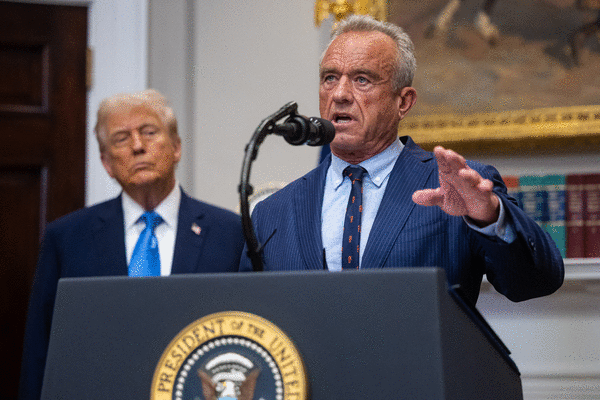
Health Secretary Robert F. Kennedy set the tone back in April when he announced the Trump administration’s plan to find the cause of autism. He declared that “autism destroys families.” He described children “who will never hold a job, they’ll never play baseball, they’ll never write a poem, they’ll never go out on a date.”
On Monday, President Donald Trump carried that message forward, calling autism a “horrible, horrible crisis” and suggesting — without evidence — that Tylenol could be the cause and that leucovorin, a type of folic acid, might be a treatment. Food and Drug Administration Commissioner Marty Makary added, “if you've seen a kid with autism, with severe autism, it's hard to watch.”
Their words left many in the autism community stunned. They’d come expecting answers and action. Instead they were offered suspect causes and unproven cures. They were reminded of a past filled with blame and judgment.
The depictions left many of them feeling hurt and dehumanized, reflecting a fundamental misunderstanding of their lived experience. And ultimately they worry there will be a broad backslide in public attitudes about autism.
“What will come out is unfortunately more confusion, more headlines, more misinformation that will just add to the burden of people like me,” says Russell Lehmann, a disability awareness and inclusion specialist at UCLA, who is autistic.
The suggestion that autism was somehow preventable — and the underlying message that the world would be better off without it — was particularly gut-wrenching. “Hearing them say that their goal is to end autism? That’s deeply alarming in our community,” says Colin Killick, executive director of the Autistic Self Advocacy Network. “What we know — and when I think any expert will tell you — is that autism is not a disease you can eradicate because it’s a fundamental part of neurodiversity. Autistic people have always existed.”
Even in parts of the autism community where the messaging didn’t necessarily offend—and in fact, helped some families feel seen for the first time, there was still recognition that portraying it in such a one-dimensional way was problematic.
Judith Ursitti, cofounder of the Profound Autism Alliance, said she appreciated the overdue “candid awareness about the realities that we face.”
Her son is among those with the most severe manifestations of autism spectrum disorder, which encompasses a broad range of neurological and developmental challenges. But Ursitti also was deeply worried about the language being used and how it could harm many autistic self-advocates who are dear to her.
Where everyone in the community agrees though, is that sham solutions and false promises won’t help anyone. And they are particularly galling when, at the same time, the administration is making deep cuts to the research and services that actually make a difference.
This spring, scores of grants that supported studies seeking to understand which environmental exposures might contribute to autism were canceled. A Reuters analysis found that spending by the National Institutes of Health on autism fell by about $31 million between January and April of this year—a 26% drop attributed to the broader purge of research deemed in violation of Trump’s gender and diversity, equity and inclusion executive orders. The Department of Education, meanwhile, has been drastically reshaping its priorities in ways that threaten some special education services that directly benefit autistic children, such as parent supports and teacher training.
The Trump administration has instead touted a new $50 million autism data science initiative, centered on pinpointing the causes of autism. Yet while the 13 new grants announced last week went to reputable institutions, several autism researchers and advocates told me they are skeptical the effort will translate into meaningful progress for autistic individuals. Only projects that analyzed existing databases were eligible for funding, meaning the work is largely focused on filing through old data to pinpoint genetic or environmental causes or develop methods to ensure autism studies are robust.
None of that directly addresses what experts and autistic individuals say is most urgently needed: studies that identify which supports and interventions work best for different groups of children, or clinical trials of potential treatments — an area that many tell me has been chronically underfunded.
But this misguided shift in the research agenda also overshadows a more immediate concern: the Trump administration’s steep cuts to Medicaid which will inflict direct harm on autistic children and adults with intellectual or developmental disabilities. Waiver programs enable families whose income wouldn’t normally qualify for the public insurance to access critical, unaffordable home- and community-based services. And while states facing budget crunches might not eliminate them entirely, families will likely see significantly less support compared to the past.
Even before those cuts, autistic individuals have struggled to get the support that allows them to live fuller, more independent lives. For example, Ursitti’s son Jack turned 22 recently, aging out of educational services. “I’ve been hearing for years that you’re going to fall off the cliff,” Ursitti says, but the reality has been sobering. She is scrambling to find staffing and funding so that his days retain structure and familiarity but laments the vast gaps in support for autistic adults. “I’m very worried about the additional cuts,” she says. “We’re already hurting.”
If there is any silver lining , it’s that the president’s disastrous plan has galvanized a deeply divided community. Different factions have long held polarized views on the causes, treatment and even how to describe autism. Now, for the first time, they are uniting in opposition, Lehmann says. “Hopefully this will be the impetus to stir up our community to speak up louder and stronger and more authentically.”
Let us hope so — and that eventually, someone in the administration begins listening to autistic individuals and acting on what they so urgently need and want. An easy place to start would be treating them with the respect and fundamental humanity they deserve.
____
This column reflects the personal views of the author and does not necessarily reflect the opinion of the editorial board or Bloomberg LP and its owners.
Lisa Jarvis is a Bloomberg Opinion columnist covering biotech, health care and the pharmaceutical industry. Previously, she was executive editor of Chemical & Engineering News.
©2025 Bloomberg L.P. Visit bloomberg.com/opinion. Distributed by Tribune Content Agency, LLC.




















































Comments