Congress' wide age gap comes into focus
Published in Political News
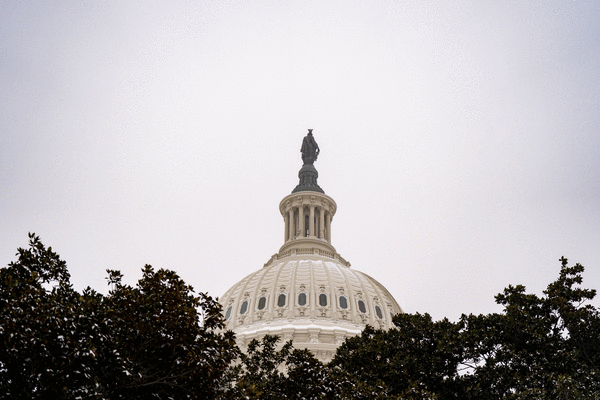
WASHINGTON — Iowa Sen. Charles E. Grassley, the oldest member of Congress, was born in 1933, the year Prohibition ended.
On the other end of the age spectrum, Congress’ youngest member, Rep. Maxwell Alejandro Frost of Florida, was born in 1997, the year Google registered its domain.
That’s an age gap of some 64 years — about the same figure as the average age of a senator in Washington and about two years above the median retirement age in the U.S. As older members of Congress hold on to their seats longer, younger lawmakers and candidates are sparking conversation about the implications of such age gaps in the nation’s top legislative body.
Georgia Democrat Jon Ossoff, the Senate’s youngest member at 39, recently described his chamber as the “world’s most powerful senior center.”
“It’s not just that the Senate is overwhelmingly full of people of a certain age for whom parenting is a distant memory,” Ossoff told CNN. “It’s also full of people who have been senators for decades, which equally distances them from the daily reality of American life.”
Ironically, some of Congress’ oldest members were once among the youngest when they were first elected.
Democratic Sens. Ron Wyden of Oregon and Edward J. Markey of Massachusetts were first elected to the House at 30 and 31, respectively.
Moreover, Grassley was first elected to the House when he was 41 — about 17 years younger than the current average age of a House member. That was in 1974, when the average price for a home in the U.S. was about $36,000. At 92, he’s been on Capitol Hill for almost 52 years.
Polling suggests Americans desire a Congress that reflects the country more closely in age. A July CNN survey found that nearly 6 in 10 U.S adults said it was a “major problem” that a quarter of people serving in Congress were over 70. Thirty-four percent said it was a “minor problem,” and just 8% said it was not a problem at all.
But that sentiment hasn’t always translated at the ballot box.
“Voters have these attitudes that they don’t want older members. But then when these older members run, especially incumbents run, they tend to put them back in power,” said James M. Curry, a political science professor at the University of Notre Dame. “Voters are the stopgap.”
‘Always been old’
The Constitution sets minimum age requirements for Congress — 25 years old for the House and 30 for the Senate — but it doesn’t stipulate an age cap.
The prevalence of older lawmakers is not entirely unusual, according to Curry.
“Congress has definitely gotten older over time. That’s undeniable. On the other hand, it’s also always been old, relative to the American population,” he said. “Part of the increase in average age in Congress has to do with the increase in the average age of Americans.”
Americans nowadays are living longer than their ancestors, thanks to improvements in medicine, among other reasons. In 1900, the average American lived about 47 years, according to the Center for Disease Control. That figure had jumped to 79 by 2024.
Aside from fueling the jokes about Capitol Hill doubling as a “senior center,” age also influences what legislation members tend to focus on, Curry said.
Older members tend “to naturally spend more time on some issues that are particularly important to older Americans, rather than on issues that are particularly important to other groups,” he said, citing concerns such as Medicare, Social Security and elder care.
“Older members of Congress spend more time on lower salient senior issues and policies, irrespective of where or who they represent or what their district looks like,” Curry said.
Younger members tend to hone in on issues such as child care, as many of them juggle careers on Capitol Hill with family obligations. For example, the four millennials serving in the Senate all have children at home, in their teenage years and below.
Members also tend to stick around, in part, because Congress’ stress on seniority incentivizes them to stay.
“The more time you can spend there, the more clout you have, the more likely you are to obtain positions of institutional power, such as being a committee chair or being in party leadership or moving up from the House to the Senate,” Curry said. “Once we started seeing these seniority-based systems put in place, that’s always been a pressure that keeps members of Congress running for reelection time and time again because as they stay, they gain more power.”
Changes afoot
But things could be changing. In the 2026 election cycle, age has been a factor in several races, especially on the Democratic side.
Several incumbents have lost primaries to younger challengers. More recently, Connecticut Rep. John B. Larson, 78, lost his bid for renomination to a 47-year-old challenger. New York Rep. Adriano Espaillat and Michigan Rep. Shri Thanedar, both 71, were ousted in their primaries by millennial opponents. The winners are sure bets to come to Congress next year from their deep-blue districts.
If Melat Kiros, 29, wins, as expected, in Colorado’s 1st District, she’d become the first Gen Z woman elected to Congress. She knocked off 15-term Democratic Rep. Diana DeGette in a June primary.
On the Republican side, 26-year-old Michael Alfonso, the son-in-law of Transportation Secretary and former Rep. Sean Duffy, won the Republican nomination for Wisconsin’s red-leaning 7th district earlier this month. If he wins in November, he’d become the youngest member of Congress.
More millennials could soon be joining the “Old Man’s Club,” a.k.a. the Senate, which currently includes Ossoff, New Jersey Democrat Andy Kim and Republicans Tim Sheehy of Montana and Katie Britt of Alabama, the youngest Republican woman elected to the chamber.
Republican Rep. Julia Letlow, 45, is heavily favored to win her Senate race in ruby-red Louisiana. Other potential new senators face battleground races this fall, including GOP Rep. Ashley Hinson of Iowa, 43, Texas Democrat James Talarico, 37, and Michigan Democrat Abdul El-Sayed, 41.
Retirements and holdouts
Nearly two-dozen members of Congress aged 70 or older are retiring after this year.
They include former Speaker Nancy Pelosi, 86, and former House Majority Leader Steny H. Hoyer, 87.
Illinois Democratic Sen. Richard J. Durbin, who was 38 when he entered the House in 1983, announced his retirement last year. “In my heart, I know it’s time to pass the torch,” the now 81-year-old said in a statement.
Former Senate Majority Leader Mitch McConnell, 84, has faced scrutiny over his absence from the chamber since being hospitalized in June following a fall and subsequent bout of pneumonia. But the Kentucky Republican already announced last year that he wouldn’t seek reelection.
In the House, five members have died during the 119th Congress — most recently, Georgia Democrat David Scott, who was 80. Three of the other four members were 70 and older.
Curry, the Notre Dame professor, said it was difficult to prove correlation between the overall effectiveness of Congress and the age of its members.
“Some of the more productive Congresses in recent history have been some of the oldest,” he said. “Some of the [older lawmakers] continue to improve, while others do drop off.”
One member of the old guard with no plans to drop off anytime soon is Markey. But first, he’ll need to get through a Sept. 1 Democratic primary challenge from Rep. Seth Moulton, 47, who has called for a “new generation of leaders.”
Six years ago, Markey comfortably dispatched another younger primary challenger, Rep. Joseph P. Kennedy III, leaning on his progressive credentials to energize young primary voters. He’s counting on the same playbook this time around and has the backing of notable progressives, including Sen. Bernie Sanders and New York Rep. Alexandria Ocasio-Cortez.
“This is the most energized I’ve ever been,” he told CNN last month. “It’s not your age, it’s the age of your ideas. And in this race, I’m the youngest guy.”
—Ryan Kelly contributed to this report.
©2026 CQ-Roll Call, Inc., All Rights Reserved. Visit cqrollcall.com. Distributed by Tribune Content Agency, LLC.





















































Comments