Wildland firefighting bill gains steam as smoke reaches Congress
Published in Political News
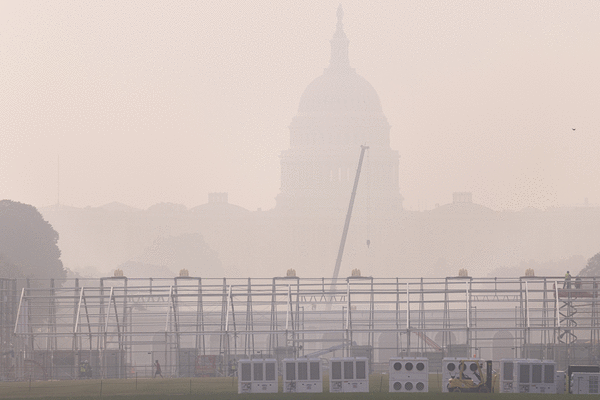
WASHINGTON — Wildfire smoke drifting into Washington, D.C., from the Western U.S. and Canada this summer made it hard to ignore the national threat stronger wildfires pose to lawmakers’ constituents across the country.
As a result, a bipartisan coalition led by Western lawmakers has a better shot this year at enacting legislation targeting wildfires at their source — reducing conditions that fuel them and preventing sparks from turning into catastrophic fires.
Advocates of the Senate Agriculture Committee-approved bill, who are looking to the annual must-pass defense authorization bill as a vehicle when Congress returns, received a major boost from the White House last week.
The Office of Management and Budget said in an Aug. 10 statement of administration policy that President Donald Trump’s advisers would recommend he sign the bipartisan Senate bill, couching it as a deregulatory measure that would help authorities “actively manage our forests” to reduce fire risks.
The unusual timing of the statement, typically released only when floor action is imminent, came after wildfires broke out in eastern Washington state that caused the evacuation of some 65,000 Spokane-area residents.
The Pacific Northwest and Mountain West have been ground zero of late for wildfires, with 21 large fires burning in Oregon, 12 in Washington and nine in Montana as of Tuesday, according to the National Interagency Fire Center.
Top administration officials including Interior Secretary Doug Burgum and Agriculture Secretary Brooke Rollins visited the Northwest last week to assess the damages, including a stop in Idaho where five fires are currently raging.
Rollins on Tuesday took initial steps to repeal a quarter-century-old rule banning road construction and other development on about 45 million acres of national forestland, in part to make it easier for logging and forest-thinning efforts to manage fire risks. But environmentalists oppose the effort and lawmakers on both sides of the aisle are aiming for a more bipartisan fix that will stand the test of time.
Historic fire season
For many senators from out West — whose states face more consistent problems of droughts and extreme heat —the issue of wildfires and subsequent air quality concerns is not a new one. However, if blazes continue burning at their current rates, 2026 could become one of the most severe wildfire seasons on record for parts of the country.
Already this year, the National Interagency Fire Center reports that the 49,242 fires reported are 29% more than the 10-year average, with 7.2 million acres burned exceeding the last decade’s average by 68%.
A bipartisan group led by Utah Republican Sen. John Curtis is seeking creative ways to snuff out the flames before they catch on under the White House-endorsed bill.
Broadly speaking, the measure would expand management of areas where fires are more likely to break out, make it easier to engage in forest-thinning and prescribed burns, and streamline environmental reviews of projects intended to address wildfire risk.
“It’s going to be one of the worst fire summers in history, and knowing that we’ve got answers to that, we just need to get them through legislation. … The sooner we pass this, the sooner these things can start helping for next season,” Curtis said in an interview last month.
“We’re seeing cities burn to the ground,” Sen. Tim Sheehy, R-Mont., a co-sponsor, said in a video he posted last week during the secretaries’ trip to Boise, Idaho. “We cannot continue to lose thousands of homes a year to wildfires.”
Democratic Sens. Alex Padilla of California and John Hickenlooper of Colorado are also co-sponsors. The Senate Agriculture Committee approved the measure in October by a vote of 18-5, with the support of ranking member Amy Klobuchar, D-Minn., and five other Democrats.
Reconciling differences
The House passed its version In January 2025, just days after Trump’s inauguration and the destructive, unseasonal wildfires in the Los Angeles area that killed 31 people and resulted in $40 billion in insured losses, according to Aon, an insurance broker.
House Natural Resources Chairman Bruce Westerman, R-Ark., introduced that version with Rep. Scott Peters, D-Calif. It passed on a 279-141 vote, with 64 Democrats joining all Republicans in support.
The two bills have key differences. Klobuchar said at her panel’s markup that the chamber’s bill improved on the House version by clarifying the scope of categorical exclusions that allow forest management projects to avoid National Environmental Policy Act reviews.
The House bill includes broader language prohibiting judicial review for certain actions, while the Senate bill included a section outlining a requirement for a public comment period for fire area assessments.
Both measures have received support from environmental groups that have historically been wary of tinkering with NEPA. However, the Environmental Defense Fund specifically endorsed the Senate’s version over the House’s.
Still, the five Senate Agriculture panel Democrats who voted against the bill in committee argued it still has too many restraints on legal action and isn’t backed up by sustained federal funding to implement its provisions.
But with backing from the White House, environmental groups as well as insurers who have to foot the massive bill for fire damages, and the U.S. Chamber of Commerce, the largest business lobby, the Senate version appears to have more momentum.
The two chambers have been working to reconcile the bills, and Westerman, who toured Utah fire damages with Curtis last month, said in a statement Tuesday that the Senate should act “as soon as possible” on the bill.
“It feels like we’ve cleared the House hurdles” on the differences between the chambers’ versions, Curtis said. He added that Westerman and Peters “remain supportive of the changes that we’ve made on the Senate side. I think we’re in good shape there.”
Curtis described discrepancies surrounding interagency coordination hubs that would be established in the bill that were close to being ironed out.
“We’ve all felt like we’re lacking innovation in the way that we fight fires, and so this creates an innovative center. And there was some question about, ‘well, like where’s the best place to place that?’” he said. “It feels like we’re very, very close now [and] I’m optimistic that we’re moving in the right direction.”
Defense nexus?
Both members and supporters of the Senate bill suggested that it could be included in the final fiscal 2027 defense authorization bill expected to pass later this year.
In a July letter, backers said that it could fit in the NDAA since many military installations face wildfire hazard exposure, “placing critical infrastructure, training ranges, and operational continuity at dozens of facilities at direct risk.”
The Senate bill has been endorsed by groups including the U.S. Chamber of Commerce, the Environmental Defense Fund, the Bipartisan Policy Center, Citizens’ Climate Lobby and the American Property Casualty Insurance Association.
Curtis described touring his state to view the damage caused by fires, and in some cases, subsequent catastrophic flooding, and being able to directly correlate the worst impacts to overgrown forests — which he argued makes the case for legislation removing barriers to prescribed burns.
“You could literally see how that fire had responded to the prescribed burns, and wherever there was a prescribed burn, they controlled it. Wherever there wasn’t, it spread,” he recalled.
‘It looked like bombs had gone off’
Despite bipartisan support for the Curtis-Westerman bills, dubbed the “Fix Our Forests Act,” there’s lingering distrust of the Trump administration’s intentions when it comes to forest management.
The pending repeal of the Clinton-era “roadless rule” announced Tuesday may not help matters. Nor will the White House budget office’s statement of support for the legislation, which also recommended “adjusting” the measure to codify the administration’s consolidation of wildfire management agencies within the Interior Department.
Democrat Sen. Jeff Merkley of Oregon — where the Big Grass Fire that is still blazing became the largest in the state’s history last week — earlier this month raised concerns about the impacts of the Trump administration’s cuts to the Forest Service, housed within USDA.
“We see this whole reorganization of putting the U.S. Forest Service into the [Bureau of Land Management] with no public commentary, no experts, no congressional hearings, no draft plan to be vetted, no anything,” Merkley told reporters.
“It looked like bombs had gone off in these towns,” he said, describing the devastation he’s witnessed in his state. “Thousands of people in the fairgrounds who couldn’t return to their homes. We want expertise, and the mistreatment of the federal expertise, the civil service, is going to hurt us for decades to come.”
Other firefighting bills
Congress has moved other bills this year to address wildfires.
In April, the House passed a bill to specify that prescribed burns wouldn’t count toward EPA’s state air quality reviews. The bill passed largely along party lines, however, because Democrats said it would also exclude weather events like droughts and heat waves, which they said could be caused by corporate polluters.
A separate Curtis-led draft bill, with support from Merkley among others, similarly seeks to encourage controlled burns by changing how their air quality impacts are treated under the Clean Air Act.
There is some hope that a long-elusive deal overhauling the federal permitting system could include provisions that could help agencies conduct prescribed burns and other wildfire mitigation activity with greater ease.
And members of both parties have introduced dozens of bills to address other aspects impacting response, ranging from pay and housing for wildland firefighters to how biomass in fire-prone forests can be collected and used.
“No one bill is a silver bullet that fixes the whole thing, and it’s pretty jurisdictionally complex,” Tyson Bertone-Riggs, managing director of policy for the Alliance for Wildfire Resilience, said in an interview. “It’s a tricky space to navigate, but I think there is a lot of very real attention on it.”
Curtis said Western senators are frustrated the issue flies under the radar for many of their colleagues, until the problem is literally knocking at Congress’ front door with poor air quality spurred by fires elsewhere.
“In case anyone wonders why western senators are constantly beating the drum about fixing our broken wildfire apparatus,” Sheehy wrote on X last month when the air in the nation’s capital was thick with smoke. “The smoke in DC today is what Montanans and other western states deal with every fire season.”
Curtis said he and colleagues continue to educate their East Coast colleagues about wildfire risk, which is steadily migrating toward them: “It’s not going to take very much drying before they have the same problems.”
©2026 CQ-Roll Call, Inc., All Rights Reserved. Visit cqrollcall.com. Distributed by Tribune Content Agency, LLC.



















































Comments