Progressives in Congress see El-Sayed win as change mandate
Published in Political News
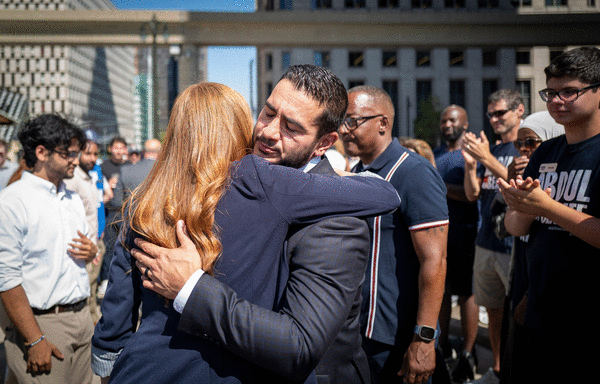
WASHINGTON — Leading progressives in Congress were quick to argue Tuesday that Abdul El-Sayed’s Senate primary win in Michigan was a sign for the Democratic Party to course correct.
After his narrow win in a bruising battle against the establishment-backed moderate Haley Stevens, El-Sayed quickly began preaching unity ahead of the general election, calling on his supporters to flash “magnanimity in victory.”
But his allies also pointed to the insurgent momentum as proof that Democrats should make changes at the very top — suggesting that intraparty bad blood is not going anywhere with only 13 weeks to go before the midterm elections. Republicans hope to capitalize on these Democratic divisions, which range from economic policies to Israel, to block a blue wave in Michigan and elsewhere.
“It’s not enough for Democrats to say, ‘We just want to go back to the pre-Trump status quo,’” Maryland Democratic Senator Chris Van Hollen said. “After all, the people of this country elected a, you know, convicted felon, because they were so upset with the status quo.”
Van Hollen, who traveled to Michigan in July to stump for El-Sayed, said voters are frustrated that Democrats aren’t doing enough to address economic issues, particularly for working-class voters. El-Sayed has supported Medicare for All, changes to the U.S. tax code and other pillars of the progressive plank that have long been resisted by more moderate Democrats.
“The Washington establishment Democratic Party needs to be shaken up, and I think voters are expressing that,” Van Hollen said.
While he did not take a swipe at any specific Democratic leaders, Van Hollen has made clear his intention to become a national voice within the party. While in Michigan last month, El-Sayed said he hoped Van Hollen would be the next Senate majority leader, an achievement that would mean toppling New York Senator Chuck Schumer.
Others on the left were more explicit in their frustrations with Democratic leaders even as El-Sayed called for unity.
“For months, the political establishment told us Abdul was too progressive, too outspoken, and too ‘dangerous’ to win,” California Representative Ro Khanna, who is expected to run for the 2028 presidential nomination, said in a fundraising appeal. “But too often, that’s just how the establishment tells outsiders to stay out.”
Senator Bernie Sanders, a democratic socialist icon and early backer of El-Sayed’s, said the nominee took on the “entire national Democratic establishment,” as well as robust spending by outside groups and special interests to win the primary.
“The days of the top-down party, I think, are finished,” the independent from Vermont said on Wednesday. “The new Democratic party is going to be broad-based. It’s going to be open and encouraging of the participation of working-class people, of young people, of lower-income people.”
Sanders, who has sparred with Democratic leaders throughout this primary season, said it’s time for party leaders to rethink their approach.
“The playbook of the Democratic leadership needs to be very substantially rewritten,” he said.
Republicans immediately pounced on the progressive victory to exploit the Democratic divide to sway moderates and independents in the battleground state.
Republicans on social media appeared to circulate a video of Hasan Piker, the polarizing livestreamer who has praised Hamas and been accused of antisemitism, delivering an expletive-laden rebuke against moderate Democrat arguments that El-Sayed needs to build bridges within the party.
At the same time, Pennsylvania Democratic Senator John Fetterman, one of Israel’s strongest supporters in the party, called on El-Sayed to renounce Piker.
_____
©2026 Bloomberg L.P. Visit bloomberg.com. Distributed by Tribune Content Agency, LLC.




















































Comments