Trump's Supreme Court win on mail voting leaves legal mess
Published in Political News
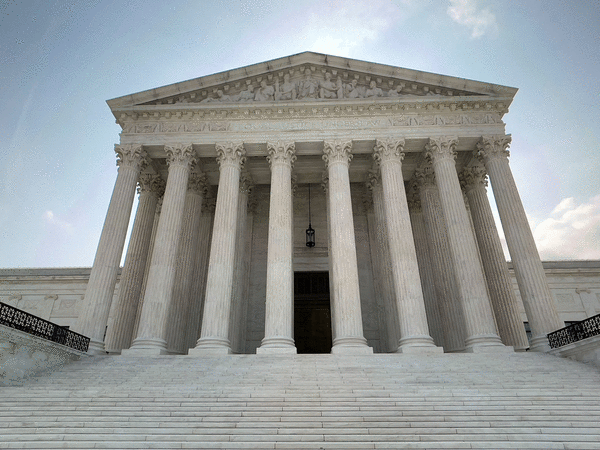
WASHINGTON — The U.S. Supreme Court delivered a jolt to the impending midterm elections by reviving President Donald Trump’s push to restrict mail-in voting while creating a tangle of new legal and logistical questions as states prepare to make ballots available.
The court’s conservative majority on Monday agreed with the Justice Department that a Boston federal judge prematurely blocked key sections of Trump’s March 31 executive order before agencies took action to implement it.
Although the ruling marked a victory for Trump, it’s not clear whether his plan will take effect for the Nov. 3 election as Republicans defend their slim majority in Congress. With many states set to mail ballots next month, U.S. officials are running out of time to execute new policies.
Administration opponents have vowed to press for new court orders in the meantime, saying Trump is exceeding his constitutional authority. The clash could quickly return to the Supreme Court – and test its past warnings against last-minute judicial interference in elections. In a court filing Tuesday, voting rights organizations said they will file a revised lawsuit and request for an immediate temporary restraining order against the government on Wednesday.
“This fight is far from over,” California Attorney General Rob Bonta, whose office led a coalition of states that sued, said in a statement. “We will continue to use every legal tool at our disposal to fight back against unlawful federal overreach whenever it occurs.”
Monday’s ruling is the latest twist in a fast-moving clash taking place in multiple courts and cases. The U.S. Postal Service announced Friday that it had finalized new rules under Trump’s directive to revamp how it handles election mail. Within hours of the Supreme Court ruling, the Justice Department launched another round of litigation to allow the agency to enforce those changes.
With more than a dozen states poised to begin sending absentee ballots in September, according to the Center for Election Innovation and Research, the timeline is increasingly tight. North Carolina, one of the states that sued, will start mailing ballots on Sept. 4. Should the postal agency’s new rules take effect, the states say they would have to rush to redesign ballots, train election officials and educate voters.
Little time
The lack of time may make it infeasible for the administration to implement the rules this year, said Jason Torchinsky, a Washington lawyer who often represents Republicans in election litigation.
“If they try to do it and they wind up messing with peoples’ ability to vote, there’s going to be a lot of questions,” said Torchinsky, a partner at Holtzman Vogel.
The court once again divided along ideological lines over Trump’s efforts to expand presidential power. Over three dissents, the justices lifted U.S. District Judge Indira Talwani’s injunction, which had barred U.S. officials from carrying out Trump’s directives in the 23 states with Democratic leaders who sued, along with the District of Columbia.
The court didn’t directly address a separate nationwide injunction Talwani handed down in a different lawsuit filed by voting rights advocates. She issued that ruling during a weekslong wait for the Supreme Court to rule in the states’ case.
The Justice Department on Monday night asked Talwani to toss out the nationwide injunction, pointing to the Supreme Court’s holding that federal judges must wait for final agency actions. That reasoning “applies with full force to this case,” government attorneys wrote.
Talwani didn’t immediately announce how she plans to proceed. In the submission from voting rights groups on Tuesday, they asked Talwani to leave the nationwide block intact until she rules on their upcoming request to pause the Postal Service’s final rule, which will be formalized on Wednesday.
“That modest course avoids any gap in protection” and “prevents the confusion and disruption of lifting and then reimposing election rules in short order,” the advocacy groups argued.
The judge previously signaled she was likely to side with the challengers again. It wasn’t immediately clear how that process would play out – or how long it would take – in light of the justices’ latest opinion. The Justice Department is expected to swiftly appeal any new restriction.
Postal changes
Under the Postal Service’s rules, the agency could return outbound ballots to state election officials if they fail to comply with revised design standards or if states don’t submit voter information in a newly created federal “portal.” The rules call for envelopes to feature a barcode that matches the voter’s identifying information.
A spokesperson for the California attorney general’s office didn’t immediately respond to requests for comment on next steps.
Trump’s executive order also directed the Department of Homeland Security to create lists of U.S. citizens to send to states as a guide for vetting voter eligibility. It also urged the U.S. attorney general to “prioritize” criminal investigations of state and local officials who issue ballots to people who aren’t eligible to vote.
Democratic officials and voting rights advocacy groups contend Trump is trying to take control over elections, which the Constitution assigns to the states. They accused the administration of rushing to implement the executive order to aid congressional Republicans as they seek to hold their majority.
The president and his allies say the measures are necessary to make sure only eligible citizens cast ballots, although instances of noncitizens voting historically are rare.
In the unsigned majority opinion on Monday, the justices said they were not ruling on the lawfulness of any actions that agencies take to implement Trump’s instructions. “On that score, time will tell,” the majority wrote.
White House spokeswoman Lauren Bis nonetheless called the ruling “a major win for the security of American elections.”
‘Chaos and uncertainty’
The Supreme Court in other contexts has warned federal judges not to cause confusion on the eve of an election, invoking what has become known as the Purcell principle, a concept named after a 2006 ruling. In a 2020 fight over Wisconsin ballot deadlines, Justice Brett Kavanaugh wrote that “when an election is close at hand, the rules of the road should be clear and settled.”
Critics say the high court is now doing exactly what it previously disclaimed. In a dissenting opinion, Justice Ketanji Brown Jackson said the ruling “needlessly injects chaos and uncertainty into the upcoming midterm elections.”
The Supreme Court majority didn’t respond to Jackson’s charge. But Torchinsky, the Republican election lawyer, said the court had little choice but to deal with the matter.
“The court is not creating the confusion,” Torchinsky said. “The court is trying to referee the frenzy between the parties.”
A looming question is how the justices would apply the Purcell principle if lower courts block the Postal Service rules. The issue has typically come up after federal judges block state election rules or voting maps, not when federal agency actions are in question.
A U.S. appeals court in Washington previewed such a fight in yet another challenge to Trump’s executive order, brought by Democratic Party leadership. The three-judge panel — which included Trump-appointed Judge Gregory Katsas — agreed with the government in July that the case was premature. But the court warned the administration might be primed for a loss if agencies tried to implement “massive changes” ahead of the November contest.
Democratic party leaders said in a joint statement that they will “fight every day until Trump’s illegal executive order, and all of his other attempts to undermine our free and fair elections, are completely thrown out.”
_____
©2026 Bloomberg L.P. Visit bloomberg.com. Distributed by Tribune Content Agency, LLC.

















































Comments