How Abdul El-Sayed scored a historic win in Michigan Democratic primary
Published in Political News
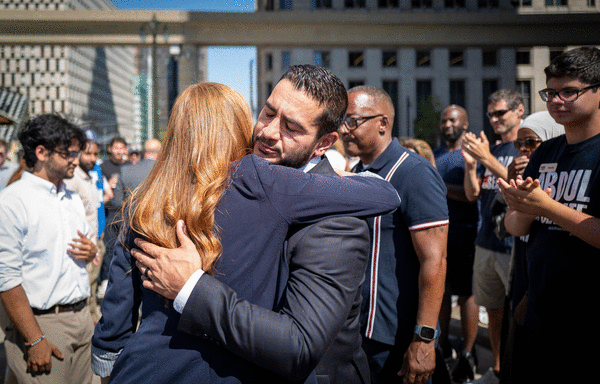
GRAND RAPIDS, Mich. — Abdul El-Sayed, the progressive Democrat who campaigned for the U.S. Senate with raucous rallies and a well-known online streamer, stood in a side room after an event in west Michigan Saturday night and described his approach as "old-fashioned."
El-Sayed, 41, of Ann Arbor said his bid for the Senate began a year ago with small meetings and questions to participants about what was happing in their lives. It later grew to more than 12,000 volunteers, according to his team.
"When you build something like that, you get a bead on what people really want out of their elected officials and start to appreciate the contrast between what they really want and what they keep getting," El-Sayed said. "I think what you're seeing out there is about people wanting a politics that actually answers for the problems in their life."
Amid a historic surge of spending on TV ads to promote his opponent, U.S. Rep. Haley Stevens of Birmingham, El-Sayed rode a wave of frustration with politics and government to a narrow victory in Michigan's Democratic U.S. Senate primary Tuesday.
El-Sayed's campaign paired a focus on traditional volunteer-based voter outreach with a simple slogan that he repeated over and over again: "Money out of politics. Money in your pocket. Medicare for All."
As of Saturday, three days before the primary election's results were tallied, El-Sayed campaign said its supporters had knocked more than 200,000 doors in Michigan. At polling places Tuesday, The Detroit News found a handful of first-time voters who said they showed up to cast a ballot for El-Sayed.
Meanwhile, groups backing Stevens of Birmingham had dominated the TV airwaves. By mid-July, United Democracy Project, which has been funded in part by the American Israel Public Affairs Committee or AIPAC, was slated to spend nearly $30 million either supporting Stevens or attacking El-Sayed, who had spoken out against military aid provided to Israel.
The national publication Mother Jones labeled it the "most expensive Democratic primary ever" on Friday.
El-Sayed was still able to win despite a $12-to-$1 disadvantage because he had the best clarity for the moment the country is in, said Michael Radtke, a Democratic political consultant and Sterling Heights City Council member.
Health care, grocery and energy costs have all increased in recent years, leaving voters looking for a solution. El-Sayed promised to take on large companies' influence, criticized data center projects and spoke out against the state's biggest electric utility, Detroit-based DTE Energy.
On the campaign trail in Michigan in 2024, Republican President Donald Trump vowed to fix the economy and rapidly drive down prices. He won the election, but anger with financial pressures has continued.
“It’s 50% candidate and 50% moment," Radtke said of success in elections. "You have to know not only what to run on, but when to run."
Janet Taylor, a 72-year-old from Lansing, cast her ballot for El-Sayed in Tuesday's election.
"Get those clowns out of Washington," Taylor said of the changes she was hoping to see.
Progressive candidates have a new path?
Stevens has served in the U.S. House since January 2019.
She had argued that she was the best Democrat to take on Republican U.S. Senate candidate Mike Rogers of White Lake Township in the general election because she had won close races before.
Republicans, meanwhile, have bashed El-Sayed and his most famous supporters, U.S. Sen. Berine Sanders of Vermont and U.S. Rep. Alexandria Ocasio-Cortez of New York, as extremists.
"Don’t be fooled, Abdul El-Sayed, Bernie Sanders and AOC are trying to bring communism to Michigan," Rogers posted on social media on Aug. 1.
Sanders, who made multiple campaign stops in Michigan for El-Sayed, brushed away the concerns of some Michigan Democrats about whether El-Sayed can win a general election contest.
"Maybe it's time to understand the status quo is not working for working families or the middle class," Sanders said. "It is working for the fossil fuel industry, for the oil companies. It is working for the insurance companies. It is working for the billionaires. And the people of this country want change.
"They want real change, and Abdul is a vehicle for that change. That is why the billionaire super PACs are spending so much money trying to defeat him."
Sanders and Ocasio-Cortez made campaign stops across the state with El-Sayed in July. The gatherings drew thousands of people and featured live music — in Detroit, the band Michigander performed. Speakers at the event portrayed the primary race as a choice between El-Sayed and the donors backing Stevens.
"We can choose $50 million and counting in dark money trying to buy the state of Michigan," Ocasio-Cortez said. "Or we can choose Dr. Abdul El-Sayed."
At other stops, El-Sayed gave speeches to crowds of 200 people before volunteers were sent out to knock on doors in their neighborhoods.
"Are we a democracy of the money?" El-Sayed asked during one event in Lansing. "Or are we a democracy of the many?"
Building on his 2018 race
At a rally inside a Grand Rapids community center on Saturday, El-Sayed recalled speaking at his University of Michigan commencement ceremony in 2007.
Former President Bill Clinton also spoke at the commencement. And El-Sayed said the two-term Democratic president suggested to him that he consider running for office someday.
"Did you see my name though?" El-Sayed said of his response to Clinton.
El-Sayed went on to earn his medical degree from the Columbia University College of Physicians and Surgeons.
But he did end up running for office in 2018. He got second place in a three-way race for the Democratic nomination for governor. Gretchen Whitmer won the 2018 primary with 52% of the vote. El-Sayed received 30%, with businessman Shri Thanedar, who's now a member of the U.S. House, in third place at 18%.
Some Democrats in Michigan believed that El-Sayed's progressive base was capped at around 30% to 40% of the Democratic primary vote.
When he launched his bid for the U.S. Senate in April 2025, there was a crowded field of Democrats, including Stevens and state Sen. Mallory McMorrow of Royal Oak. After McMorrow dropped out in early July, many within the party thought El-Sayed would struggle with a one-on-one matchup against Stevens, which would require much more than 30% of the vote to win.
But El-Sayed was able to draw new people to his cause and politics in general, said U.S. Rep. Ayanna Pressley, a Democrat from Massachusetts who joined him on the campaign trail this summer.
"I'm meeting a lot of people that this is the first time that they've engaged in the process," Pressley said. "They are so fed up ... Either they're here out of that frustration or they're here because he's the first person in a long time to give them a sense of hope."
People were drawn to his message about getting money out of politics and providing health care coverage for all residents, Pressley said.
"They are just tired of the status quo," Pressley said. "They think he'll bring a different, a fresh perspective and approach that's sorely needed."
Voters look for a change with El-Sayed
Andrew Kelly, a 21-year-old from Genoa Township, voted for the first time on Tuesday, casting a ballot for El-Sayed in the Democratic primary.
Kelly described El-Sayed as inspiring. Plus, he said, El-Sayed's campaign has been reaching young people through social media.
"When we had those Canadian wildfires, I saw a post where he was out there, just kind of giving pointers, giving tips and tricks," Kelly said.
El-Sayed, who's authored books and hosted a podcast, did a video about delays opening the Gordie Howe International Bridge and another where he mimicked a Taylor Swift song.
Stevens repeatedly attempted to turn El-Sayed's podcast experience into a negative.
At different points during a debate last month, Stevens accused El-Sayed of running "for celebrity."
"A lot of you remember Abdul from when he first ran for governor in 2018," Stevens said at one point. "It didn't work out, so he started the podcast. He wrote the book. And now, he's running for Senate.
But El-Sayed focused his attacks on the outside money pouring into aid Stevens.
“Sixty million dollars from outside organizations in this race didn't just go nowhere. It's because those exact same organizations expect something on the other side,” he said in response to a question about affordability. “They … expect to own your next U.S. senator.”
One first-time voter, Charlie Ayyash, 18, of Plymouth, said he supported El-Sayed both with his vote and financially because of his commitment to not accept corporate or super PAC funding.
"It can sway votes," Ayyash said of money in politics. Without it, "they're making (decisions) based on their people."
Faizullah Muhammad, 55, of Canton Township, also had never voted in a primary before Tuesday.
El-Sayed was different enough to get him to the polls, he said. He'd only seen him in a YouTube ad, but he appreciated how energetic he was and that his background in medicine was uncommon for a politician.
"I only came for Senate," said Muhammad, a teacher. "I want a new voice, a fresh voice. I'm sick of traditional politics."
—Staff Writer Breana Noble contributed.
©2026 www.detroitnews.com. Visit at detroitnews.com. Distributed by Tribune Content Agency, LLC.



















































Comments