Kansas laws restricting abortion providers are unconstitutional, judge rules
Published in Political News
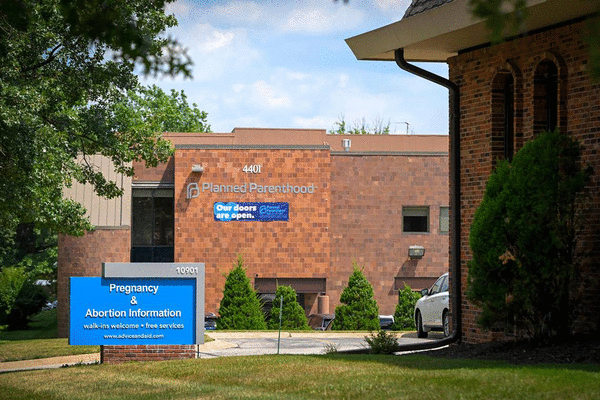
In a major victory for supporters of abortion rights in Kansas, a Johnson County District Court judge on Monday granted a permanent injunction blocking a bevy of state laws that imposed strict requirements for abortion providers and patients.
“Today’s ruling allows me to do my job the way I was trained to and focus on what’s most important: my patients,” said Dr. Traci Nauser, an OB-GYN who owns an Overland Park clinic that provides abortions.
The lawsuit against the state of Kansas was brought by Hodes & Nauser and Planned Parenthood Great Plains, another Overland Park abortion clinic.
Monday’s decision invalidates various provider mandates that the clinic owners argued were designed to scare and shame people out of terminating pregnancies.
The 261-page ruling comes more than nine months after a bench trial in Johnson County. It was filed with the court on Monday, the same day that its author, K. Christopher Jayaram, was sworn in as the newest member of the Kansas Supreme Court.
Some of the restrictions enjoined by the decision have been on the books since 1997. Others, including a requirement that abortion providers survey women about their reasons for seeking the procedure and provide medically dubious information suggesting that pill abortions are reversible, were adopted by the Kansas Legislature in 2023.
Those and other pre-existing requirements, including Kansas’ 24-hour waiting period for abortions and a rule that physicians must listen to a fetus’s heartbeat 30 minutes before an abortion, were temporarily halted by Jayaram in the early stages of the court proceedings in 2023. Additional requirements adopted in 2024 were also blocked on a temporary basis before the permanent injunction was granted.
Implications for abortion access
The ruling was handed down on the eve of a primary election where voters will weigh a proposed constitutional amendment that would overhaul the process for selecting Supreme Court justices by switching to direct election — a proposed reform that Republican officials believe could help the cause of assembling an anti-abortion majority on the high court.
The GOP lawmakers who placed the proposal on the ballot have long been frustrated by the Supreme Court’s stubborn independence, including its 2019 determination that the right to an abortion is enshrined in the Kansas Constitution.
Abortion providers sensed an opening to challenge restrictions they have long opposed after Kansas voters in 2022 overwhelmingly rejected a proposed constitutional amendment that would have given lawmakers broad authority to further restrict or ban the procedure.
“Kansans were resolute when they voted to preserve abortion rights, and today’s victory is a reflection of their will,” said Alice Wang, senior staff attorney at the Center for Reproductive Rights. “Restrictions like these only exist to push abortion care out of reach.”
The Kansas Attorney General’s Office argued that the restrictions at the heart of the lawsuit are necessary for women to understand all of their options before terminating a pregnancy. Attorney General Kris Kobach did not immediately respond to a request for comment through a spokesperson on Tuesday.
Mackenzie Ayers, a spokesperson for Kansans for Life, the state’s leading anti-abortion group, criticized the ruling as irresponsible and dangerous.
“By striking down the Woman’s Right to Know Act, the court has stripped away commonsense protections that had been in place for nearly 30 years and helped ensure women received the information they needed before making a life-altering decision, leaving them even more vulnerable to a predatory abortion industry that consistently puts its own profits ahead of women,” Ayers said.
Understanding the abortion ruling
In his ruling, Jayaram described pregnancy as an “intimate healthcare condition.”
“For some, it is joyous. For others, it is not,” Jayaram wrote. “. . . The decision to terminate a pregnancy is complex and intensely personal.”
The decision drew heavily from the Supreme Court’s landmark 2019 Hodes ruling upholding the constitutional right to an abortion.
“Because a woman’s right to bodily autonomy (including her right to decide whether to terminate or to continue a pregnancy) is fundamental, the court concludes, given the overwhelming evidence adduced at trial, that the state’s rationale and legislative schemes . . . simply do not, in significant part, survive constitutional scrutiny,” Jayaram wrote.
Beyond infringing on patients’ bodily autonomy by forcing patients to “navigate a labyrinth of procedural hurdles” before receiving care, Jayaram ruled that the restrictions infringe on providers’ free speech by compelling them to share inaccurate and misleading information about abortions with patients, both verbally and in posted signs.
Jayaram wrote that the Kansas Women’s Right to Know Act, a 1997 law that has since been updated repeatedly, creates “a tragic problem” for physicians and their patients.
“Namely, it obligates providers, such as the plaintiffs, to participate in obfuscating the medically-relevant and necessary data a pregnant woman contemplating an abortion should have by first providing them with the voluminous, ideologic, repetitive, and often inaccurate or misleading information mandated by the state,” Jayaram wrote in his analysis.
He characterized the restrictions as “draconian,” noting that the state of Kansas “has long attempted to regulate women’s reproductive choices.”
“Through sterilization, institutionalization, and selective prosecution, the state historically displaced women as the decision-maker about matters of sex and reproduction, and punished women who did not conform to its chaste-until-marriage vision of womanhood,” Jayaram wrote.
He found that there is no set of circumstances under which the Kansas abortion restriction could be applied constitutionally.
Kansas allows pregnancies to be terminated before the 22-week mark following a patient’s last menstrual period. Providers testified in court that since the federal right to an abortion was struck down in 2022, Kansas abortion clinics have seen an influx of patients from states that ban the procedure, including Texas, Oklahoma, Louisiana and Arkansas.
Witnesses supporting abortion restrictions
Among the witnesses who testified on behalf of the state were three women who shared their stories about receiving abortions in the 1970s and 1980s before coming to regret their decision to terminate pregnancies.
Jayaram wrote that their testimony was of “marginal, if any, relevance to the issues in this case,” noting that only two of the women received abortions in Kansas, and none of them received abortions in the state when the relevant restrictions were in place. He characterized their opinions on abortion as “biased and untrustworthy.”
Another witness for the defense was Dr. Monique Chireau Wubbenhorst of the de Nicola Center for Ethics and Culture at Notre Dame, which advocates against abortions. She acknowledged under oath that in her 30-year career, she had cared for a total of 25 to 30 patients who experienced what she believed to be abortion complications.
Another of witnesses put forward by the attorney general’s office was Maureen Condic, an animal biologist with no clinical experience whose professional publications have exclusively involved animal research.
Jayram found the state’s witnesses not to be credible.
Kobach’s office did not immediately respond to a question about whether it plans to appeal the ruling.
_____
©2026 The Kansas City Star. Visit at kansascity.com. Distributed by Tribune Content Agency, LLC.





















































Comments