58 years of attacks on the media by powerful leaders trying to deflect criticism, from Nixon to Trump
Published in Political News
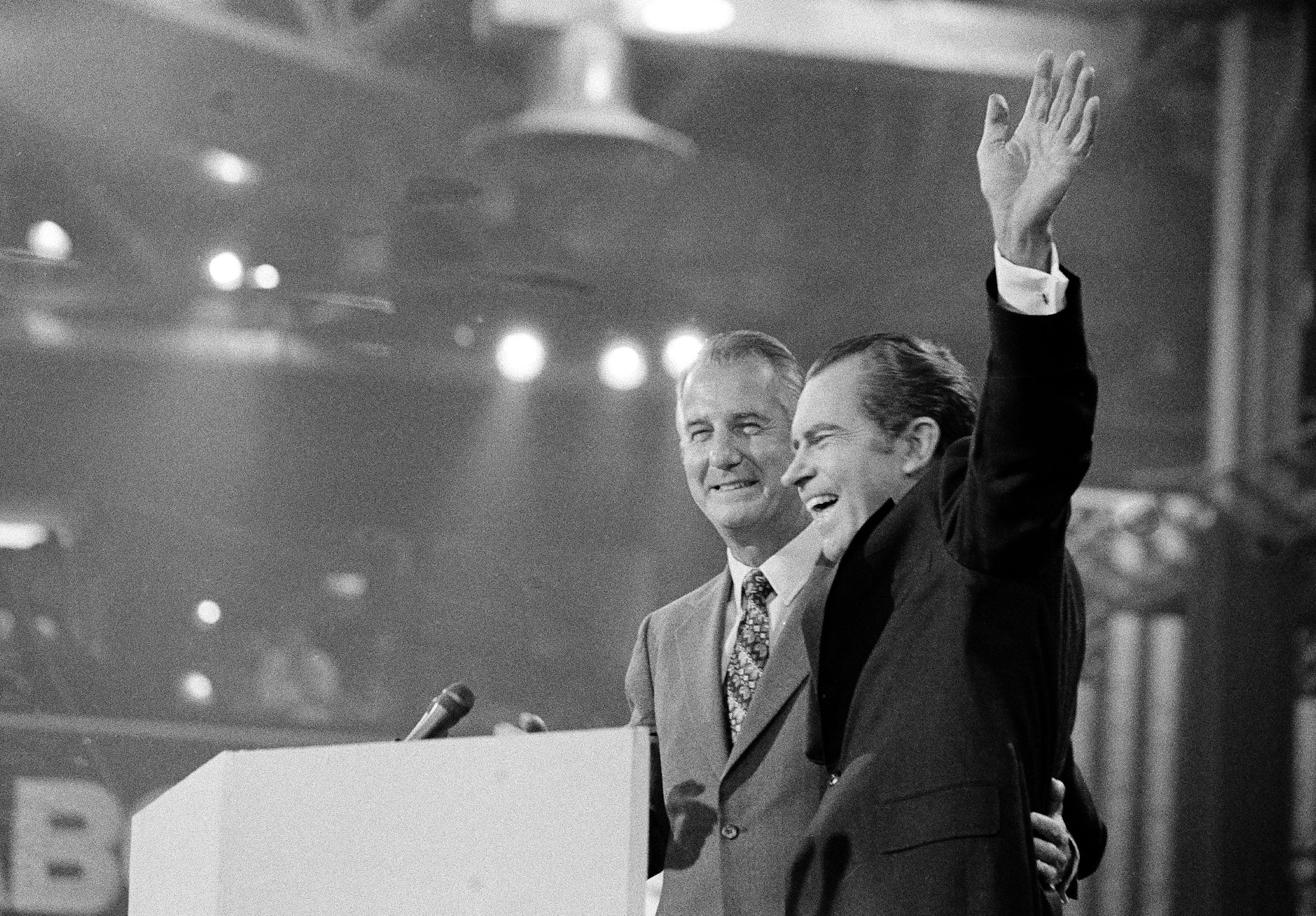
In his White House Correspondents’ Association dinner speech on July 24, 2026, President Donald Trump made his usual diatribes against the news media. He derided the “failing” New York Times and reiterated his complaint that CNN reporter Kaitlan Collins doesn’t smile enough. He dismissed the award she received at the dinner as “fake” and celebrated the recent firing of top CBS News employees.
Such ongoing extreme hostility from the president has contributed to Americans’ loss of faith in the news media, which has plummeted to an all-time low.
While the situation is in many ways unique to this moment, a perceived crisis around the very notion of “objective reporting” – and presidential use of that idea to denigrate and delegitimize the press – has a long history.
Republican presidential candidate Richard Nixon, for example, attacked coverage of police brutality at the 1968 Chicago Democratic National Convention as one-sided in favor of antiwar protestors. Once in office, Nixon deployed Vice President Spiro Agnew to verbally assault journalists for their putative bias and elitism.
In an infamous 1969 speech, Agnew denounced TV newsmen – they were, indeed, mostly men – as “an effete corps of impudent snobs,” hostile to the president and therefore out of touch with average Americans. Agnew singled out NBC anchorman David Brinkley for his claim that “objectivity is impossible” and that “fairness” was a more reasonable objective. Like many journalists, Brinkley understood “objectivity” as implying an almost mechanical delivery of pure facts, while “fairness” was more realistic, an earnest effort to be judicious.
Agnew concluded with a challenge: People should “let the networks know that they want their news straight and objective.” He framed this populist turn as an alternative to government interference. But journalists felt the looming threat of censorship.
Brinkley’s statement was not impudent. It was realistic: an acknowledgment that journalists are humans with preconceptions and values, but that their professional mandate is to strive for impartiality.
Carefully balanced reporting was not only the baseline of journalists’ training but also a business imperative. There were only three national nightly news shows, all seeking the widest possible audience. Moderation was more profitable than swinging hard left or right.
Although frustrated with journalism in general, Agnew zeroed in on TV in his speech because it had displaced print as Americans’ leading news source. And the reality of Federal Communications Commission licensing, whereby a federal agency determined who could use publicly owned airwaves, made broadcasters vulnerable to the actions of a vengeful president.
The licensing issue still resonates. Comedian Jimmy Kimmel, a frequent Trump critic, had his show briefly suspended by ABC after angering the president’s supporters.
“We can do this the easy way or the hard way,” FCC chair Brandon Carr said. “These companies can find ways to change conduct to take action on Kimmel or, you know, there’s going to be additional work for the FCC ahead.”
Kimmel survived this attack largely because public support surged, and he continues to satirize the White House. Others have been less fortunate.
Struggling to compete, newspapers in the 1960s and ’70s could have easily downplayed Agnew’s criticisms of a rival medium.
Instead, they stood up for TV. In the course of my research, I’ve found that not only in publicly accessible material but also in unpublished archival papers both broadcasters and newspapers consistently understood an attack on one media outlet as an attack on all, a lesson that holds true in 2026.
One of Agnew’s “snobs” was the liberal New York Times columnist Tom Wicker. Wicker was on Nixon’s “enemies list,” and he voiced concerns about not just Nixon and Agnew but also more generally about the very notion of objectivity.
Agnew raised hackles across the American journalism community. But Wicker’s reactions stand out in particular, because he was employed by what was then known as “the paper of record,” whose grandiose credo had long been “To Give the News Impartially, Without Fear or Favor.”
In a column published on Nov. 16, 1969, Wicker granted that it was legitimate for Agnew to ask “how the power of that extraordinary medium (TV) can be most equitably controlled and exercised in the general public interest.”
But Wicker underscored that Agnew “couched his argument in direct political attack on those who differed with Mr. Nixon” and “came close to claiming immunity from criticism for Presidential utterance.”
Two years after Agnew’s “effete snobs” speech, Wicker wrote an essay for Columbia Journalism Review objecting to journalism’s “tradition of objectivity” and “orientation toward nationalism in politics and toward establishmentarianism in other areas of society.”
The consequence, he wrote, was a heavy and generally uncritical reliance on official sources, all in the name of a spurious notion of objectivity.
Deeply offended, New York Times executive editor Abe Rosenthal sent a confidential memo to publisher Punch Sulzberger.
“In essence,” Rosenthal wrote, “what Tom’s piece adds up to is a public statement by … a well-known columnist of the Times … that objectivity and comprehensiveness, the journalistic foundations of this paper, are no longer valid and that the kind of paper the Times is now is no longer meaningful.”
Rosenthal said Wicker’s public expression of these thoughts was “bad for the paper” externally and “bad for morale” internally.
Regardless, such disputes at The New York Times were always waged behind the scenes. The gold standard for journalism was – and remains, whenever possible – to tell the story, not be the story.
Today, by contrast, it is widely known that the CBS News division “is on fire,” as longtime “60 Minutes” correspondent Scott Pelley said, shortly after he was sacked.
Newly installed CBS News Editor-in-Chief Bari Weiss, who has no broadcast experience, positions herself as an advocate for “free speech and free thinking” and her Free Press newsletter as a reclamation of objective reporting. Yet at CBS she has made editorial choices, including killing a story highly critical of the Trump administration, that consistently favor the White House.
Like Agnew, in other words, Weiss appears to cloak uncritical acceptance of presidential positions as a battle against “bias.”
Denouncing “bias” is usually an attempt by those in power to deflect from what reporters have uncovered – from Vietnam to Watergate to Iraq. It is thus startling for someone within journalism to use the establishment’s word – bias – to self-censor.
The apparently deliberate imploding of CBS News and its flagship investigative journalism program “60 Minutes” is all the more shocking when you consider the network’s past triumphs in serving the public interest while angering politicians and presidents.
In 1971, for example, the Army and the Nixon administration attacked “The Selling of the Pentagon,” a CBS documentary about military public relations activities. Officials charged that the editing had been misleading and malicious, and the U.S. House of Representatives subpoenaed CBS journalists’ raw footage.
This congressional investigation ended as a victory for the press and the public’s right to know. CBS refused to share its outtakes, and the network’s president risked going to jail for contempt of Congress.
In his column, Wicker declared the documentary excellent, and he correctly painted the subpoena of CBS materials as resulting from White House pressure.
That same year, The New York Times and The Washington Post printed the Pentagon Papers, revealing that the government had been misleading Americans for years regarding Vietnam. The two newspapers were briefly silenced by the White House, which persuaded the courts to order them to cease releasing the documents, and then were vindicated when the Supreme Court barred the government from restraining publication.
Wicker argued that “no statute exists that says government officials must be protected from the exposure of their follies or misdeeds,” and that the Pentagon Papers’ culprit was the government, not the newspapers.
Here, Wicker made a fair, if not strictly objective, evaluation.
Such opinionated defenses of the press still ring true today. Agnew repeatedly attacked naysayers as “nattering nabobs of negativism,” but journalism serves a positive function in particular when its stories are negative.
That’s how the public is able to hold government accountable, and accountability is crucial to the fight for democracy and against censorship and authoritarianism.
This article is republished from The Conversation, a nonprofit, independent news organization bringing you facts and trustworthy analysis to help you make sense of our complex world. It was written by: Heather Hendershot, Northwestern University
Read more:
Chicagoans watch films of the violent 1968 convention protests to get ready for the Democratic convention
Fictional newsman Ted Baxter was more invested in fame than in good journalism – but unlike today’s pundits, he didn’t corrupt the news
2024 is not 1968 − and the Democratic convention in Chicago will play out very differently than in the days of Walter Cronkite
Heather Hendershot does not work for, consult, own shares in or receive funding from any company or organization that would benefit from this article, and has disclosed no relevant affiliations beyond their academic appointment.


















































Comments