As lawmakers politicize the 250th anniversary, Americans are looking for unity over division
Published in Political News
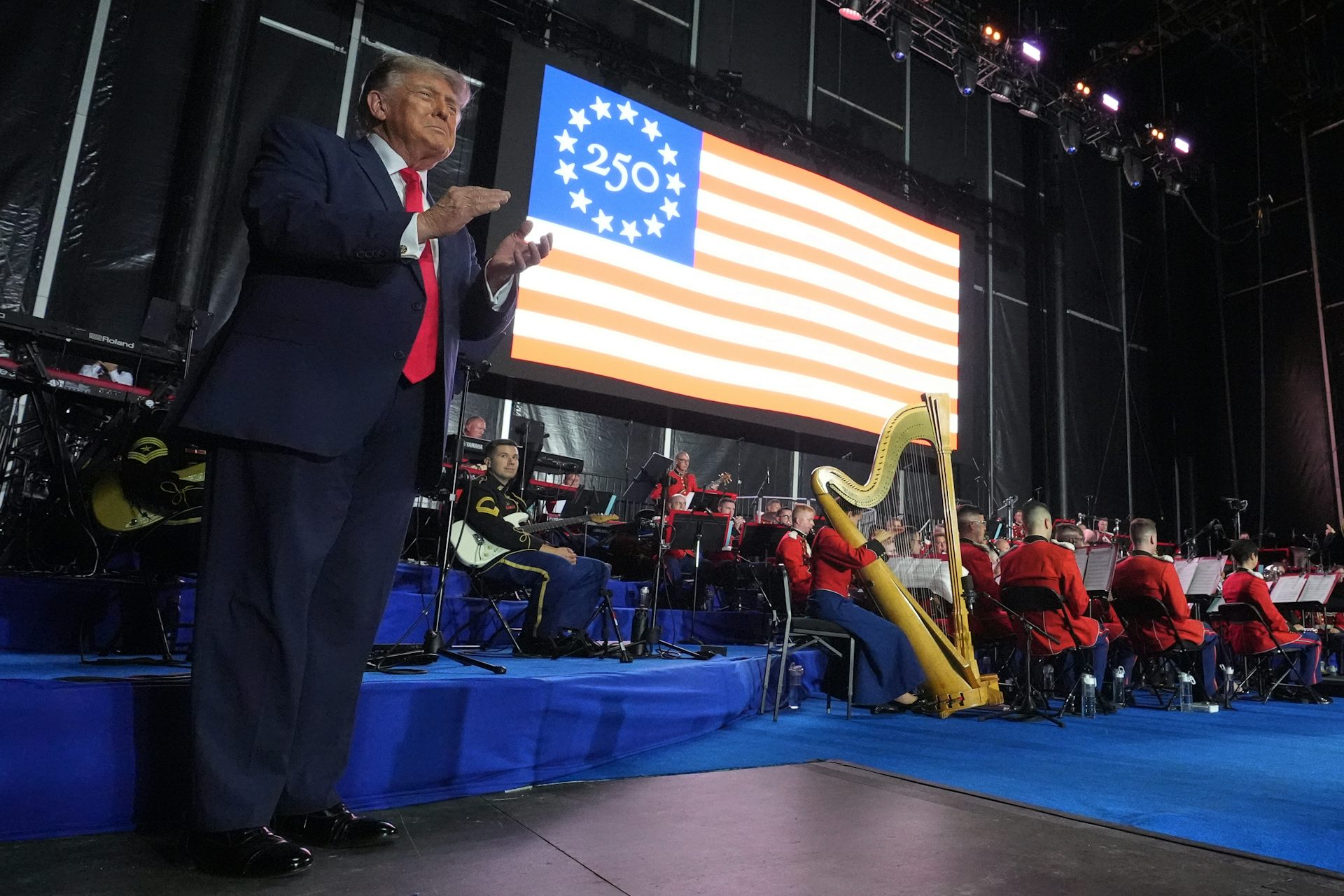
The Trump administration has planned a series of commemorative events as part of its Freedom 250 initiative to celebrate America’s 250th birthday. These commemorations, according to Chief of Protocol Monica Crowley, were intended to “bring the country back together” through a renewed sense of patriotism, national unity and civic pride.
The Great American State Fair – a 16-day event on the National Mall designed to showcase all 56 U.S. states and territories – was at the center of the plans. But the effort to commemorate the nation’s semiquincentennial has been mired in political controversy.
Several musical artists withdrew from the fair in May, arguing that what was presented as a nonpartisan celebration had become politicized. Eight states – including Pennsylvania and North Carolina, both won by President Donald Trump in 2024 – declined official participation.
Fair attendance was reportedly lackluster, and the event experienced several technical issues that included frequent power outages and a display of the Confederate flag. Additionally, House Democrats have accused Trump and Freedom 250 of turning the festivities into a “hotbed of corruption and self-enrichment.”
To cap off the 250th anniversary on July Fourth, Trump announced ahead of the celebration that he would hold a political rally at the White House that he billed as “the most spectacular TRUMP RALLY of them all.” During the speech, he nodded to his intention to pass the SAVE Act – or the Safeguard American Voter Eligibility Act – to combat alleged electoral fraud, and his military interventions in Iran and Venezuela.
Lost in the controversy surrounding the celebration of the nation’s 250th anniversary are the views of everyday Americans. What do they think about the historic milestone?
Our latest UMass poll suggests that while there is division over the meaning of the 250th anniversary, there is nevertheless strong evidence that Americans are less divided than the politics surrounding the anniversary would suggest.
In March 2026, we asked a nationally representative sample of 1,000 Americans about their views of the 250th anniversary. We asked them whether the ideals of the Declaration of Independence – that people possess unalienable rights, that governments exist to protect these rights, and the assertion that “all men are created equal” – still resonate today. We also asked whether Americans still share things in common.
When we asked respondents to select one statement that best captures what the 250th anniversary means to them, we found limited excitement for the celebrations. Only 37% selected “a proud national milestone,” while 24% said the celebration was “not something I think much about.” Eighteen percent categorized it as “mostly symbolic and ceremonial.”
Unsurprisingly, we found partisan differences on this question. Sixty-two percent of Republicans believe the anniversary is a “proud national milestone,” compared with only 20% of Democrats. The 250th anniversary, according to 29% of Democrats, is “not something I think much about.” Only 11% of Republicans express that same viewpoint.
Finally, 25% of Democrats thought the milestone was a “chance to reflect on our unfinished work,” with 4% of Republicans holding a similar opinion.
Despite the division over America 250, our survey found a number of areas of strong agreement across partisan lines concerning the legacy of the Declaration of Independence and the future of the nation.
When asked how much the U.S. has succeeded in achieving its founding ideals, 57% responded “a moderate amount” or “a great deal.” Only 33% said “not at all” or “not very much.”
Republicans were more likely to declare success, with 80% responding “a moderate amount” or “a great deal,” yet a majority of Democrats, 52%, also agreed.
Close to 6 in 10 Americans, or 59%, indicated that the founding ideals of the declaration still guide the country. This view was shared by majorities of Democrats, 51%, and Republicans, 75%.
Almost 3 in 4 Americans, 74%, endorsed the statement that “Americans have far more in common than things that divide us.” This sentiment cuts across Democrats, 79%, and Republicans, 76%.
Lastly, 63% agreed that “The U.S. is one nation with a shared history and common future, and should never be divided,” including strong majorities from both parties.
In the midst of serious challenges at home and abroad – including the Iran war, a weak economy and the conflict over immigration – we found that Americans strongly believe there is more that unites Americans than divides them.
Despite the actions of Trump, there remains a desire to celebrate how the values at the heart of the founding continue to shape a more inclusive and egalitarian nation.
This article is republished from The Conversation, a nonprofit, independent news organization bringing you facts and trustworthy analysis to help you make sense of our complex world. It was written by: Tatishe Nteta, UMass Amherst and Adam Eichen, UMass Amherst
Read more:
How a tiny Caribbean island made American independence possible
Canada’s little‑known role in helping to spur American independence in 1776
Why a growing number of Trump supporters are experiencing voter’s remorse
The authors do not work for, consult, own shares in or receive funding from any company or organization that would benefit from this article, and have disclosed no relevant affiliations beyond their academic appointment.






















































Comments