Trump administration targets state AI laws over ideology
Published in Political News
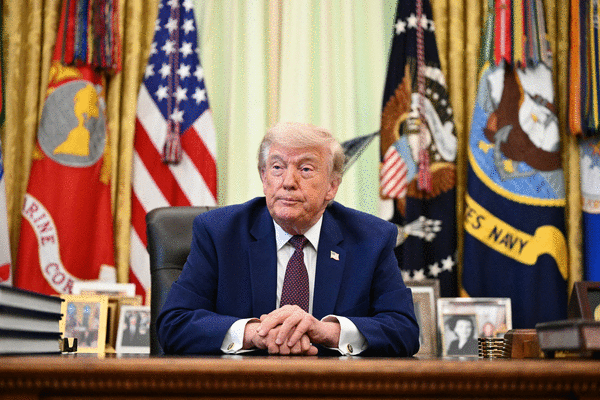
The Trump administration is continuing its pushback against state artificial intelligence laws that it views as ideologically biased, proposing a new Federal Trade Commission policy.
The proposed policy statement, which is open for public comment through July 31, would affect how the FTC regulates AI companies. The agency said it’s meant to address concerns that “AI companies that distort their systems’ outputs to achieve undisclosed ideological objectives” could be deceiving consumers in violation of federal law.
“The FTC wants to hear from businesses and consumers about their experiences and concerns regarding the subversion of AI systems for ideological ends,” Chairman Andrew N. Ferguson said in a statement.
The proposal specifically mentions a first-of-its-kind Colorado law that had banned “algorithmic discrimination,” or AI output that might lead to decisions disfavoring people on jobs, loans or healthcare based on their race, religion, gender and other protected categories. But the Colorado legislature already has repealed that provision. The revamped law instead focuses on regulating technology that results in “consequential decisions” for consumers.
The controversial law prompted a lawsuit from xAI, Elon Musk’s artificial intelligence company, which the U.S. Department of Justice supported.
In December 2025, President Donald Trump issued an executive order targeting state AI laws, including creation of a Department of Justice AI Litigation Task Force to challenge state AI laws. His order also directed the FTC to issue a policy statement on regulation of state laws that “require alterations to the truthful outputs of AI models.”
Stateline asked the FTC if there were any state and city laws that officials felt were currently in violation of federal laws, but received no response.
Tyler Thompson, a Denver-based lawyer with the firm Reed Smith who tracks emerging technology law, said the FTC proposal is important because it raises the possibility that companies could face deceptive-practices claims based on how they tune, weight or steer AI models, which could also prompt state policy on the issue.
“Just the fact that companies could be tweaking their models and that could lead to a deceptive trade practice, I think is huge news,” Thompson said.
Thompson believes the legal battle and the FTC’s focus on restricting similar laws will lead to “a more niche” policy focus on AI – such as deepfakes, nonconsensual sexual content, children’s safety, companion chatbots and data centers — areas where there is bipartisan agreement.
Noah M. Kenney, founder and principal consultant of Digital 520, an AI governance, security and privacy consultancy, who also responded to the FTC’s request for public comment, said the proposed statement carries more political pressure rather than being an enforceable federal regulation.
“The real effect of this statement is signaling and pressure, not legal preemption, especially paired with the December executive order’s AI litigation task force.”
Kenney said there is also an irony in the federal government’s argument.
“A federal effort to dictate what counts as a ‘neutral’ or ‘accurate’ output raises its own First Amendment concerns about compelled speech,” he said.
_____
_____
©2026 States Newsroom. Visit at stateline.org. Distributed by Tribune Content Agency, LLC.
















































Comments