Analysis: How Roberts led a fractured Supreme Court to wins for the right and defeats for Trump
Published in Political News
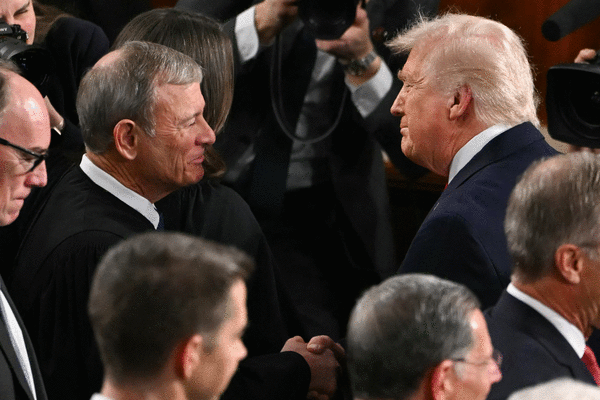
WASHINGTON — Chief Justice John G. Roberts Jr. led a fractured Supreme Court this year that both expanded a president's power to run the government and dealt major defeats to President Donald Trump.
In Trump's second year back in the White House, Roberts and the court punctured his claim to have power with no limits.
The justices struck down his worldwide tariffs, ruling these import taxes are a matter for Congress, not the president.
They also threw out his executive order that would end the principle of birthright citizenship. The Constitution wrote this promise into law, Roberts said, and the president may not change it.
The court also ruled in December that the president did not have the power to put National Guard troops on the streets of Chicago.
The three decisions came over fierce dissents from conservative Justices Clarence Thomas and Samuel A. Alito Jr. and with Neil M. Gorsuch in two of them.
The three liberal justices dissented angrily when the court ruled the administration may end Temporary Protected Status for Haitians and Syrians.
They did the same when the court ruled the president may replace the top appointees of semi-independent agencies.
But they joined Roberts in a 5-4 ruling that affirmed the independence of the Federal Reserve and blocked Trump's move to fire Fed Governor Lisa Cook.
Trump has won on most immigration fronts because Roberts and the conservatives believe Congress put the enforcement power in the hands of the administration. They point to the law authorizing temporary protection which says there shall be "no judicial review" of the decision to end the protection.
Roberts is a solid conservative who also tries to keep the court on a middle course. It's an approach that rarely wins plaudits from the right and almost never from the left.
This year the chief justice prevailed with different coalitions.
This week, the court ruled by a 5-4 vote against the Republican National Committee and upheld state laws that allow for counting late-arriving mail ballots. Justice Amy Coney Barrett joined with Roberts and Justices Sonia Sotomayor, Elena Kagan and Ketanji Brown Jackson.
Barrett also joined the chief justice in the rulings on tariffs and birthright citizenship.
This week, the court also limited the power of police to use cellphone data to look for crime suspects. This too came on a 5-4 vote when Justice Brett M. Kavanaugh joined Roberts and the three liberals.
Harvard law professor Richard Lazarus, who has been a friend of Roberts' since their time in law school, said the chief justice "is clearly working very hard" to put together majorities.
"It is not easy to formally preside over a court in which five of its members (Justices Thomas, Alito and Gorsuch on the right and Justices Sotomayor and Jackson on the left) deride the kind of efforts at moderation that is the chief's preferred signature and harshly condemn him when he strays from their own views."
Washington attorney Roman Martinez, a former clerk for Roberts, said the court is "clearly right of center" but the decision on tariffs was the most important of the year.
"It is a huge deal for the court to say 'no' to the president on his major policy initiative," he said.
Stanford law professor Michael McConnell agreed. "It's hard to claim the court is in Trump's pocket when he lost the major cases," he said.
Trump responded to the tariff defeat by calling the justices in the majority a "disgrace to our nation" and "disloyal to the Constitution."
They "sicken me," he said of Justices Barrett and Gorsuch, his two appointees who joined Roberts in the 6-3 majority.
Trump went to the court in April to hear his top attorney defend his executive order on birthright citizenship. He left after an hour of mostly skeptical questions.
On the term's last day, Roberts issued a clear and eloquent 26-page opinion setting out America's history of according citizenship to children who were born in this country, without regard to their parents.
This view came from England "and crossed the Atlantic with the colonists — and was adopted with little fanfare after the Revolution," he wrote. "Nothing is better settled," Justice Joseph Story wrote in 1830.
But it was unsettled by the fight over slavery.
"In the odious decision of Dred Scott v. Sandford, this Court imposed the Southern States' beliefs onto the Nation" and decreed Blacks could not become citizens, Roberts wrote.
Abraham Lincoln and Frederick Douglass were among the many who condemned the court's decision, he said.
"It took more than a decade — and the addition of names such as Antietam, Gettysburg, and Chancellorsville to our national canon — but Douglass's vision of 'our common humanity' would be fulfilled," he wrote.
The Reconstruction Congress wrote this rule into the 14th Amendment and said "All persons born" here are citizens by birth.
The principle of birthright citizenship had been upheld by the Supreme Court in 1898, the chief justice wrote, and it had gone unchallenged until Trump returned to the White House last year.
But Thomas filed a 91-page dissent arguing that immigrants must be "domiciled" here before their children may become citizens.
Alito filed a separate 39-page opinion branding the Roberts opinion a "serious mistake."
On that note, the court adjourned for its summer recess.
_____
©2026 Los Angeles Times. Visit latimes.com. Distributed by Tribune Content Agency, LLC.





















































Comments