US Supreme Court to review Washington state law meant to protect runaway trans teens
Published in Political News
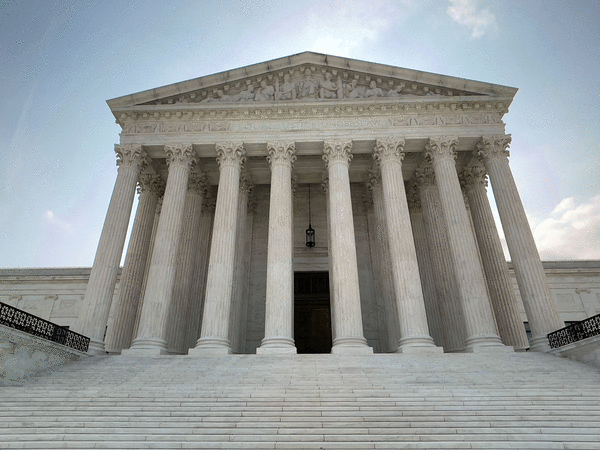
The U.S. Supreme Court on Monday agreed to hear a challenge to a Washington state law aimed at helping transgender or pregnant runaway teens to access emergency shelter.
The 2023 law drew national media attention and backlash, including dueling protests at the state Capitol, a failed repeal effort and federal legal challenges brought by parents and organizations represented by America First Legal, a conservative legal group headed by current Trump White House adviser Stephen Miller.
Attorneys representing the parents and organizations sued state officials over the law in August 2023 and had their cases dismissed twice by lower courts before petitioning the Supreme Court in January.
Their petition was granted Monday, and the nation’s highest court will hear arguments this fall over whether parents can challenge laws or policies allowing someone else to make decisions about their teenage child’s access to gender-affirming healthcare.
In an email Monday, Gene Schaerr, a Washington, D.C.-based attorney representing the plaintiffs, said the groups look forward to proving parents have standing to challenge laws “designed to keep parents in the dark about their children’s gender identity, consideration of gender transitions and other subjects on which parents have a legitimate interest.”
Mike Faulk, a spokesperson for state Attorney General Nick Brown, said the law was passed to help reunite runaway teens with their families and access behavioral health services. The law makes clear that state social workers must make “good faith attempts” to contact runaway teens’ families with the goal of getting the child back home.
“We previously won this challenge at the district and circuit court levels,” Faulk said in an email Monday. “We will be prepared to successfully defend it at the Supreme Court.”
News of the Supreme Court’s decision on Monday weighed on Christian Santana, staff attorney for QLaw Foundation of Washington, an organization providing legal advocacy for LGBTQ+ people. Overturning the legislation could make it harder for vulnerable people to access healthcare in Washington and continues a “domino effect” of challenges to laws meant to protect transgender youth, Santana said.
“Given the makeup of the Supreme Court, I’m not expecting it to go the way we would prefer it to go,” Santana said by phone Monday. “I wouldn’t put money on it.”
State lawmakers approved Senate Bill 5599 in April 2023, amending existing state law that required shelters to notify parents within 72 hours if their child arrives at the shelter, unless doing so could subject the child to abuse or neglect.
Under the new law, shelters can first notify the state Department of Children, Youth and Families if a person between 13 and 18 arrives at the shelter seeking reproductive or gender-affirming healthcare, such as an abortion or hormone therapy. State social workers then handle notifying the teen’s parents, offering to make referrals on the teen’s behalf for mental health services, and offering services designed to reunite the teen with their parents and resolve conflicts between them.
The law was meant to help teenagers — especially those who do not feel safe at home or whose parents have kicked them out — to get off the street and into emergency shelters. Before the law passed, advocates said vulnerable LGBTQ+ and pregnant teens sometimes left shelters after 72 hours because they did not want to be reconnected with their families, exposing them to homelessness or danger.
The bill drew fierce backlash, including an X post by Donald Trump Jr. in April 2023, claiming the legislation amounted to “govt. sanctioned kidnapping.” Days later, rallies drew hundreds of supporters and detractors to the state Capitol.
The legislation also sparked viral posts making false claims about the bill, including that it would give the state government custody of children if parents refused to allow their child to receive gender-affirming care.
The law took effect in July 2023 after a group of opponents’ push to repeal it failed. It does not address custody and does not change the state’s existing medical consent laws, which allow anyone over 13 to receive mental healthcare without an adult’s permission. It also bars anyone under 18 from having gender-affirming surgery without a parent or guardian’s approval.
America First Legal sued the state one month later, arguing the law deprived some parents of their constitutional rights to make decisions about their child’s upbringing and healthcare. The group also claimed the law incentivizes teens to run away because they want to get healthcare without their parents’ permission.
The U.S. District Court for the Western District of Washington dismissed the lawsuit in December 2023, finding the plaintiffs did not have standing to sue because their alleged harms were based on a “speculative chain of possibilities.” The U.S. Court of Appeals for the Ninth Circuit affirmed the lower court’s decision in an opinion last July, agreeing that the plaintiffs failed to show they had been injured or would be injured by the law.
_____
©2026 The Seattle Times. Visit seattletimes.com. Distributed by Tribune Content Agency, LLC.




















































Comments