Supreme Court rules Trump may fire heads of independent agencies, but not the Federal Reserve
Published in Political News
WASHINGTON — The Supreme Court on Monday gave President Donald Trump new power to fire the heads of most independent agencies created by Congress — but not the Federal Reserve.
Chief Justice John G. Roberts Jr. announced two opinions, one of which bolstered the president's power as the chief executive and a second which said this authority did not extend to the Federal Reserve board.
The first was a 6-3 decision that had the support of five conservatives, while the second had a 5-4 majority that included the three liberals.
Roberts, a former White House lawyer, has long been skeptical of independent agencies whose officials may wield regulatory power in conflict with the views of the president.
Since the 1880s, however, Congress has at times created independent agencies led by a bipartisan board of experts. In 1935, a unanimous Supreme Court had upheld these multi-member boards and commissions.
But Roberts and the court overturned that precedent and declared it conflicts with the executive power of the president.
"Our Constitution creates three branches, but only one President," he wrote. "To discharg(e) the duties of his trust, the President must have the assistance of officers he can trust. ... Subordinates who exercise the President's power are subject to removal by him. Then, and only then, can they remain accountable to the President, and the President to the people."
The decision upholds Trump's firing of Rebecca Slaughter, one of two Democratic appointees on the five-member Federal Trade Commission.
In dissent, Justice Sonia Sotomayor "distorts the structure of government to fit the majority's theory of unitary, total executive control. The result is a President who emerges with far greater power than ever before. It is a power, however, that neither the People, nor Congress, nor the Constitution bestowed upon him."
Under what has been dubbed the "unitary executive" theory, the court's conservatives believe the president's executive power in Article II of the Constitution overrides Congress' power in Article I to write the laws and structure the government.
The departments and agencies of the federal government exist only because Congress created them by law.
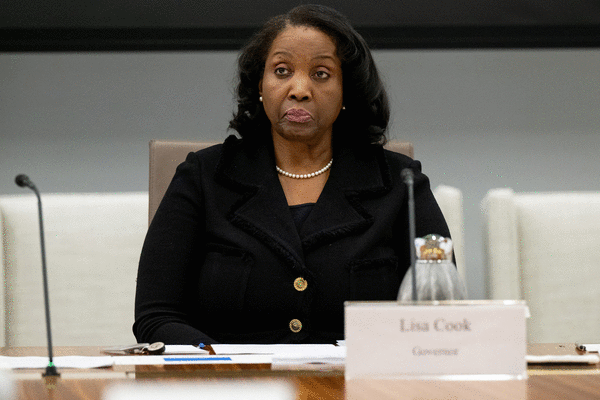
But in the second opinion, the court blocked Trump's bid to fire Fed Governor Lisa Cook, an appointee of President Joe Biden.
Roberts said the central bank dates back to the nation's founding, and Congress created the Federal Reserve Board in line with "our Nation's tradition of central banking protected from political interference."
Trump tried to fire Lisa Cook in a social media post, he said.
But "the Federal Reserve's Governors do not serve at the President's pleasure — they instead serve staggered 14-year terms, and may be removed only 'for cause,' " he wrote.
Justice Brett M. Kavanaugh cast a crucial vote to support the Fed's independence. He said he joined the majority because it "confirms the longstanding historical practice and understanding that the Federal Reserve is an independent agency whose Governors enjoy for-cause removal protection consistent with Article II of the Constitution."
The court did not finally decide on Cook's case, except to say she deserved due process of law. She could not be fired without a hearing and evidence, the court said.
The setback for independent agencies came as no surprise, however.
Even prior to Trump's election, Roberts has insisted agency officials must be accountable and under the control of the president.
Last year, the justices blocked lower court rulings that would have reinstated agency officials who were fired by Trump.
For most of American history, however, it had been understood that Congress had the power to structure the government and to create semi-independent agencies to carry out specific tasks like regulating railroad rates or the money supply.
These agencies and commissions were led by a bipartisan board of experts who were appointed with a fixed term. They could be fired only for cause, not because of a political disagreement with the president.
The Supreme Court upheld these multi-member commissions in 1935 on the grounds their work was more legislative and judicial than simply enforcing the law.
But the court's current conservative majority has contended these commissions and boards wield executive authority and are therefore, subject to direct control by the president.
In creating such bodies, Congress often was responding to the problems of a new era.
The Interstate Commerce Commission was created in 1887 to regulate railroad rates. The FTC, the focus of the court case, was created in 1914 to investigate corporate monopolies.
The year before, the Federal Reserve Board was established to supervise banks, prevent panics and regulate the money supply.
During the Great Depression of the 1930s, Congress created the Securities and Exchange Commission to regulate the stock market and the National Labor Relations Board to resolve labor disputes.
Decades later, Congress focused on safety. The National Transportation Safety Board was created to investigate aviation accidents, and the Consumer Product Safety Commission investigates products that may pose a danger. The Nuclear Regulatory Commission protects the public from nuclear hazards.
Typically, Congress gave the appointees, a mix of Republicans and Democrats, a fixed term and said they could be removed only for "inefficiency, neglect of duty or malfeasance in office."
Slaughter was first appointed by Trump to a Democratic seat and was reappointed by Biden in 2023 for a seven-year term.
_____
©2026 Los Angeles Times. Visit latimes.com. Distributed by Tribune Content Agency, LLC.



















































Comments