Trump kicks off sales pitch for Iran deal few Americans like
Published in Political News
As U.S. officials hammered out an agreement weeks ago to end the war in Iran, President Donald Trump faced a dilemma: How to sell a provision that unlocked billions of dollars in frozen funds for Tehran to the American public.
Trump had lambasted President Barack Obama for a 2015 deal that gave cash to Iran and sought to avoid criticism that he was doing the same. In an Oval Office meeting with Vice President JD Vance and other advisers, the group came up with a solution, according to a White House official familiar with the discussion: require Iran to use the money to buy U.S. agricultural goods.
It has not proven to be a panacea. While the proposal created a talking point that may resonate with some of Trump’s war-weary supporters in the American heartland, it has done little to quell criticism from members of both political parties that the deal is too favorable to Iran. Furthermore, Tehran said it hasn’t agreed to the commodity purchases.
The episode underscored the daunting challenges the administration faces in its strategy to sell the pact to voters before midterm elections in November, which will swing heavily on Americans’ perceptions of the economy.
Trump’s “strategy is to declare victory here and to pivot. And he needs to pivot because the war itself is likely to be a liability,” said William Howell, political science professor and presidential scholar at Johns Hopkins University.
Polls show the war is deeply unpopular with voters, reinforcing the need for a more robust sales effort. A Quinnipiac University poll released this week found 60% of voters said the war was not worth it, while 59% described themselves as not confident the deal will work.
Trump has made no secret that the prospect of an economic catastrophe sparked by the war drove his decision to cut a deal. He has said publicly twice that he does not want to be remembered as “the late, great Herbert Hoover,” referring to the U.S. president who was in office at the outset of the Great Depression.
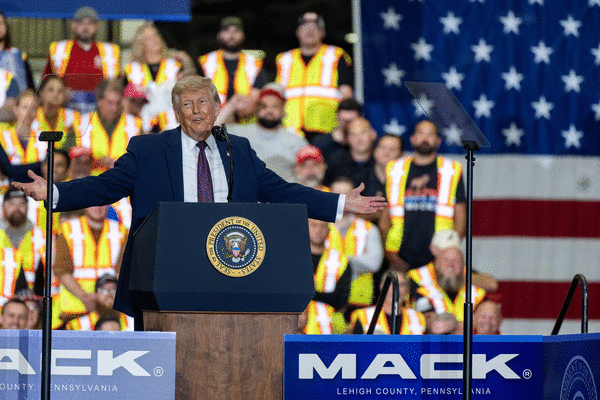
The president has sought to pump up his sales pitch in the last week, taking time during an economic-themed event in Pennsylvania on Tuesday and a rally on the National Mall in Washington on Wednesday to tout the deal and its ramifications. “Oil is going to come charging down, and with oil comes everything else,” he said in Pennsylvania.
The sequencing of that drop will be key for Trump. U.S. oil prices have erased nearly all their wartime gains. Yet gasoline prices, which are posted on roadways and have outsize sway on economic perceptions, are unlikely to fall to pre-crisis levels until shipping in the Strait of Hormuz is fully restored and stockpiles of crude and gas are replenished.
That may not happen before the end of 2026, a month after the midterms that will determine which party controls Congress. Still, falling gas prices should improve consumer sentiment quickly, said Carola Binder, an associate professor of economics at the University of Texas at Austin.
“Once they get the sense that prices are going to be lower for a sustained amount of time, then that can really have a large boost,” Binder said.
The recent drop in gasoline prices has begun to boost consumer morale, but it’s slow going. Data out Friday showed the University of Michigan’s sentiment gauge rose in June to the second-lowest level on record.
In the meantime, the White House is relying on the bully pulpit. White House talking points for its allies, seen by Bloomberg News, showed how the administration has tried to inoculate itself against outside criticism. The points say Iran’s “rewards” won’t come from U.S. taxpayers, that Obama “never even got a signed document” and that Trump has “ended the fighting on every front” with “no forever war.”
The White House official said a full-scale campaign to highlight the deal would come once it is finalized. It is difficult to stand up a major public-relations effort before that, the official said.
Democrats have sought to seize on criticism of the agreement to attack the president’s deal-making prowess. But the party has also been beset by infighting about its own direction, most recently with New York elections that exposed deep divisions between its progressive and centrist wings. That could hobble its attempt to capitalize on the war’s unpopularity and coalesce around how it will curb Trump’s power and address voters’ affordability concerns.
It might not need much help. The events of this week showed the path from an interim deal to a final one likely will be rocky.
The U.S. attacked Iran a day after Tehran hit a commercial ship in the Strait of Hormuz, an incident that threatened to break the two countries’ fragile ceasefire. Negotiators still differ over whether ships will have to pay to transit the vital waterway, and Iran has continued to resist U.S. demands that it dismantle its nuclear program.
Trump has set a 60-day timeline for nuclear talks with Iran. If they are successful, a formal deal could be unveiled right as midterm campaigning heats up. If they are not, Trump could have an added albatross to explain away as he campaigns for Republican candidates.
For the moment, Trump has shown frustration that Americans do not see the war as a success.
Just this week, he tussled with Republican lawmakers for passing a measure demanding he end the war, groused to NATO chief Mark Rutte about shoddy support from some European allies and announced that the Justice Department would investigate why gas prices were not falling faster.
That approach has won him few allies. Trump’s long-running feud with U.S. Senate Republican leaders, and the preponderance of national security hawks among them, has left him with only a handful of high-profile lawmakers willing to help sell the deal.
———
(With assistance from Mark Niquette and Daniel Flatley.)
©2026 Bloomberg L.P. Visit bloomberg.com. Distributed by Tribune Content Agency, LLC.
















































Comments