Court's TPS ruling hits Haitians hard in Massachusetts, big win for Trump
Published in Political News
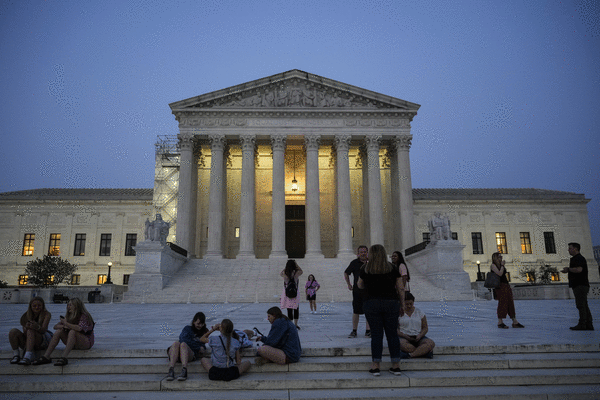
The Supreme Court’s decision to end temporary legal protections for Haitians and Syrians hit the state hard, with an outcry of “you cannot turn your back on us,” but was hailed by some for capping asylum seekers.
The blow was especially difficult for the 45,000 Haitians who live and work in Massachusetts.
The 6-3 ruling is a big win for the Trump administration, however, and follows charges that immigrants were poorly vetted after former President Joe Biden’s Democratic administration dramatically expanded the Temporary Protected Status (TPS) designation.
“This is the time for all of us to raise our voices and to say this country is also our country, is also the country of immigrants, because we are the ones who built it,” said Geralde Gabeau, founder and CEO of Immigrant Family Services Institute, in an impassioned address in the State House Thursday.
“If you can enjoy the seat of being on the Supreme Court, it’s because immigrants have worked so hard to give you that seat, so you cannot turn your back on us. We will not turn our back on our brothers and sisters. We will not turn our back on our neighbors. We are going to fight, and I said, by God’s grace, we will win,” Gabeau added.
Massachusetts has the third largest Haitian immigrant population in the country, with many contributing to the state’s workforce and economy, including in “health care, elder care, hospitality, education and other critical industries,” the governor’s office stated.
TPS has ended for about 1 million people from 13 countries, including about 650,000 from Venezuela and 50,000 from Honduras. Decisions are looming for about 200,000 Salvadorans and 100,000 Ukrainians whose protections expire soon.
Other countries with smaller numbers include Afghanistan, Myanmar, Cameroon, Ethiopia, Lebanon, Nicaragua, Somalia, South Sudan and Yemen.
Congress and lower courts will now have to decide what happens next, but deportations could potentially begin in about a month,
“These decisions reaffirm that immigration statutes must be interpreted according to their plain meaning and that courts cannot rewrite immigration laws enacted by Congress,” said Andrew Arthur, Fellow in Law and Policy at the Center for Immigration Studies. “The Court made clear that if immigration laws are to be changed — whether asylum procedures or Temporary Protected Status — that responsibility rests with Congress.”
State Attorney General Andrea Campbell stressed nothing will happen immediately.
“I want to assure TPS holders and their families that this decision today does not go into effect today,” said Campbell. “You remain protected today. The termination of TPS is expected to go into effect once the Supreme Court formally issues its judgment, which could happen in a matter of days or weeks, and we will continue to overcommunicate with respect to that decision. Usually it’s 32 days, but it can be more or less.”
The attorney general said the case would be brought back to the district court but the Supreme Court’s ruling limited the claims lower courts could hear, noting that “the court has said that the plaintiffs are unlikely to prevail on constitutional claims” and the odds are “stacked against them.”
Future court decisions could take weeks or months, she said, with potentially no protections for TPS holders in the meantime.
Campbell encouraged nonprofits, businesses, large conglomerate corporations, faith communities, and more to call the Department of Homeland Security in support of TPS.
Boston Mayor Michelle Wu and Gov. Maura Healey said the city and state would continue to help immigrants affected.
“We are going to keep fighting for accurate information to be out in our community, for access to trusted legal supports to be available to every single person who needs it, and resources to ensure we’re reaching everyone to understand their rights,” said Wu.
United Way on a statewide level and the Boston Foundation for the city will collect donations to assist immigrants impacted by the court’s decision, officials said.
The governor said her office would issue guidance to employers across the state related to the TPS issue.
“We’re going to make sure that we defend people’s access to justice and to due process in this country,” Healey said, directing residents to mass.gov/immigrantresources. “So, please consult those legal resources. Talk to a lawyer about other resources that may be available as well.”
Elizabeth Sweet, executive director of the Massachusetts Immigrant and Refugee Advocacy (MIRA) Coalition, called the decision “inhumane, immoral, and abhorrent” and said the organization was “committed to advocating for the rights and safety of all immigrants.”
“Forcing individuals to return to an extremely dangerous and violent situation, one which they have already fled, will rip families and communities apart,” Sweet said. “Haitian TPS holders are critical to the makeup of our state and country, and this decision will be catastrophic for our state’s workforce and economy.”
Council on American-Islamic Relations Executive Director Nihad Awad said “policies that target these families for deportation because of their race and ethnicity are contrary to our nation’s values.”
“Congress should pursue legislative solutions to make clear that courts do indeed have the authority to review TPS termination decisions, to recognize the contributions of TPS recipients, and to protect families from unnecessary hardship and separation,” Awad said.
Additional information and resources for impacted Massachusetts immigrants and residents can be found at mass.gov/immigrantresources.
_____
©2026 MediaNews Group, Inc. Visit at bostonherald.com. Distributed by Tribune Content Agency, LLC.




















































Comments