Supreme Court ruling on immigrant protections could affect thousands in Minnesota
Published in Political News
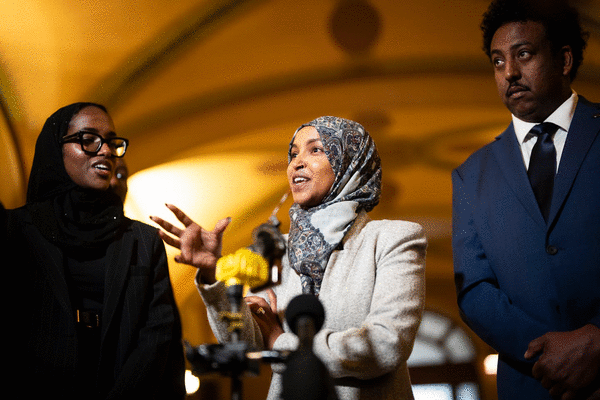
The U.S. Supreme Court backed the Trump administration’s efforts to end temporary protected status, or TPS, for Haitian and Syrian immigrants on Thursday over objections that the countries remain unstable and too dangerous for immigrants to return to.
The ramifications could impact thousands of immigrants living in Minnesota under TPS.
Justice Samuel Alito wrote in his opinion that the Trump administration’s “TPS designation decisions are not subject to judicial review.” That means immigrants on temporary status from countries such as Somalia and Ethiopia face an uncertain future.
Here’s a look at the program and how it could play out in Minnesota.
TPS is a federal program that allows people from distressed foreign countries to live and work in the United States temporarily. It does not automatically lead to permanent resident status. The U.S. has traditionally used TPS to welcome immigrants from countries undergoing war, natural disasters and epidemics.
As of March 2025, about 8,500 TPS holders lived in Minnesota, according to the National Immigration Forum. There are more than 1 million immigrants nationally living in the U.S. under the program. But since President Donald Trump returned to office, he has not extended TPS for any nationality and attempted to terminate it every time a country’s TPS status comes up for renewal.
Many of those orders have been working their way through legal challenges. In addition to Haiti and Syria, the Trump administration has attempted to end TPS for people from 11 other countries: Yemen, Somalia, Ethiopia, South Sudan, Burma, Venezuela, Nicaragua, Honduras, Nepal, Cameroon and Afghanistan.
The government doesn’t disaggregate TPS holders by nationality and receiving state.
However, there are 350,000 Haitians and 6,000 Syrians with TPS in the U.S. Minnesota is home to about 4,000 Haitians and 1,500 Syrians.
A divided Supreme Court ruled 6-3 that the judicial branch cannot interfere with the government’s decision to end TPS.
Advocates for Haitian and Syrian TPS holders argued that the Trump administration’s desire to end temporary protections for these groups was based on racial animus rather than the state of affairs in Haiti and Syria to determine whether humanitarian protections are still needed.
The Trump administration said the program, which has been repeatedly extended for decades at a time, is being abused as a de facto permanent immigration program rather than a temporary one.
Alito rejected arguments that the administration’s actions were racist against Haitians and Syrians because the administration moved to end TPS for every nationality that has come up for renewal.
TPS allows no judicial review of the administration’s choice of whether to designate TPS for any country, the ruling concluded.
TPS is in a state of legal limbo, but 17 countries had TPS in 2025: Afghanistan, Burma (Myanmar), Cameroon, El Salvador, Ethiopia, Haiti, Honduras, Lebanon, Nepal, Nicaragua, Somalia, South Sudan, Sudan, Syria, Ukraine, Venezuela and Yemen.
All but one of those countries have nonwhite majority populations, but immigrants from Ukraine are also worried that their status won’t be renewed when it comes up in October. DHS doesn’t break down how many immigrants have TPS by nation of origin and receiving state, but more than 100,000 Ukrainians are estimated to have TPS nationally.
A TPS designation typically lasts for up to 18 months.
Before the Supreme Court ruling, several federal district court judges have sided with immigrant groups, granting temporary reprieve to those from several nationalities. However, appeals courts have overturned those district court orders, and on Thursday, the Supreme Court ruled in favor of the Trump administration.
Many immigrants relying on TPS have begun consulting immigration attorneys about how to switch to a different legal status. Some TPS holders have lived in the U.S. for decades and have American-born children. Others had said it is too dangerous to return home. For example, the ongoing lawsuit to stop the cancellation of TPS for Yemen points out that the U.S. State Department does not recommend anyone travel to Yemen without making a will first.
Immigrants left without any legal status after the cancellation of TPS for their country must leave the U.S. or risk being deported.
_____
©2026 The Minnesota Star Tribune. Visit startribune.com. Distributed by Tribune Content Agency, LLC




















































Comments