Asylum-seekers may be turned away at the southern border, Supreme Court rules
Published in Political News
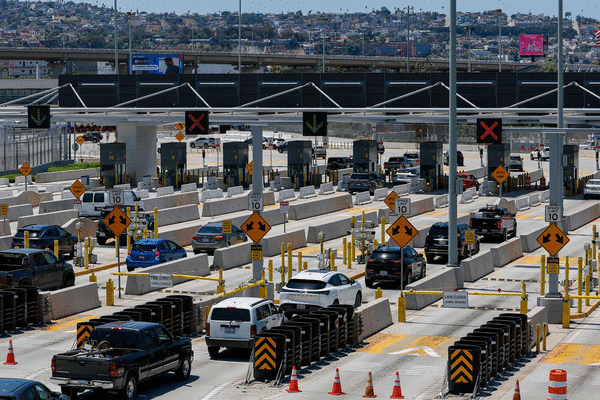
WASHINGTON — Asylum-seekers may be turned away without a hearing at the southern border, the Supreme Court ruled Thursday in a historic retreat from the promise of relief for those who say they are fleeing persecution.
The justices split over whether this was a simple dispute over legal wording or a moral question involving desperate families.
Siding with the Trump administration, the court’s conservatives said the Refugee Act of 1980 offers a right to seek asylum to migrants who “arrive in the United States” but not those who are turned back when they approach a border crossing or a port of entry.
“This case presents a straightforward question” that turns on the word “in,” said Justice Samuel A. Alito Jr. “In ordinary speech, no one would say that a person ‘arrives in’ a place — for example, a house, a city, or a country — before the person enters that place.”
The liberal dissenters agreed with immigration rights lawyers who saw this as a nonsensical reading of the law.
Justice Sonia Sotomayor said the asylum law arose from the “internal moral reckoning that followed the Holocaust and World War II.”
She cited the infamous voyage of the MS St. Louis in 1939. More than 900 Jewish refugees attempted to flee persecution in Nazi Germany by setting sail aboard the ship, which was turned away from Cuba and the United States.
Most of the passengers were returned to Europe, and several hundred died in the Holocaust, she said.
“Congress passed the Refugee Act in 1980 because it did not want this country to repeat the mistakes of its past. Yet if the refugees on the M.S. St. Louis were to walk up to a port of entry on our southern border today, the majority’s interpretation would allow immigration officers to refuse even to consider their asylum applications by physically blocking them from stepping foot onto U. S. soil,” Sotomayor wrote.
Justices Elena Kagan and Ketanji Brown Jackson agreed.
The decision upholds a turn-back policy that began in 2016 as an emergency response to a surge of Haitian immigrants at the San Ysidro border crossing.
The Department of Homeland Security said these asylum-seekers must wait on the Mexican side of the border until they could return for a scheduled interview. The policy was extended to other border crossings, but it was challenged as illegal in federal court in San Diego.
Last year, a divided 9th Circuit Court of Appeals ruled that those restrictions were illegal if they prevented migrants from applying for asylum.
“To ‘arrive’ means ‘to reach a destination,’” wrote Judge Michelle Friedland. “A person who presents herself to an official at the border has ‘arrived.’”
She said the “government’s reading would reflect a radical reconstruction of the right to apply for asylum because it would give the executive branch vast discretion to prevent people from applying by blocking them at the border.”
The 2-1 decision upheld a federal judge in San Diego who ruled for migrants who had filed a class-action suit and said they were wrongly denied an asylum hearing.
But Solicitor Gen. D. John Sauer urged the Supreme Court to review and reverse the appellate ruling, noting 15 judges of the 9th Circuit joined dissents that called the decision “radical” and “clearly wrong.”
The administration argued federal immigration law “does not grant aliens throughout the world a right to enter the United States so that they can seek asylum.”
From abroad, they may “seek admission as refugees,” Sauer said, but the government may enforce its laws by “blocking illegal immigrants from stepping on U.S. soil.”
Defenders of the asylum system denounced the decision.
“We believe that today’s ruling violates international law, as well as the express intent of Congress,” said Erika Pinheiro, executive director of the migrant support organization Al Otro Lado, which led the legal fight. “For decades, the United States has allowed individuals and families who are fleeing persecution, torture and death to ask for protection at U.S. borders.”
“Cruelty is not a substitute for real solutions. Blocking people from seeking asylum at official ports of entry will do nothing to fix our broken immigration system, said Rebecca Cassler, senior litigation attorney at the American Immigration Council. “It only makes things more chaotic and dangerous for vulnerable families.”
The Federation for American Immigration Reform applauded the decision.
“Our immigration laws are written to be pro-enforcement, not-anti-enforcement,” said Christopher J. Hajec, deputy general counsel of FAIR. “Because of this, courts that hamstring enforcement are often forced to violate basic logic, as the 9th Circuit did here. We are pleased the Supreme Court saw that the lower court’s reading would make immigration law incoherent, and reversed.”
©2026 Los Angeles Times. Visit at latimes.com. Distributed by Tribune Content Agency, LLC.





















































Comments