Ad targeting US House hopeful prompts debate over reach of Michigan AI law
Published in Political News
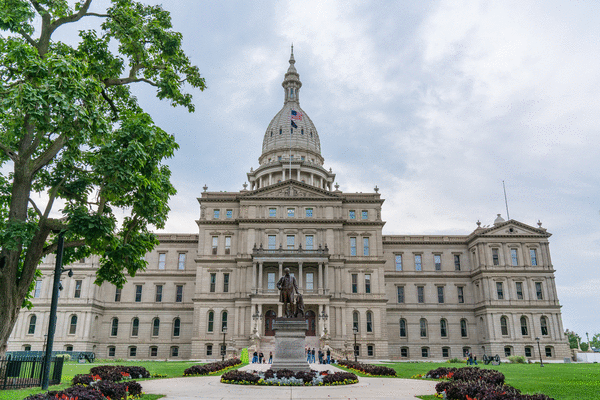
LANSING, Mich. — An ad targeting a candidate for the U.S. House is prompting new questions about state limits on the use of generative artificial intelligence in political ads, with the Michigan Bureau of Elections maintaining the state law does not apply to federal races.
Cheree De Golia of Lansing filed a complaint Tuesday with the Bureau of Elections over an attack ad running against Democratic congressional candidate Bridget Brink, in which the former ambassador to Ukraine is portrayed as President Donald Trump's "hand-picked" ambassador.
In the ad, paid for by the super political action committee, Michigan Values PAC, a video of Brink accepting Trump's nomination to the Slovak Republic is superimposed on a folder that Trump is shown holding at what appears to be the Oval Office desk. The ad concludes, "Bridget Brink worked for Trump. She doesn't work for Michigan."
De Golia argued the ad's manipulation of the video violates a state law passed in 2023 that requires political ads using AI to disclose as much within the ad. It is unclear whether the ad was generated using AI, though the video footage in the ad is clearly manipulated.
"The ad manipulates video of Donald Trump to make it seem as if he is holding a portfolio featuring an image of Brink, which has never occurred and was generated instead with AI," De Golia said in her complaint.
"The communication did not contain a clear disclosure informing viewers that the political advertisement was generated in whole or substantially by artificial intelligence, as required by Michigan law."
In a statement, the Michigan Values PAC said the complaint was a "transparent effort by the Brink campaign to distract from the underlying facts."
"No AI was used to create the ad," the group said, arguing the footage of Brink used in the video came from C-SPAN.
The Michigan Bureau of Elections confirmed it was investigating the complaint and could not provide further information until after the investigation. However, the bureau noted Michigan's AI disclosure requirement for political ads is a state law, not federal.
"AI disclosure is required under MCFA (Michigan Campaign Finance Act)," said Samantha May, a spokesperson for the Michigan Bureau of Elections in Secretary of State Jocelyn Benson's office. "However, MCFA is state law. It does not regulate candidates for federal office. For federal races, it is preempted by federal statutes."
The language of the state law appears to specifically list federal candidates as covered by the AI disclosure mandate. The statute describes political advertisements covered by the AI disclosure mandate as political ads "relating to a candidate for federal, state, or local office in this state, any election to federal, state, or local office in this state."
When asked for clarification in light of the language of the state law, the Bureau of Elections did not immediately respond.
State Rep. Penelope Tsernoglou, an East Lansing Democrat who authored the bill, said the intent was for the rules to apply to federal candidate ads.
"I would have to do some further research to understand the interaction with federal law," said Tsernoglou. "But our intent was to have it apply.”
Other state-level campaigns appear to be adhering to the statute. Senate Minority Leader Aric Nesbitt, a Porter Township Republican who recently suspended his campaign for governor, frequently posted AI videos on his social media feed depicting outlandish, fictitious clashes between Nesbitt, who was frequently riding a tractor, and Benson, Gov. Gretchen Whitmer and other Democrats.
His videos routinely ended with an AI-generated image of Democratic Attorney General Dana Nessel disclosing that the video had been generated with AI as well as a written disclaimer at the bottom of the video.
Brink's campaign contacts TV stations
Aside from the Bureau of Elections complaint, Brink's campaign has also asked TV stations airing the ad to pull it down, alleging image manipulation, misrepresentation of her service as ambassador, and misattribution of a statement made by U.S. Secretary of State Marco Rubio.
The campaign, in a letter written by its attorney, Mark Brewer, noted that Brink's career as a foreign service officer spanned five presidential administrations. She was appointed ambassador twice: Trump nominated Brink to be ambassador to Slovakia in 2019, where she served until shortly after Russia began its war on Ukraine in 2022, when President Joe Biden nominated her to be ambassador to Ukraine. She resigned from her role in protest of Trump.
"It is outright false and misleading to claim she is Trump’s 'handpicked ambassador' when her service was to our country under five presidents, from both parties, and she actively walked away from her distinguished career to stand up to Trump," Brewer wrote.
Further, Brinks did not agree that "Trump was standing up for America," as Rubio argued in a tweet after a contentious meeting with Ukrainian President Volodymyr Zelenskyy, Brewer wrote. A U.S. government account for the Ambassador to Ukraine, not Brink's personal account, retweeted it, he said.
"As this ad is unquestionably false and misleading, with the intention of deceiving your viewers, we ask that you immediately cease airing it on your station," Brewer wrote.
Michigan Values PAC, a Washington, D.C.-based Super PAC established in May, used the same ad buyer as VoteVets, which recently launched pro-Matt Maasdam ads.
VoteVets has endorsed former U.S. Navy SEAL Matt Maasdam, an Ann Arbor Township Democrat running against Brink in the 7th Congressional District primary. William Lawrence, a progressive community organizer from Lansing, is also running in the Democratic primary.
The winner of the three-way Democratic primary in August will face sitting U.S. Rep. Tom Barrett, R-Charlotte, in the November general election for the 7th District, which includes Clinton, Ingham, Livingston and Shiawassee counties and parts of Eaton, Genesee and Oakland counties.
Brink's campaign this week linked the manipulated Michigan Values PAC ad to Maasdam, arguing he and his "out-of-state, dark money allies" were using AI deepfakes to mislead voters.
"I’ve spent my life facing cyber attacks, disinformation campaigns, and threats from Putin, including missile and drone attacks as the first woman to serve as U.S. Ambassador in a war zone — Matt Maasdam’s attacks and AI deepfakes don’t scare me, and I’ll never back down," Brink said in a statement.
Maasdam's campaign declined to comment directly on the ad.
"Michigan Values PAC is an independent expenditure group that operates entirely independently of our campaign," said Emma Grundhauser, a spokeswoman for Maasdam. "Federal law prevents us from coordinating with them in any way, so we cannot speak to their activities."
-----------
©2026 www.detroitnews.com. Visit at detroitnews.com. Distributed by Tribune Content Agency, LLC.















































Comments