Black candidates in Florida's 20th District consider uniting behind one candidate against Wasserman Schultz as deadline looms
Published in Political News
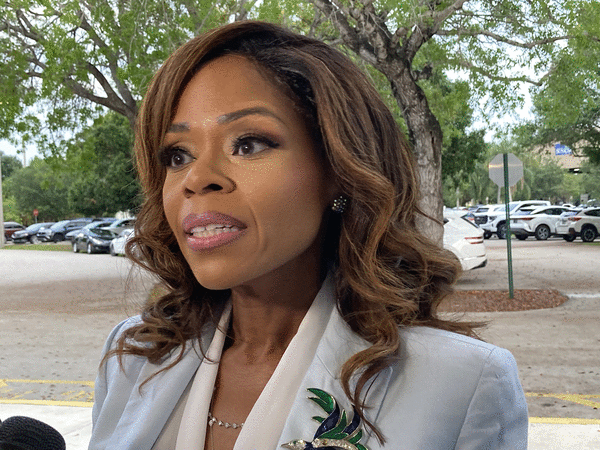
FORT LAUDERDALE, Fla. — The four Black candidates running in the Democratic primary in Broward County’s 20th Congressional District are still actively working on a deal in which all-but-one would drop out of the race, setting up a one-on-one contest with Congresswoman Debbie Wasserman Schultz.
The candidates met for four hours in Pompano Beach on Monday to discuss their options, and on Tuesday were still considering what they would do, two of the candidates and another participant in the meeting said.
“It was a very, very good meeting, a very, very healthy discussion. I think the candidates that are running are looking to consolidate and identify the one person that they’re all going to get behind,” said state Sen. Rosalind Osgood, a Fort Lauderdale Democrat who was present.
“I think it will happen soon,” Osgood said.
Luther Campbell, Sheila Cherfilus-McCormick, Dale Holness and Elijah Manley don’t have a lot of time; candidates have until Friday to officially qualify to get on the Aug. 18 primary ballot. Candidates could still qualify and withdraw later, but dropping out after the deadline would preclude running for another office this year.
Wasserman Schultz officially qualified for the ballot on Tuesday. The state Division of Elections listing showed none of the four Black candidates had done so by mid-afternoon Tuesday.
One possibility discussed by the group was whether Campbell, the rap music star turned civic activist and youth football coach, would withdraw from the congressional contest and instead run for governor.
Osgood and candidate Manley said Campbell running for governor was one of the options discussed.
Campbell’s campaign manager didn’t immediately respond to a text message Tuesday. One of Campbell’s brothers, Stanley, ran statewide in 2024, receiving 19.6% of the vote in an unsuccessful candidacy for the Democratic nomination for U.S. Senate.
Manley and Cherfilus-McCormick, another candidate at the meeting, said it was productive but no conclusions had been reached. Holness, the fourth candidate, didn’t immediately respond to a text message seeking comment.
“We’re still having conversations about consolidating,” Cherfilus-McCormick, who resigned from Congress in April and is running to return, said in a phone interview in which she also referred to the consolidation as something that “will take place.”
Manley said “a majority of the candidates were on the same page” in favor of consolidation. “This needs to be a head-to-head” contest between one candidate and Wasserman Schultz, he said.
The biggest sticking point: “Everybody feels they’re the better candidate,” Manley said. He added that he “would consider withdrawing from the race if we decided one candidate was the strongest.”
Appearing on CNN after an earlier meeting of the four candidates, Campbell described it this way: “When I looked at everybody in the room, I just sat there and listened and I talked at the end. But I only saw one person in that room that’s capable of fighting this juggernaut, and that’s me.”
Osgood had previously considered running for Congress, but is not doing so. She said Tuesday she has qualified as a candidate for reelection to the Senate.
The Monday conversation “amongst them (was) about getting behind one person. Everybody was willing to do what they need to do, whether it’s move to another race or stand down at this time for the bigger cause for the community,” Osgood said.
Monday’s gathering was convened by Broward State Attorney Harold Pryor, one of the highest-ranking Black elected officials in the county. Pryor declined, through a representative, to comment.
After a similar meeting he convened a week earlier, he said in a statement that he was “concerned that a high number of candidates may well fracture the community that I not only represent, but also live in.”
National focus
The question of race and the primary in the all-Broward 20th Congressional District has received national attention. For two weeks in a row, it has been a subject covered on CNN’s “First Of All,” a weekly program that focuses on “stories affecting communities of color.”
The 20th District contest has become a focal point after Republicans in the Legislature ratified a mid-decade redrawing of congressional districts proposed by Gov. Ron DeSantis. President Donald Trump had earlier told Republican-controlled states to change their congressional districts with the objective of getting more Republicans and fewer Democrats elected in November.
The new Florida map chopped up and reconfigured the congressional districts in Broward and Palm Beach counties, which are the Democratic areas of the state. South Florida currently has five heavily Democratic districts; under the new map it has three.
Wasserman Schultz, the longest serving Democrat in the Florida congressional delegation, decided to run for reelection in one of those districts, the 20th. It includes some of her current district, but also most of the African American and Caribbean American communities in Broward County. Since 1992, those communities had been combined with others in Palm Beach County to form a district that has been represented by a Black lawmaker.
An estimated 42% of the district’s voting age population is Black. Democratic data analyst Matthew Isbell has estimated that in 2024, Democratic primary voters in the district were 51% Black, 35% white and 7% Hispanic.
Cherfilus-McCormick, Manley, Campbell and Holness have objected to the candidacy of Wasserman Schultz, who is white, arguing that the reconfigured 20th District should be represented by someone who shares their lived experiences.
The change comes at the same time the U.S. Supreme Court ruling has empowered many states in the South to eliminate districts that were crafted to increase the chances of electing Black members of Congress, something that will reduce the number of Black representatives after Election Day.
Wasserman Schultz, who has touted her seniority to show she would be better able to achieve results for the district, said she has represented a majority-minority district before, and has released testimonials and endorsements from Black political leaders.
Deliberations
Osgood said the candidates talked about “different options” on Monday, including the governor’s race, running for other congressional seats or staying in the public arena through boards and commissions.
“There was nothing really definitive. There was just a lot of data, a lot of conversation, a lot of looking for pathways for people to serve in various capacities,” Osgood said.
Cherfilus-McCormick said the four hours was not devoted entirely to who would stay in the race and who would withdraw.
“It was really talking about the bigger picture,” she said.
Cherfilus-McCormick said several participants are concerned that Black voters could feel left out of the political process. After Orange County mayor Jerry Demings, who is Black, withdrew from the primary for governor last week after he was diagnosed with prostate cancer, Cherfilus-McCormick said “there is a void. And with that void, where are they going.”
Cherfilus-McCormick said that the issue needs to be fully aired. “Silence isn’t going to get us there. Pretending it doesn’t exist is not going to get us there,” she said.
Cherfilus-McCormick, who has had a rocky relationship with Wasserman Schultz, said her former colleague running in the new 20th District is seen by many Black people as “egregious.”
During an interview on CNN’s “First Of All” on Saturday, Campbell said District 20 “is ground zero to whether or not the Democratic Party is going to support African American candidates. When you have a person like Debbie Wasserman Schultz running in this race, it shows that there is a serious divide within the Democratic Party.”
Campbell also said Cherfilus-McCormick cannot be the Black community’s standard-bearer. She resigned in April minutes before the Ethics Committee was considering what sanction to recommend, possibly including expulsion, after its adjudicatory subcommittee found she had committed 25 violations. She faces a federal criminal trial next year.
And Campbell strongly criticized Wasserman Schultz.
“It’s time to get rid of people like her,” he said. “They leave the people out, hanging out in the dry, to get on TV, and all they do is scream and holler. Meanwhile, everyday Americans are suffering at the pump, at the grocery store. And it’s because of people like her.”
Campbell added that, “People hate her.”
Foreign Affairs role
Besides her ability to secure money and get policies into law through her seniority on the important House Appropriations Committee, Wasserman Schultz has touted her proximity to the Democratic leadership, where she serves as a co-chair of the Steering and Policy Committee.
House Democratic Leader Hakeem Jeffries generated headlines last week when he steered clear of the District 20 primary, saying he hadn’t yet decided if he’d support Wasserman Schultz’s campaign for reelection.
On Tuesday, the House Democratic Caucus, which is led by Jeffries, appointed Wasserman Schultz to serve on the House Foreign Affairs Committee. In a statement, she thanked Jeffries and U.S. Rep. Gregory Meeks of New York, the top Democrat on the Foreign Affairs Committee “for this vote of confidence.”
_____
©2026 South Florida Sun-Sentinel. Visit sun-sentinel.com. Distributed by Tribune Content Agency, LLC.




















































Comments