Missouri governor moves direct democracy, income tax votes to August primary
Published in Political News
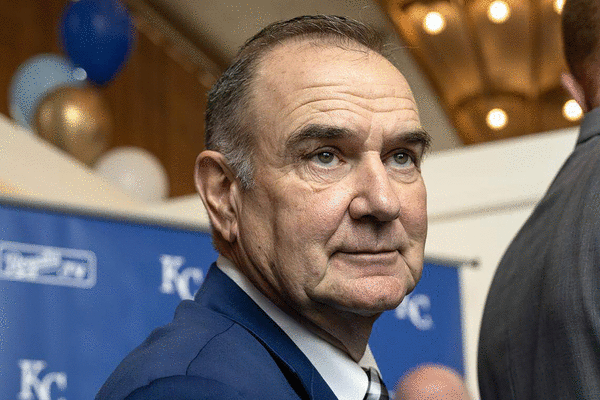
KANSAS CITY, Mo. — Missouri Gov. Mike Kehoe on Friday moved to the Aug. 4 ballot a pair of proposals that seek to replace the income tax with expanded sales taxes and overhaul the state’s form of direct democracy, a major decision that could determine the measures’ chances of passage.
The Republican governor made the announcement in a news release Friday afternoon. The decision effectively shapes Missouri’s upcoming elections and also solidifies the fact that Missouri voters will decide the fate of abortion rights on Nov. 3.
“With several significant issues set to appear before Missouri voters this year, it is important that we both prepare for the outcome of each proposal and allow each issue to receive the careful public consideration it deserves,” Kehoe said in a statement on Friday.
Kehoe’s announcement sets the stage for an extraordinary election cycle. Missourians are gearing up for a trio of high-profile votes in August and November, including whether to overhaul the state’s tax structure, make it harder for citizens to amend the state Constitution and strike down a historic 2024 vote that legalized abortion.
Missouri Republican lawmakers, with firm control of the General Assembly, voted to place each of the key policy measures on the November ballot. But Kehoe on Friday wielded the powers of his office to move the income tax and direct democracy measures to the August election.
The Republican governor also moved measures that would require the direct election of all county assessors and renew a sales tax for parks conservation to August.
The decision was strategic. Republicans are hopeful that the income tax and direct democracy measures will perform better in the August primaries, where voter turnout is weaker than November but typically more solidly Republican.
In moving two of the state’s most high profile and controversial policy measures to August, the decision also seeks to prevent Democratic opponents from tying Republican candidates to those issues in November.
Kehoe’s move comes as Republicans, despite their firm grip on Missouri politics, are gearing up for a potentially tortuous election cycle nationally amid rising gas prices and President Donald Trump’s fledgling poll numbers.
The direct democracy measure, called Amendment 4, and the income tax plan, called Amendment 5, are poised to have the most immediate impact on Missourians.
Direct democracy
Amendment 4 takes aim at Missouri’s initiative petition process, a more than a century-old form of direct democracy that allows citizens to collect signatures and put policy measures to a statewide vote.
In recent years, initiative petitions have allowed voters to overturn an abortion ban, raise the minimum wage, legalize marijuana, limit tax increases, expand Medicaid and legalize sports betting.
The new, first-in-the-nation plan would make it virtually impossible for most citizen-led constitutional amendments to pass on the ballot, political experts previously told The Star.
Currently, initiatives need a simple majority (50% plus one) in order to pass. If Amendment 4 passed, citizen-led constitutional amendments would need to win majority support statewide and also win a majority in every one of the state’s eight congressional districts to pass.
That threshold would give voters in just one congressional district the power to veto an amendment, no matter how popular the measure is statewide. Missouri would be the only state in the country with such a requirement, called a concurrent majority, according to a review of state ballot measure rules compiled by the National Conference of State Legislatures.
The higher threshold would also not apply to state lawmakers. Amendments placed on the ballot by the General Assembly would still only have to receive a simple majority statewide in order to pass.
Republican lawmakers, who control both chambers of the General Assembly, have for years sought to curtail the initiative petition process. Republican supporters of the overhaul argue that it’s been too easy for voters to amend the Missouri Constitution and that the current process allows outside interest groups to influence elections.
Amendment 4, however, represents the most expansive attempt to weaken the process in recent memory. Opponents of the measure frame it as a broader attack on democracy in Missouri that will effectively eliminate citizens’ right to petition their government.
A host of groups have lined up against the proposal in recent days. Earlier on Friday, a group called Protect Majority Rule launched a campaign to oppose the overhaul. M’Evie Mead, the group’s campaign director cast the upcoming vote as a historic moment in Missouri.
“This is about who holds the power in Missouri,” Mead said in a statement. “Right now, if a majority of Missouri voters support something, it passes. That’s how democracy is supposed to work. Amendment 4 would end that, and we’re going to stop it.”
Income tax
Kehoe’s announcement also solidified the fact that one of his key policy initiatives, a plan to eliminate the income tax, will appear on the Aug. 4 ballot.
The eventual goal of the proposal would replace the income tax with expanded sales and use taxes over several years, a sweeping change that Republicans say would bolster the state’s economy.
“The issue at hand here is competitiveness. And competitiveness starts with our tax code,” Kehoe said during his annual State of the State address in January. “Missouri’s tax structure must evolve.”
But the measure has started to split some Republicans who argue it would hand state lawmakers too much power to raise other taxes. The plan has also alarmed residents and officials in Kansas City who fear it will hurt low-income residents and force state and local governments to make drastic cuts to services.
If approved, the measure would grant lawmakers broad authority to increase sales taxes and implement taxes for services with the goal of reducing the income tax. An opposition group called Missourians for Fair Taxation has cast the proposal as an “Everything Tax” and argues the proposal would trick voters into raising other taxes.
Scott Charton, a spokesperson for the group and another group opposing the direct democracy overhaul, pointed to a fiscal projection approved by Republican State Auditor Scott Fitzpatrick, who wrote that the measure “will not have a direct impact on state or local tax revenue.”
“Amendment 5 is so vague, even the State Auditor cannot say how much taxes could ultimately go up, which means Missourians are being asked to approve a constitutional change without knowing the full impact to their own pocketbooks,” Charton said.
-----------
©2026 The Kansas City Star. Visit at kansascity.com. Distributed by Tribune Content Agency, LLC.



















































Comments