Democrats renew effort to prevent US military action against Cuba
Published in Political News
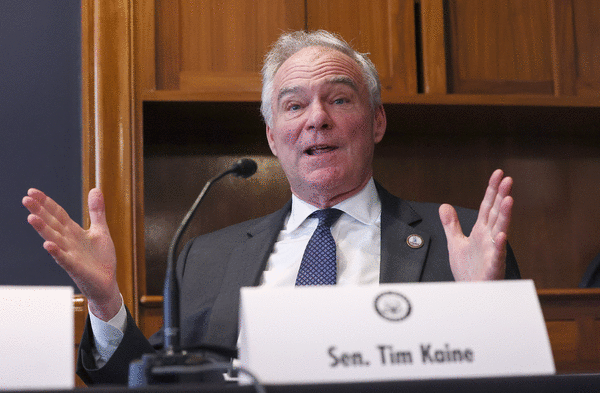
WASHINGTON — A trio of Senate Democrats is trying again to rein in President Donald Trump’s ability to order military action against Cuba.
Sens. Tim Kaine, D-Va., Adam B. Schiff, D-Calif., and Ruben Gallego, D-Ariz., have introduced a war powers resolution that would direct Trump to “remove the United States Armed Forces from hostilities within or against Cuba, unless explicitly authorized by a declaration of war or a specific authorization for use of military force,” according to draft bill text.
The resolution comes after the Trump administration unveiled a criminal indictment against former Cuban President Raúl Castro, which Democrats fear could be a pretext for military action, in the same way the administration used criminal charges against Venezuelan President Nicolás Maduro as justification for a militaryraid there.
It also comes on the heels of Senate Democrats notching a procedural win on their monthslong effort to end the war in Iran through a war powers resolution tailored to that country.
“The last thing that our country needs right now is a regime change war in Cuba based on imaginary threats to the homeland that would devastate the Cuban people and generate a man-made migration crisis,” Kaine said in a statement. “As President Trump continues to threaten Cuba with direct military action, we will continue to give our Senate colleague every opportunity to stop the chaos.”
Under the 1973 War Powers Resolution, Kaine, Schiff and Gallego will be able to force an initial procedural vote on their measure after 10 days.
The same trio previously introduced a Cuba war powers resolution in March, but Republicans successfully derailed the measure.
In April, Republicans raised a point of order that the resolution was not entitled to privileged status under the War Powers Resolution since U.S. troops aren’t actively engaged in combat against Cuba. The point of order was sustained in a mostly party-line vote of 51-47.
Since then, though, the Trump administration has intensified its threats against Cuba.
On Wednesday, federal prosecutors charged Castro, the 95-year-old brother of longtime Cuban leader Fidel Castro who served as defense minister for decades, with ordering the 1996 downing of civilian planes that killed four Cuban-Americans.
U.S. Southern Command also announced Wednesday that the aircraft carrier USS Nimitz and its associated strike group had entered the Caribbean Sea. The Nimitz had been participating in exercises with Brazil and is now in the process of transiting to Virginia for decommissioning, but the public announcement of its arrival in the Caribbean raised eyebrows amid the Cuba tensions.
Asked Wednesday what will happen to Cuba following the indictment, Trump told reporters, “we’re going to see,” adding, “it’s a failing nation.”
The indictment adds to a pressure campaign the Trump administration has been waging against Cuba since the beginning of the year.
Since January, the United States has imposed a blockade of oil shipments to the island, causing fuel shortages that have led to lengthy blackouts and aggravated an economic crisis.
CIA Director John Ratcliffe visited Cuba last week in a rare publicly disclosed trip that the agency said was intended to deliver a message that the United States was open to engagement. On Thursday, though, Secretary of State Marco Rubio expressed pessimism about reaching a diplomatic agreement with Cuba.
“The likelihood of that happening given who we’re dealing with right now is not high,” Rubio told reporters.
©2026 CQ-Roll Call, Inc., All Rights Reserved. Visit cqrollcall.com. Distributed by Tribune Content Agency, LLC.
















































Comments