Judge weighs challenges to Trump order on mail voting limits
Published in Political News
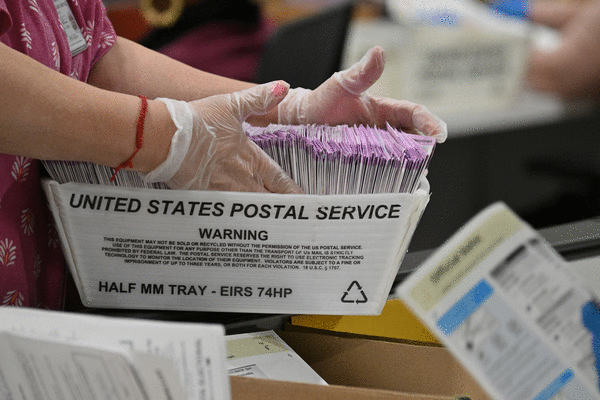
WASHINGTON — A federal judge in Washington acknowledged Thursday the tight timeline he faces in deciding whether to pause President Donald Trump’s executive order to create a national voter list and limit mail voting nationwide.
Congressional Democratic leaders, the Democratic National Committee and party campaign committees, as well as civil rights groups and advocacy organizations, urged Judge Carl Nichols for the U.S. District Court for the District of Columbia to pause aspects of the executive order Trump issued at the end of March.
The executive order sought to have the Department of Homeland Security create a nationwide “state citizenship list” and then have the government coordinate with states to use that list as they manage their voter rolls. Separately the order would have the U.S. Postal Service create a rule to restrict election mail to only people on state voter lists.
Additionally, the order directed the attorney general and other agencies to seek to investigate and punish states or local governments that did not comply, including by rescinding federal funds.
At one point during Thursday’s two-hour hearing, Nichols said that if he waited until July, when the order stated the postal service would finalize the rule, “now we’re on the cusp of election season.”
“Why shouldn’t I take it up now?” Nichols asked the government.
Stephen Pezzi, attorney for the Justice Department, argued that the Democrats and civil rights groups can’t articulate how the federal government would violate the law because of the order, either in the creation of the voter list or with the postal service rule.
Both sides are “shadowboxing over a hypothetical list that hasn’t been created yet,” Pezzi said.
The DOJ, while acknowledging that the state lists would not contain perfect information about every eligible voter, can’t be held responsible for potential unlawful actions by a state to remove an eligible voter from the rolls, Pezzi said.
State actions like that are “not a concern, for the most part, of the federal government,” Pezzi said.
Nichols also pushed the challengers to explain how he could block a rulemaking the government has not started yet, as “we don’t know how DHS is going to compile the list.”
“We don’t know, sitting here today, whether any of these steps are going to take place,” Nichols said.
Lalitha Madduri, attorney for the Democratic groups challenging the order, argued that federal privacy law prohibits the creation of exactly the kind of list laid out by the executive order. Madduri said Congress prohibited that sort of cross-referenced national database without explicit authorization in another law.
“There is no lawful way to compile the list,” Madduri said.
Danielle Lang, attorney for the civil rights groups, pushed Nichols to act sooner rather than later, as “waiting will erode public confidence in elections.”
Lang pointed out that the order seems designed to create the “maximum amount of chaos and confusion” in elections, and that the final rules would come amid a flood of primaries in the summer and fall.
The final rules would come after some primaries, before others, and with 60 days for voters, state and local election officials to deal with a new set of rules for mail ballots, she said.
The American people deserve to know their elections will be “governed by the rule of law, not by the whims of a president asserting power he doesn’t have,” Lang said.
Several states intervened in the case, arguing that they want the Trump administration to compile the list. Missouri Solicitor General Louis Capozzi III, arguing for those states, said the challengers can’t show the states would actually use the list unlawfully.
The case is one of several filed against the law since Trump issued it at the end of March.
Originally, the Democratic Party and civil rights groups suits were brought separately before being consolidated before Nichols last month. Both sides sought a preliminary ruling that the effort to create the voter list and the directive to the Postal Service likely violate federal law and should be stopped.
After the two-hour hearing, Nichols said he would not rule immediately – but gave the government a warning to notify him if it takes any steps to implement the order.
“It would not be good for the government if it took anything other than a capacious interpretation of my expectations,” to be informed, Nichols said.
The March order follows several steps taken by the Trump administration seeking to assert greater federal control of elections. That includes an executive order last year seeking to require proof of citizenship to register to vote in federal elections and blocking the counting of late-arriving mail ballots, which has been blocked by multiple lower courts.
Separately, the DOJ has also sought sensitive, nonpublic voter roll data from more than half of states through lawsuits, many of which are still pending but have been blocked by every judge who has ruled on the effort’s legality.
_____
©2026 CQ-Roll Call, Inc. Visit at rollcall.com. Distributed by Tribune Content Agency, LLC.
















































Comments