Supreme Court resembles a feuding family with arguments that go on for years
Published in Political News
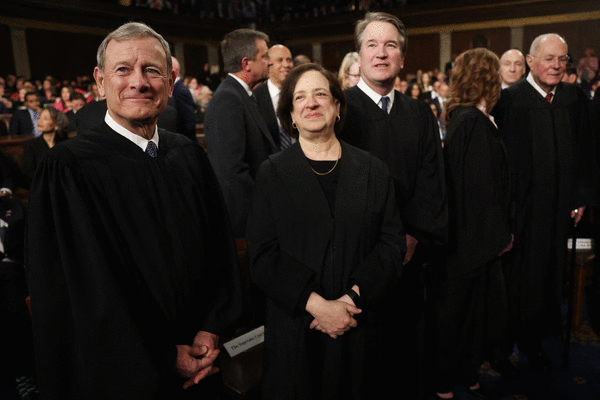
WASHINGTON — The Supreme Court often resembles a feuding family where the same heated arguments go on for years.
The justices disagree over race, religion, abortion, guns and the environment, and more recently, presidential power and LGBTQ+ rights. And while they try to maintain a cordial working relationship, they don't claim to be good friends.
"We are stuck with one another whether we like it or not," Justice Amy Coney Barrett wrote last year in her book, "Listening to the Law."
And like it or not, the testy exchanges and simmering anger have been increasing, driven by the sharp ideological divide.
The three liberals had known since October the conservative majority was preparing to elevate partisan power over racial fairness.
By retreating from part of the Voting Rights Act, the court's opinion last week by Justice Samuel A. Alito will allow Republicans across the South to dismantle voting districts that favor Black Democrats.
Justice Elena Kagan, who first came to the court as a law clerk for Justice Thurgood Marshall, denounced the "demolition" of a historic civil rights law.
In dissent, she quoted Marshall's warning that if all the voting districts in the South have white majorities, Black citizens will be left with a "right to cast meaningless ballots."
But Alito and Chief Justice John G. Roberts joined the court 20 years ago believing the government may not make decisions based on race.
Their first major ruling was a 5-4 decision that struck down voluntary school integration policies in Seattle and Louisville. It was illegal to encourage some students to transfer based on their race, Roberts said.
When faced with a redistricting case from Texas, Roberts described it as the "sordid business ... [of] divvying us up by race."
With President Donald Trump's three appointees on the court, the conservatives had a solid majority to change the law on race. Three years ago, they struck down college affirmative action policies.
Watching closely were states such as Alabama and Louisiana.
They had been sued by voting rights advocates, and both had been required to draw a second congressional district with a Black majority.
Their state attorneys appealed to the Supreme Court, arguing these race-based districts were unconstitutional.
In a decision that surprised both sides, Alabama lost by a 5-4 vote in 2023.
Roberts said the Voting Rights Act as interpreted by past decisions suggests Alabama must draw a second congressional district that may well elect a Black candidate. The three liberals agreed entirely and Justice Brett M. Kavanaugh cast a tentative fifth vote.
Alito and Justice Clarence Thomas filed strong dissents, joined by Barrett and Justice Neil M. Gorsuch.
Last year, the justices agreed to decide a nearly identical appeal from Louisiana, and this time Roberts joined the conservative majority and assigned the opinion to Alito.
He argued the Voting Rights Act gave "minority voters" an equal right to vote but not a right to "elect a preferred candidate."
The decision dealt a double blow to Black Democrats because an earlier 5-4 opinion by Roberts freed state lawmakers to draw voting districts for partisan advantage.
That ruling, combined with Wednesday's decision, will bolster Republicans trying to maintain their narrow hold on Congress.
As if to highlight that point, the court's six Republican appointees were guests of President Trump at last week's White House dinner for King Charles.
Just a few days before, Trump had slammed the court in another social media post.
"The Radical Left Democrats don't need to 'Pack the Court'. It's already Packed," he wrote. "Certain 'Republican' Justices have just gone weak, stupid, and bad." They had struck down his sweeping tariffs, he said, "they probably will ... rule against our Country on Birthright Citizenship."
That didn't stop him from inviting them to the White House, nor did the partisan appearances dissuade them from attending.
Alito is enjoying his moment of acclaim as the voice of the conservative legal movement.
In March, the Federalist Society held a day-long conference in Philadelphia to celebrate the "Jurisprudence of Justice Alito."
He is the subject of two new books. One, by journalist Mollie Hemingway, calls him "the justice who reshaped the Supreme Court and restored the Constitution."
The other, by author Peter S. Canellos, is "Revenge for the Sixties: Sam Alito and the Triumph of the Conservative Legal Movement."
Alito attended Princeton during the Vietnam War and was put off "by very privileged people behaving irresponsibly," as he later described his classmates.
He then went to the Yale Law School and, like Thomas, left with a lasting disdain for the left-leaning faculty and students.
Alito has a book of his own scheduled to be released in October. It is called "So Ordered: An Originalist's View of the Constitution, the Court and Our Country."
Last month, rumors and speculation had it that Alito and perhaps Thomas planned to retire this year so Trump and the Senate Republicans could quickly fill their seats.
At age 76, Alito is at the peak of his influence and has no interest in stepping down, and he and Thomas confirmed to news organizations they had no plans to retire this year.
For 20 years, Alito has cast reliably conservative votes at the Supreme Court and regularly argued for moving the law farther to the right.
Most famously, he wrote the court's 5-4 opinion in the Dobbs case that overturned Roe vs. Wade and the constitutional right to abortion.
Roberts issued a partial dissent, arguing the court should uphold Mississippi's 16-week limit on abortions and stop there.
Alito has called religion a "disfavored right," and there too a change is underway.
In the decades before his arrival, the court had handed down steady rulings barring taxpayer funds for religious schools or religious ceremonies or symbols in public schools or city parks.
Then, the court viewed these official "endorsements" of religion as violations of the 1st Amendment's ban on an "establishment" of religion or the principle of church-state separation.
Those decisions have faded into the background, however.
Instead, Alito, Roberts and the four other conservatives see today's threat as one of discrimination against religion, not official favoritism for religion.
They ruled church schools and their students may not be denied state aid because of religion. Similarly, Catholic charities and other religious groups may not be excluded from publicly funded programs because they refuse to accept same-sex parents, the justices said.
They upheld a football coach's right to pray on the field. And they ruled for a wedding cake maker in Colorado and other business owners who refused to serve same-sex couples in violation of a state civil rights law.
Religious liberty has now replaced separation of church and state as the winning formula at the Supreme Court.
The next test on that front may come from Louisiana, which calls for the posting of the Ten Commandments in public school classes.
In the past, the court had ruled such religious displays violated the 1st Amendment, but it is not clear that the current majority will agree.
The court's oral arguments for this term ended last week. Many of them were dominated by questions from liberal Justices Sonia Sotomayor and Ketanji Brown Jackson.
A statistical tally by Adam Feldman for Scotusblog found that Jackson, the newest justice, had spoken twice as many words as the most talkative of the conservative justices.
Her arrival shifted the "center of verbal energy" to the liberal side, Feldman wrote. While Jackson "sits in a class of her own," Sotomayor also presses the argument on the liberal side.
The court now has about eight weeks to hand down the decisions in 35 remaining cases. Usually, May and June can be a trying time because of intense disagreements over the opinions in close cases.
But for the liberal justices, it also may be a time mostly for writing dissents.
©2026 Los Angeles Times. Visit at latimes.com. Distributed by Tribune Content Agency, LLC.





















































Comments