Supreme Court voting rights ruling set to reshape local power from statehouses to school boards
Published in Political News
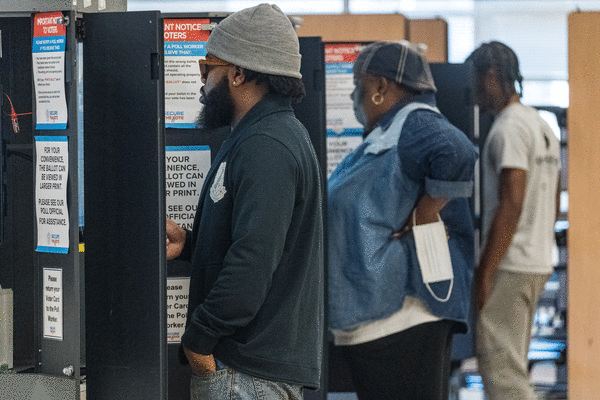
The U.S. Supreme Court’s new decision gutting a key provision of the federal Voting Rights Act clears the way for state officials to drastically reshape not only Congress but also state legislatures, county commissions, city councils and even local school boards.
The ruling, released last week in a case called Louisiana v. Callais, dismantled some of the final guardrails protecting the electoral power of Black, Hispanic and other racial minority voters that had been enshrined in the Voting Rights Act, a landmark 1965 federal civil rights law that bars racial discrimination in voting access.
The 6-3 decision all but nullifies a provision called Section 2 that required states to draw electoral maps to give racial minority voters the opportunity to elect their chosen candidates.
And while intense national attention on the case’s fallout has focused on the U.S. House as the 2026 midterm congressional elections loom, the new ruling also applies to state legislative districts and maps for county or municipal elections.
Those localized changes are just hovering further down the road.
“While everyone has been focusing on what this means for the power in Congress, there’s a whole other sector of power that it changes,” said Davante Lewis, an elected member of the Louisiana Public Service Commission and one of the litigants in a case that pushed Louisiana to create the congressional maps that were eventually struck down in the Callais ruling.
“This is a decision on who gets to serve on a school board, who gets to serve on a city council, who gets representation in the judiciary,” Lewis said.
Electoral maps are typically redrawn every 10 years after a census, but the Trump administration has encouraged Republican-led states to redraw districts to favor the GOP, a controversial move that has prompted some Democratic-led states to retaliate with gerrymandering of their own.
“But after 2030, I think we’re definitely going to see the impact of the Callais decision at the state level,” said Travis Crum, a law professor at Washington University in St. Louis whose research focuses on voting rights, race and federalism.
Effects across the South
Critics of the ruling say it will fundamentally dilute the voting and governing power of Black and other minority citizens up and down the ballot, particularly in the South. There, many of the seats held by Black elected officials are in so-called opportunity districts that were created after the Voting Rights Act to allow Black and other minority voters to elect their preferred candidates.
“On the congressional level, we’re in this race to the bottom of redistricting, but when it comes to the state legislative level, we’ll have to wait and see,” Crum said.
In 10 state legislatures across the South, Republicans could gain more than 190 seats currently held by Democrats, most of them Black representatives in majority-minority districts, according to an analysis released in December by voting rights groups Fair Fight Action and Black Voters Matter Fund. At the federal level, one analysis from The New York Times found that Democrats stand to lose a dozen U.S. House seats across the South.
In the hours after the Supreme Court ruling, Republicans across the nation began calling for maps to be redrawn, particularly in states where courts had forced them to create districts where Black or other racial minorities made up the majority of residents.
“These lines should all be colorblind. You should never be basing a decision on race,” said Arizona Republican state Sen. Warren Petersen, who’s president of the state Senate and running for attorney general.
He told Stateline he believes both congressional and state legislative maps should be redrawn in Arizona — even if it takes litigation.
Mississippi Republican Gov. Tate Reeves called a special legislative session set for later this month, when he wants lawmakers to draw new election maps for Mississippi state Supreme Court districts. A federal judge in Mississippi will have to quickly decide whether to adopt a new map for some special elections scheduled for November.
Democrats, too, took action. In Illinois, lawmakers backtracked on a proposed constitutional amendment that would have directed lawmakers to consider race in drawing district lines, a provision taken directly from the Voting Rights Act. Instead, Illinois Senate President Don Harmon, a Democrat, told Capitol News Illinois that lawmakers want to learn more about the ruling before putting such an amendment on a ballot for voters to decide, to prevent unintended consequences that could undermine voting rights.
In many states, Republicans are focusing first on congressional redistricting. Louisiana Republican Gov. Jeff Landry postponed his state’s U.S. House primaries even though absentee voting has already begun. In Alabama, Republican Gov. Kay Ivey called a special state legislative session aiming to move the state’s May 19 primary in at least a handful of districts. Prominent Georgia Republicans were also calling for their state’s political maps to be redrawn, though GOP Gov. Brian Kemp said in a statement that it’s too late to do that this year.
And in North Dakota, the ruling leaves a tribal redistricting case in limbo. Tribes had used Section 2 of the Voting Rights Act to sue the state over a legislative district map the North Dakota legislature approved in 2021.
Gerrymandering for partisan advantage is legal at the federal level, though some states do have their own laws restricting or prohibiting it. In Florida, Republican Gov. Ron DeSantis is arguing the Supreme Court ruling invalidates voter-approved amendments that prevent the state from gerrymandering districts based on race or political party.
For most states, though, state officials can redraw maps explicitly to favor Republican voters, for example, so long as they don’t state their intention to disadvantage voters based on race.
‘Ripple like wildfire’
Critics of last week’s Callais ruling also worry it will rapidly erode the pipeline that has made it possible for Black and other minority candidates to get elected to office.
“Now, state legislatures can draw maps where they are picking their voters instead of their voters picking them,” said Lewis, the Louisiana commissioner. “They can dilute the power of Black and brown people serving in the state legislature, which means there’s fewer people to fight a congressional map” that pulls voting power away from minority communities.
He worries that if Black Democratic state lawmakers oppose their white Republican colleagues in legislatures with GOP majorities, those colleagues could redraw maps to eliminate the Black lawmakers’ seats, claiming they’re doing it only for partisan reasons.
The diluting of minority voting power, he said, “is going to ripple like wildfire.”
At the most local level, city councils and county boards typically draw those voting maps, but the ruling could be used to apply to them as well, said Crum, the law professor.
Arizona is one of a handful of states where an independent commission, rather than the state legislature, determines both congressional and legislative districts. Outside of a court order, it can’t convene before the turn of the decade.
Petersen, the Arizona state senator, said he’s prepared to litigate if the state’s redistricting commission doesn’t take action to redraw districts that he said are unconstitutionally drawn. He doesn’t expect new maps before 2028, though.
“We’ve heard complaints from constituents that they don’t like the way their district was drawn,” he said. “We have some people here in Arizona that represent completely far-flung areas.
“I do think you’ll get a better outcome on some of these legislative districts” by removing race-based districting, he said.
Lawmakers in some states have tried to guard against the loss of federal protections by introducing their own state-level voting rights bills. Nine states have their own versions of the federal Voting Rights Act, according to the National Conference of State Legislatures: California, Colorado, Connecticut, Illinois, Minnesota, New York, Oregon, Virginia and Washington.
Lawmakers in at least 11 other states have introduced such bills this year alone: Alabama, Arizona, Georgia, Florida, Louisiana, Maryland, Mississippi, New Jersey, Oklahoma, Rhode Island and Vermont.
The new Supreme Court ruling doesn’t render those laws unconstitutional, said Crum.
“But people who are seeking to undermine those state Voting Rights Acts are certainly going to rely on some of the themes” of the recent ruling, Crum said. “You might see them try and replicate some of the moves the court made.”
_____
_____
©2026 States Newsroom. Visit at stateline.org. Distributed by Tribune Content Agency, LLC.

















































Comments