Culture of silence around abortions for active-duty military intensifies, researchers say
Published in Political News
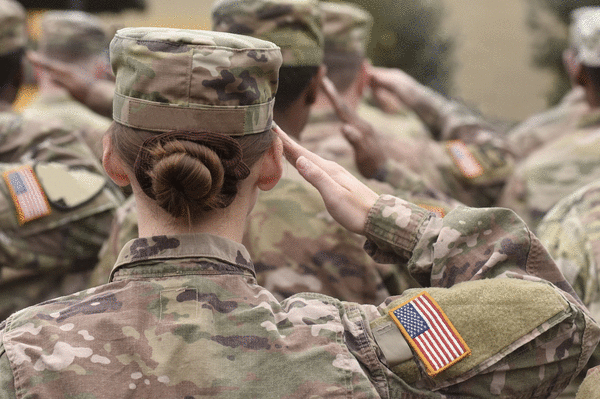
Researcher Caitlin Gerdts planned to release a new study about abortion access for active-duty military service members, much like the one in 2019 that was published with input from 323 participants.
But over a six-month period in 2024, in a new legal environment for abortion access, the research team was only able to find three service members who agreed to participate, even though their identities would be kept secret. With that few people, a study couldn't be completed, and the group published an analytical essay instead.
"It makes sense that this is a particularly difficult moment," said Gerdts, vice president for research at international nonprofit Ibis Reproductive Health.
Researchers say it's important to understand what kinds of barriers active-duty service members are facing when living in any state — especially in states with strict abortion bans. But those who spoke with Stateline said it is becoming increasingly difficult to access that population because of chilling effects around state laws, the actions of the U.S. Department of Defense under its current leadership, and factors specific to the military that existed long before federal abortion protections were overturned.
The Department of Defense did not respond to Stateline's request for comment before publication.
In many cases, research on abortion generally focuses on providers, especially with studies that involve interviews. But among organizations that talk often with civilian patients — including Advancing New Standards in Reproductive Health at the University of California, San Francisco — researchers told Stateline they haven't experienced the same problems with recruitment that Gerdts described, suggesting the issue is specific to the military.
As of 2021, there were more than 230,000 women in active-duty roles in the U.S. military, according to the U.S. Department of Defense, and 95% are of reproductive age, between 18 and 44. The RAND Corp. found in 2022 that about 40% of women on active duty are in states with severely limited access to abortion or no access at all, including military-heavy states such as Florida, Georgia, North Carolina and Texas.
Kristen Jozkowski, senior scientist at Indiana University's Kinsey Institute, said not being able to gather data from a specific population can make it more difficult to help them.
"As a researcher and behavioral scientist, I think it is an issue when we cannot get access to any population, particularly ones who may be unique or at increased risk of something," Jozkowski said. "It limits our ability to grow knowledge as a society and make empirically informed decisions and recommendations."
Change in policy
After Defense Secretary Pete Hegseth assumed office in January 2025, one of the first directives his department issued rescinded a 2-year-old policy that allowed service members to seek abortion care no matter where they are stationed without having to use one of the 30 days of leave they are entitled to each year. It also had allowed members and their dependents to be reimbursed for related travel expenses such as transportation, lodging and meals.
That policy took effect shortly after the U.S. Supreme Court's 2022 Dobbs v. Jackson Women's Health Organization decision, under Democratic President Joe Biden. Over a period of seven months from June through December 2023, it was used 12 times, and cost about $40,000 for out-of-state travel, The Associated Press reported, citing data from the Pentagon.
Under the military's TRICARE insurance, abortion itself has only ever been covered if the pregnancy was a result of rape or incest, or if it's necessary to save the pregnant patient's life. But the current policy also doesn't allow out-of-state travel, related expenses or special leave.
More recently, the Trump administration has changed policies affecting military veterans.
In December, the U.S. Department of Justice officially rescinded a 2022 policy that allowed the U.S. Department of Veterans Affairs to provide abortions and related counseling, permitting them only in instances when the pregnant patient's life is at risk. Estimates from the nonprofit National Partnership for Women & Families, which supports abortion access, showed that as of June 2023, nearly 400,000 women veterans lived in states that had already banned abortion or were likely to ban it.
Scant research
The topic of abortion related to active-duty servicewomen is chronically understudied, said researcher and U.S. Army veteran Caitlin Russell. A review of existing studies between 1991 and 2022 that Russell recently completed found that in those three decades, there were 15 studies or policy papers specifically focused on that subject.
"I think even folks who are more sympathetic or evidence-based about protecting service members don't realize the scope of the issue," said Russell, researcher and track director for a nurse practitioner program at the University of Pennsylvania.
During her time in service, Russell said, she was unaware of what the military's policies around abortion were. In the years since, she has talked to dozens of military health care providers, leaders and personnel who also don't know the existing policies. She helped create a website called Camo Care with information from military sources to help bridge that gap.
As a veteran, Russell has been successful in finding participants for previous studies, but she said she has struggled more lately, in part because of limitations by social media companies. Russell paid for an advertisement to run on Facebook and Instagram in late 2024 seeking active-duty participants, and it was rejected because of a policy against ads about social issues, she said.
Russell said the lack of engagement from military members makes sense given its culture of silence and discouragement around women's issues in general. She served in the Army from 2006 to 2013, including a year and a half as a company commander at Fort Bragg, North Carolina, and during two deployments to Afghanistan. Russell said the culture treated women like they were weak for things such as menstrual pain.
"When I was at Bragg, you didn't even talk about your period, let alone an abortion," she said.
That rings true for Joanna Sweatt, a former Marine Corps member who learned she was pregnant with a fourth child in 2002 while stationed in California, despite using contraception. She knew she would be deployed to Iraq soon, and couldn't afford another child.
She learned she was pregnant through a routine test at an on-base medical station largely staffed by nurses, after she told them she wasn't feeling well. The possibility hadn't crossed her mind when it came back positive, but she knew right then what her decision would be.
"I was like, 'I have to have an abortion.' And I recall saying that out loud, and the person telling me, 'Well, we can't help you at all. That's something you have to do on your own.' And that was just it," Sweatt said.
Sweatt did her own research to find a clinic, and the only appointment she could get was on a Thursday, which meant she needed to ask for leave. That meant she had to detail the reason why she needed to take time off, where she would be, and how many miles away it was from the base, and she had to get the request approved. And after that, she said, it became part of the gossip on base that she'd had an abortion.
"Your life is public once you join the service, basically," Sweatt said.
Sweatt is now the national organizing director for Common Defense, a veteran-led progressive advocacy organization, and said events that have been happening nationally can feel chilling for military members who work under strict chains of command that expect deference. She referred to the Trump administration deploying the National Guard to U.S. cities, to the U.S. Department of Homeland Security detaining veterans and family members of active-duty immigrants, and to recent reports that Hegseth has denied promotions to people in the military based on race and gender.
She also cited the firing of more than a dozen senior military officers and the termination of multiple Judge Advocates General — better known as JAGs — in early 2025.
All of those events add to a culture that was already known for retaliatory behavior, Sweatt said, and make service members unlikely to want to participate in any activities that might put a target on their back, even an anonymous survey.
Russell said when she was in the Army, she wouldn't have trusted that information she gave out would remain private either. She assumed her phone and computer were monitored.
"It sounds a little paranoid, but that's just the reality that you live in," she said.
As part of her organizing work, Sweatt said Common Defense conducts surveys and holds community meetings at places with large bases — such as Louisiana, North Carolina and Texas — but many people ask for some of their information to be redacted on surveys, including their base. And at community events, including online Zoom meetings, some military members are sending a family member in their place to ask questions on their behalf.
"They are being very careful as to who they engage with," she said.
_____
_____
©2026 States Newsroom. Visit at stateline.org. Distributed by Tribune Content Agency, LLC.





















































Comments