Trump's Iran pivots spotlight Washington's insider trade threat
Published in Political News
NEW YORK — In the oil market, volatility recently spiked to levels not seen since the onset of the COVID-19 pandemic. Commodities and stocks globally have whipsawed in response to every twist and turn in the Iran war: A strike, a pause, a threat to wipe out a civilization, a ceasefire; then a deal, no deal, and the prospect of one again.
One consistent theme of the recent gyrations has been well-timed transactions that have minted money for traders. Some of them, particularly in the oil market, have appeared to follow a pattern: impeccably timed, just before President Donald Trump’s proclamations or social media posts.
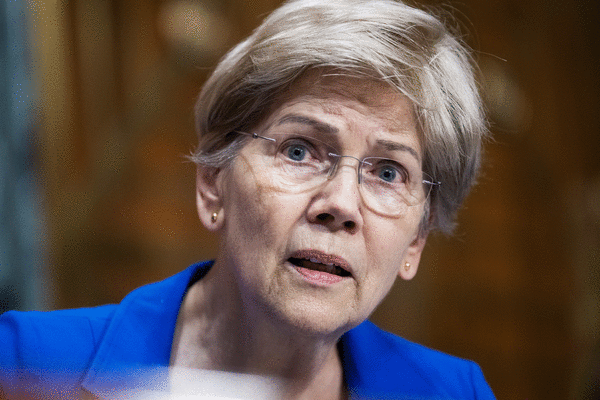
Trades on April 7 were among those flagged in a letter Senator Elizabeth Warren sent the Commodity Futures Trading Commission asking for an investigation. Around 3:45 p.m. that afternoon in New York, traders moved more than 15 million barrels of Brent and West Texas Intermediate contracts in two minutes, worth about $1.7 billion. U.S. and European stock-index futures saw a similar surge in the same window.
Roughly three hours later, Trump posted on Truth Social that he was announcing a two-week ceasefire. When markets reopened, WTI oil fell more than 15% and equities rose more than 2.5% in early trading. In theory, an investor who shorted $1 million worth of oil futures during the spike in trading that afternoon could have made nearly $170,000 by taking profit after Trump announced a ceasefire that evening.
Previously, on March 23, 16 minutes before Trump posted on Truth Social that the U.S. would postpone strikes against Iranian energy infrastructure for five days, billions of dollars in oil and stock-market futures changed hands. In the two minutes from 6:49 a.m. in New York, contracts traded representing at least 6 million barrels of Brent and West Texas Intermediate, according to exchange data compiled by Bloomberg.
About 6,000 US stock-index futures contracts traded in the same window, worth more than $2 billion. After Trump’s post went up at 7:05 a.m., Brent fell about 15% and U.S. stocks rose nearly 4% from their session lows to intraday highs.
Prominent Democratic lawmakers and other critics contend some of the recent, profitable trades seem almost too perfect to be based on skill or luck alone. Amid mounting political pressure, the CFTC has opened a probe for signs of insider trading.
In the latest flash point, Representative Ritchie Torres on Wednesday asked the CFTC to expand its probe to “suspicious” trading in oil futures ahead of Trump’s declaration of a ceasefire extension this week.
“This episode is not an isolated occurrence,” he wrote. “Rather, it is part of a broader and deeply concerning pattern.” The CFTC, which previously declined to comment on the probe, didn’t respond to questions about it on Thursday.
No evidence has emerged that White House staff have profited off insider trading. But officials recently sent a staff-wide email warning employees against using confidential information to place trades.
“All federal employees are subject to government ethics guidelines that prohibit the use of nonpublic information for financial benefit,” Davis Ingle, a White House spokesman, said in a statement on Thursday. “However, any implication that administration officials are engaged in such activity without evidence is baseless and irresponsible reporting. The CFTC will always uphold its duty to monitor fraud, manipulation, and illicit activity daily.”
CME Group Inc. and Intercontinental Exchange Inc., which run the platforms where major oil futures trade, declined to comment.
To be sure, concerns over possible insider trading on government information have swirled in other administrations, including during Trump’s first term.
In 2019, the CFTC dug into the question of whether government leaks were fueling big profits in the futures market after a controversial Vanity Fair article suggested investors made billions of dollars trading ahead of market-moving news. That probe didn’t result in an enforcement action.
Aitan Goelman, former CFTC enforcement director who’s now a partner at law firm Zuckerman Spaeder, said the derivatives regulator has plenty of power to investigate. However, he said that punishing someone determined to be behind a suspicious trade is trickier.
Derivatives rules make it “more complicated than it is on the securities side,” he said.
The CFTC’s main authority to root out insider trading based on information from government sources is also relatively new. Concern that futures traders might be profiting from inside information prompted lawmakers to include a provision known as the Eddie Murphy rule in the 2010 Dodd-Frank Act.
The regulation made it illegal for investors in the commodities market to engage in the type of scheme depicted in the famed 1980s movie “Trading Places,” in which characters played by Murphy and Dan Aykroyd used a leaked government crop report to make millions betting on orange juice futures.
As the CFTC digs in and debates rage online over whether some trades are being driven by inside information, markets beyond crude also continue to swing.
Even before the Iran war, there were whispers in Washington about whether people could be wagering with inside information about next moves by Trump or those of his administration. Trades just before Trump’s “Liberation Day” tariff pause announcement in April 2025 and prediction market bets on the ouster of Venezuelan leader Nicolás Maduro drew speculation.
Bets on world events are ballooning on prediction markets. On Polymarket, the geopolitics category is fast becoming one of the most popular on the platform. Bettors placed a record $560 million in wagers on the category in the week ending April 6, up from about $100 million in the first week of the year, according to user-compiled data on Dune Analytics.
Unlike the crowded oil futures trades, prediction markets can be relatively sparse — making it easier to move a market. That dynamic was on display in January when a single trader on Polymarket made nearly $400,000 betting on the capture of Maduro, with the biggest trades placed just before Trump publicly announced the military operation.
The Maduro episode also ricocheted into other bets on geopolitics. At the time, wagers on Ayatollah Ali Khamenei being removed from power in Iran by this summer rose sharply. He was killed in the opening hours of the war.
In March, Polymarket announced “enhanced market integrity rules” specifying three types of insider trading conduct that are prohibited: transacting on stolen confidential information, illegal tips, or betting by those in a position to influence the outcome of an event. The firm also said all types of fraud and market manipulation are prohibited.
Market integrity questions on prediction markets extend beyond conflict bets. Kalshi said Wednesday it had suspended and fined three congressional candidates for “political insider trading” on bets tied to their own campaigns. The firm had no additional comment on Thursday. Kalshi lays out insider trading prohibitions on its website and in March also said it was taking additional steps to prevent it.
More bets on politics and global events are coming. So are more questions about how the people behind them are getting them right.
_____
(With assistance from Devika Krishna Kumar, Courtney Subramanian, Ben Bartenstein, Isis Almeida, Alex McIntyre, Megan Howard and Mia Gindis.)
_____
©2026 Bloomberg L.P. Visit bloomberg.com. Distributed by Tribune Content Agency, LLC.

















































Comments