Supreme Court hears arguments on US power to strip green cards
Published in Political News
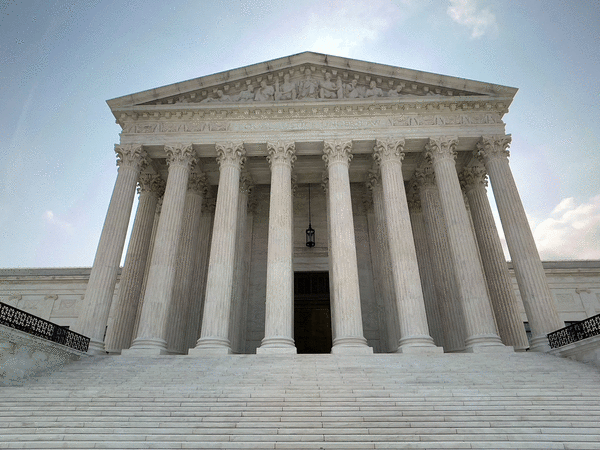
WASHINGTON — Supreme Court justices grappled over a president’s power over immigration enforcement Wednesday during oral arguments over a technical challenge to the government’s ability to take away someone’s green card as they enter the country.
Over the course of more than an hour of oral arguments, the justices delved into what checks or reviews, if any, immigration officers would have on the power to take away the more permanent green cards and instead admit those immigrants into the country with the temporary status of parole.
Sopan Joshi, assistant solicitor general, argued federal immigration officials should not have to meet a high standard like “clear and convincing evidence” to do so. Joshi pointed out that in the legal challenge before the justices, an immigration official found on a database that the immigrant had been indicted on a criminal charge.
Justice Ketanji Brown Jackson pointed out that allowing unchecked ability to admit green card holders through parole would create an incentive to single out immigrants, who find it harder to travel and retain work on parole.
A motivated administration “could use this kind of thing to inappropriately parole people rather than admit them, so that it depresses immigration,” Jackson said.
Joshi responded that the justices should not assume that government officials would act in bad faith.
Justice Samuel A. Alito Jr. called Jackson’s concern a “conspiracy theory,” and pointed out that the decision to grant the immigrant parole in the current case was based on a state criminal charge in a federal database.
“That’s not what we have here, we have a criminal charge, the immigration officer did not make that up,” Alito said.
Both sides said that under federal immigration law, Lawful Permanent Residents, or green card holders, are presumed to be able to enter the country. But there are certain exceptions, such as when the immigrant has “committed” certain offenses, or admits to them, within five years of receiving the green card.
The decision to revoke the green card and place the immigrant on parole can be reviewed later as part of a removal proceeding, the parties said.
The case started when Muk Choi Lau, a green card holder, was indicted on a counterfeiting charge in New Jersey in 2012 and then left the United States. On his return to the United States, immigration officials took away his green card and paroled him into the country.
Lau challenged the decision to give him parole and won at both at a federal trial court and U.S. Court of Appeals for the Second Circuit. At the lower courts, they found the decision to admit Lau under parole was improper and that immigration officials did not have “clear and convincing” evidence of Lau’s conduct based on the indictment alone.
Later in the arguments Alito also pressed Lau’s attorney, Shay Dvoretzky, about whether he believed the “conspiracy theory” about mass parole for green card holders.
Dvoretzky said it was not a theory but a “logical consequence” of the government’s ability to revoke green cards in favor of parole without any checks.
“I think it is a very real risk that if the court rules in favor of the government in this case and gives the government that power, that the power may be used for all it’s worth,” Dvoretzky said.
Dvoretzky said the justices should not issue a far-reaching ruling in the case, as the government’s position had changed and both sides had not taken specific positions about what level of proof should apply at the border.
Justice Amy Coney Barrett said that a ruling against Lau would “actually be more favorable” to green card holders.
Barrett said requiring a high standard of proof to parole someone into the country would “gut” the exception or incentivize a system where the administration detains all green card holders to investigate whether the exceptions apply.
The justices will likely issue a decision in the case before the close of the court’s current term at the end of June.
The case is Todd Blanche, Acting Attorney General v. Muk Choi Lau.
_____
©2026 CQ-Roll Call, Inc., All Rights Reserved. Visit cqrollcall.com. Distributed by Tribune Content Agency, LLC.





















































Comments