Future for voter ID bill unclear in Senate
Published in Political News
WASHINGTON — Five weeks ago, Senate Republicans said they were bracing for an extended fight as they kicked off debate on their marquee election overhaul bill. Now, they have quietly set aside what’s known as the SAVE America Act.
The question is: For how long? And is there an appetite to return to debating a bill that currently doesn’t have a chance for passage?
It’s unclear what the future looks like for the legislation, which would require proof of citizenship to register to vote and photo ID at the polls. Republicans haven’t garnered the Democratic support they would need for passage under the chamber’s 60-vote threshold. Nor has the “extended floor debate” changed the minds of most Senate Republicans when it comes to blowing up the chamber’s rules on the filibuster to lower that threshold to 51.
The Senate had planned to stay on the legislation, but new priorities with impending deadlines sucked much of the oxygen away from it once they returned last week from their spring recess.
And for the moment, it has essentially been abandoned.
On Monday, Senate Majority Leader John Thune told reporters they would “pivot off” the bill to focus on their budget reconciliation measure to fund Department of Homeland Security immigration enforcement, along with other “pressing issues” like renewing Section 702 of the Foreign Intelligence Surveillance Act before its new deadline next week.
On Tuesday, the Senate agreed 52-46 on a motion to proceed to the budget resolution that would allow for a reconciliation bill.
“If we don’t have other pressing stuff in front of us that has to get done and has a short timeline associated with it, then we’ll see about getting back” to it, Thune, R-S.D., said.
Democrats and voter advocacy groups on Tuesday were already claiming victory. The Campaign Legal Center said the Senate had “stopped debate” on the bill and that “this development means the legislation has effectively stalled out and failed in the Senate, amidst opposition from lawmakers on both sides of the aisle.”
The debate on the election bill was not the splashy “talking filibuster” that many on the Hill and in the White House had pushed for. Senate leadership resisted pursuing that strategy because of the burden it would put on majority members to maintain a quorum throughout.
Sen. Josh Hawley, R-Mo., said the legislation is “not going to pass unless we force the Democrats to actually hold the floor, which is what I would do.”
Hawley also said there isn’t enough support widely to abolish the filibuster. “There is a majority of my colleagues who would like to do that. Are there 51? I don’t think there are,” he conceded.
And what’s transpired on the Senate floor hasn’t been close to the 24/7 full-court press that influencers on the right had called for or that Republican members of the House wanted.
There were several days when no Republican senator spoke about the issue on the Senate floor. Even a rare weekend session last month focused on the legislation was a dud, with most senators not hanging around for the debate.
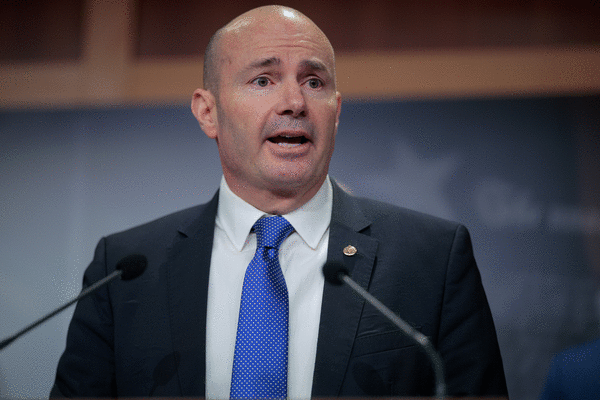
Even Sen. Mike Lee, R-Utah, who has been leading the charge for a talking filibuster on the bill, has not spoken on the topic on the Senate floor since before the chamber left for a recess, when he addressed his colleagues for two hours on the topic.
Republican senators argued the exercise was still successful.
Sen. Ron Johnson, R-Wis., who supports ending the filibuster, said he believes “having it on the floor was valuable. I think we showed Democrats are complete hypocrites. They said they’re for voter ID, and then they voted against it. So, useful exercise.”
“But again, the real truth of matters, in order to actually pass it, we have to limit the filibuster,” Johnson said.
Sen. Mike Rounds, R-S.D., said “we picked up some really good opportunities to put Democrats in unfavorable positions with regard to women or men and women’s sports and so forth,” referring to President Donald Trump’s push to tack unrelated legislation on the voter ID bill targeting transgender Americans.
“We think this has been a successful approach, just by putting them in an uncomfortable position,” he said.
But their colleagues across the building aren’t enthused, and are re-upping their threats to try to derail other legislation unless the Senate moves SAVE in some capacity.
Rep. Anna Paulina Luna, R-Fla., has repeatedly threatened to tank FISA, for example, unless the voter ID bill is attached.
“Thune, I know you don’t like me for saying this, John, but this is literally your call,” Luna said. “You’re literally blocking this. … We’re not going to vote for FISA unless [voter ID] is contained in it.”
Reconciliation rehash
Some Republican senators are eyeing the possibility of pursuing a second reconciliation package this year to which they could add some election provisions.
But that plan comes with caveats; budget experts say the effort faces long odds because of the Senate’s “Byrd rule,” which bars provisions from reconciliation legislation that are “extraneous.”
Sen. John Hoeven, R-N.D., said “we’ll look and see if there’s things that we can do as far as [another] reconciliation with SAVE America.”
Johnson said Congress “could” pursue aspects of the bill, like offering state’s “financial inducements.” But “not the full SAVE AMERICA Act. It wouldn’t pass the Byrd bath.”
Some lawmakers wanted Thune to tack voter ID bill provisions onto the reconciliation measure the Senate is currently trying to move. But leadership has fought to keep the bill narrow to move quickly and help fund DHS, which has been shut down for roughly 10 weeks. The reconciliation effort currently being considered aims to provide up to $70 billion in funding to sustain the immigration agencies for at least the next three years.
“Do you want to pass elements of the SAVE America Act using funds and conditioning federal funds? Great. We can do that,” Sen. Ted Cruz, R-Texas, told CNBC on Tuesday. “Right now, Republican leadership’s plan is, let’s do nothing else besides ICE and CBP, because apparently we don’t want to accomplish more.”
Sen. Susan Collins, R-Maine, who was considered a crucial “yea” during March’s procedural vote to kick off SAVE debate, said Tuesday of whether she’d like to return to the bill: “There’s a lot for us to do and to prioritize. That’s really up to the leader.”
©2026 CQ-Roll Call, Inc., All Rights Reserved. Visit cqrollcall.com. Distributed by Tribune Content Agency, LLC.





















































Comments