Conservative Alaska lawmaker tells GOP to stop 'political games' after being criticized for voting bill
Published in Political News
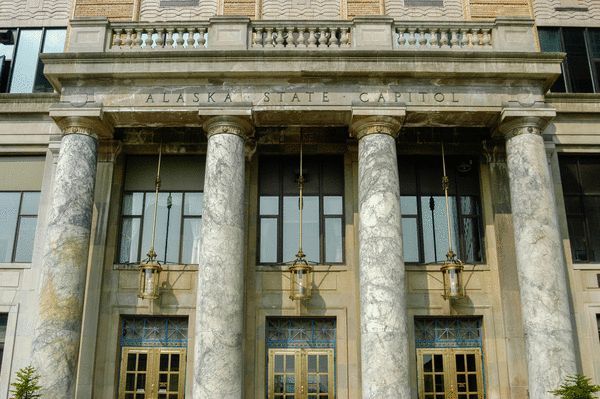
ANCHORAGE, Alaska — A Republican lawmaker is urging Gov. Mike Dunleavy not to veto a bill updating Alaska’s voting and election laws.
Dunleavy has until the end of the month to decide whether to sign or veto Senate Bill 64, which would create a ballot curing process that allows voters to fix minor mistakes on their ballots; allow the Division of Elections to more easily remove inactive voters from the state’s rolls; create a ballot tracking system; and create a rural community liaison position in the Division of Elections, among numerous other changes.
The broad legislation — which includes priorities of both Democrats and Republicans — passed the Legislature last month with support from all members of the House and Senate majority caucuses. Three Republican House minority members also voted in favor of the bill, including Rep. Sarah Vance, a Homer Republican from the House minority who worked with Anchorage Democratic Sen. Bill Wielechowski to draft the final version of the bill.
Since then, Vance has faced criticism from Alaska GOP insiders for working across the political aisle to shepherd the long-sought bill to passage. In response, Vance last week posted a video on social media blasting the Alaska Republican Party.
“To the Republican Party: You need to do some soul-searching. Because you wonder and you ask yourself why people aren’t joining the party, why they aren’t counting the cost and running for office — good people like me — it’s because of these political games,” Vance said in a Facebook video posted Wednesday.
The video was responding to comments from Alaska conservative writer Suzanne Downing, who called the voting bill a “legislative demon child” and called on Dunleavy to veto it, reasoning that the improvements it aims to make to voting access in rural Alaska, where polling places regularly fail to open on Election Day, will disproportionately benefit Democrats.
Vance responded by pointing out that several of the provisions included in the final bill were part of a piece of legislation that the Dunleavy administration put forward in 2022. Dunleavy’s bill, which was crafted by then-Lt. Gov. Kevin Meyer, sought to allow the Division of Elections to more regularly remove voters from the state rolls, create a ballot tracking system and allow ballot curing — all provisions that were included in this year’s Senate Bill 64.
But Dunleavy’s bill also would have eliminated a voter-approved mechanism for automatic voter registration through the Permanent Fund dividend application. Some Republicans have long sought to repeal the automatic voter registration process, despite the fact that it was adopted through a popular ballot measure in 2016.
Despite the differences between the bills, Vance said that “if the governor vetoes Senate Bill 64, he will essentially be vetoing his own election bill.”
Vance said Monday that she spoke with Dunleavy over the weekend, and he told her “he was going to do what’s best for Alaskans.”
Dunleavy spokesperson Jeff Turner declined to provide additional information on whether Dunleavy would allow the bill to become law.
Debate on the fate of the bill is tied in part to the Alaska Republican Party’s opposition to the state’s voter-approved election system, which includes open, nonpartisan primaries and top-four ranked choice general elections.
Leaders in the Republican Party have been closely involved in an effort to repeal Alaska’s voting system through a ballot measure that would revert the state to party-run primaries and pick-one general elections.
Senate Bill 64 makes no changes to Alaska’s voting method, which is broadly supported by many in the Legislature.
Downing wrote on her political website that improving election access for rural voters would “cement” ranked choice voting in place by improving voting access for rural Alaskans, who broadly support the open primary system.
It’s not the first time that Republican leaders have openly talked about thwarting improvements to voting access in an effort to tilt election results in favor of the GOP. In 2024, then-House Speaker Cathy Tilton, who now serves in the state Senate, said in an interview that her caucus blocked the passage of an election reform bill because it would have favored Mary Peltola, the Democratic incumbent in that year’s U.S. House race.
Vance said in her social media video that Downing’s claims about rural voting made her “sound discriminatory.”
“That, to me, is egregious, because every voice in Alaska matters and every vote should count, even if it’s not for me,” Vance said.
If Dunleavy vetoes the election bill, lawmakers are set to vote on overriding his veto, which would require support from two-thirds of lawmakers.
An override is “achievable, because this bill is based on sound policy. It should not be partisan,” said Vance.
_____
©2026 Anchorage Daily News. Visit at adn.com. Distributed by Tribune Content Agency, LLC.

















































Comments