RFK Jr. says vaccine might have stopped child measles death
Published in Political News
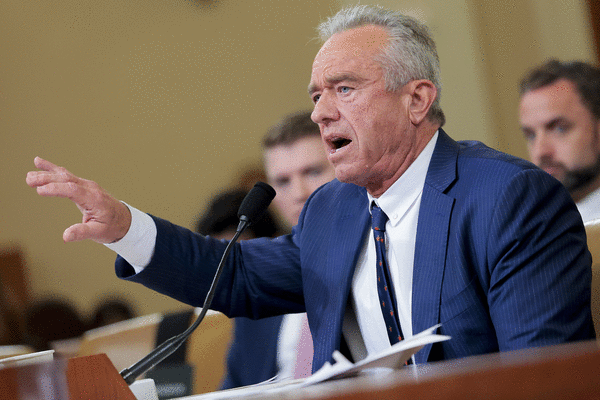
WASHINGTON — U.S. Health and Human Services Secretary Robert F. Kennedy Jr. acknowledged that vaccination may have saved the 6-year-old Texas child who died from measles last year, even as he defended the Trump administration’s controversial policies at a hearing on Capitol Hill Thursday.
Kennedy’s questioning before the House Ways and Means Committee forced the nation’s top health leader to discuss immunizations, even after the administration issued a directive to avoid talking about the changes that are deeply unpopular with the American public. It was the first in a series of seven annual budget hearings Kennedy faces.
The Health Secretary was also asked difficult questions about his stewardship of the department at a separate hearing later in the day in front of a House Appropriations Committee subcommittee. Agencies under his purview, such the Centers for Disease Control and Prevention and the Food and Drug Administration, have faced severe staff cuts and frequent shakeups among the top leadership.
The CDC only had a formal leader for 29 days before she was fired by Kennedy. Separately on Thursday, the White House named Erica Schwartz, a U.S. deputy surgeon general during the first Trump administration, to run the agency. She will need to be confirmed by the Senate, though she’s seen as a more conventional pick for the role.
Kennedy also said HHS will be rebuilding its workforce with a “better group of people who are actually going to address chronic health” after thousands were fired by DOGE. Last year, HHS went to 62,000 employees from 82,000, according to the secretary. It’s since hired 10,000 and will add 12,000 more.
Vaccine challenges
While Kennedy’s remit is touting President Donald Trump’s budget priorities — like the creation of the Administration for a Healthy America — his rhetoric on immunization policy in the past year has drawn heavy scrutiny. In an exchange with Representative Linda Sánchez, a California Democrat, he acknowledged the possibility that the first U.S. measles death in more than a decade may have been averted by vaccination.
“Do you agree with the majority of doctors that the measles vaccine could have saved that child’s life?” Sánchez asked.
“It’s possible, certainly,” Kennedy responded.
The two also sparred over how the U.S. has fared in addressing the recent record-breaking measles outbreak. Sánchez argued the country has faced a dramatic increase during the second Trump administration, while Kennedy said other countries like Mexico are experiencing more infections.
In a later hearing, Representative Madeleine Dean, a Pennsylvania Democrat, asked Kennedy whether he believed the measles vaccine is safe and effective. “Yes, it’s safe for most people,” he said and agreed with her assertion that getting the measles vaccine is safer than getting measles.
While questions about immunizations drew the most contentious exchanges during the hearings, they weren’t common. The discussion focused mainly on medical fraud and abuse, allowing Kennedy a reprieve from immunization issues that the Trump administration is looking to avoid.
Staying on message
An internal memo from earlier this year directed HHS officials to focus on popular policies ahead of the midterm elections, including drug pricing and promoting healthy eating. Implicit was a directive to avoid what isn’t popular: Kennedy’s crusade to remake existing vaccine policy. In public appearances since the memo was issued, Kennedy has successfully avoided the subject.
In his opening statement, Kennedy stayed on message — listing off his department’s actions on health care pricing and food policy, and highlighting funding for rural health programs. He also acknowledged the backlash to his tenure with a quote from his uncle, former President John F. Kennedy, about change having enemies.
“We see those forces clearly — entrenched interests, defenders of a failing status quo, and institutions that put profit ahead of the American people,” Kennedy’s statement said. “That resistance underscores the urgency of this moment.”
Thursday’s hearings are Kennedy’s first congressional appearances since a Senate hearing in September that devolved into a heated confrontation over his vaccine policy changes and his firing of the CDC director. For months, he struggled find a new leader for the agency, changed the childhood immunization schedule and had his overhaul efforts paused by the courts.
Still, Kennedy has been working behind the scenes to continue the push. Last week, he revamped the charter for a key federal immunization committee to sidestep the federal judge’s ruling and moved to add non-voting members to the advisory group from organizations that are critical of vaccinations.
Hepatitis B
Other immunization topics also emerged during the hearings. Representative Judy Chu, a California Democrat, called out Kennedy’s changes to the hepatitis B shot for infants, which protects from a viral infection that can lead to liver cancer. The health secretary’s revamped vaccine committee voted to remove the universal recommendation for newborns in December.
Kennedy defended the move, saying the shot is still covered by insurance and claimed there was no safety study conducted for the shot. The CDC says the hepatitis B vaccine has been extensively studied for safety and no “serious health problems” have been linked.
Kennedy has long railed against immunizations. He previously led Children’s Health Defense, a nonprofit group that opposes them, and filed lawsuits — including some that are still pending — against the government for vaccine injuries. In the past year, he purged the advisory committee and reconstituted it with members that included vaccine critics. He then bypassed it to pare down the number of diseases covered by the childhood vaccine schedule.
Both actions were challenged in court by state attorneys general and leading medical organizations. In March, a federal judge ruled that Kennedy’s actions were outside of the legal bureaucratic process. The Trump administration has yet to appeal, but is still within its 60-day window to file.
The Trump administration’s current budget proposal allocates around $111 billion in funding to HHS, a $15.8 billion reduction from the 2026 allocated level. HHS, which is responsible for the Medicare insurance program for the elderly, typically has the largest budget of any federal department. The CDC and NIH would take the brunt of the cuts.
The administration is also trying to revive the Administration for a Healthy America — Kennedy’s pet project — by allocating at least $17.5 billion to the new organization that would focus on chronic disease. Last year’s budget included the creation of the so-called “AHA,” but it was denied by Congress, as were proposed deep cuts to the National Institutes of Health.
_____
(With assistance from Annika Inampudi.)
_____
©2026 Bloomberg L.P. Visit bloomberg.com. Distributed by Tribune Content Agency, LLC.
















































Comments