At L.A. 'shadow hearing' on elections, House Democrats join experts to defend voting systems
Published in Political News
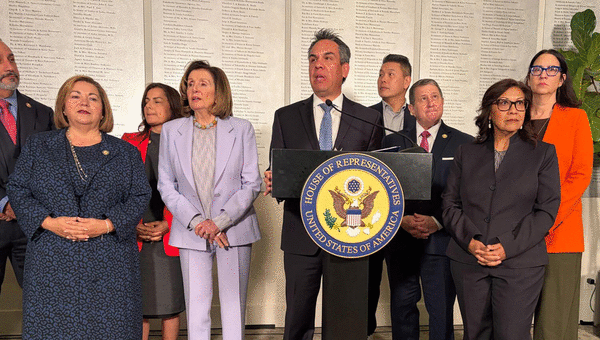
LOS ANGELES — House Democrats and a panel of elections experts expressed unwavering confidence in state voting systems and dismissed Trump administration claims of widespread fraud and other vulnerabilities during a special "shadow hearing" in Los Angeles on Tuesday.
They accused President Trump and his Republican allies of pushing sweeping federal reforms — including stricter voter ID laws and new restrictions on voting by mail — that would disenfranchise millions of eligible Americans, especially low-income, rural and elderly voters, as well as voters of color and those with disabilities.
"They are taking us backward, and not to a good place," said Rep. Nancy Pelosi (D-San Francisco), who helped lead the hearing at the Daniel K. Inouye National Center for the Preservation of Democracy in Little Tokyo.
They also stressed that they and their allies were working hard to prevent such backsliding.
"While Republicans are expecting Democrats to just sit idly by as they attempt to steal yet another election, Democrats are getting out in the community, raising the alarm bells about the GOP's efforts to rig these elections and fighting back in the courts, in Congress and in our communities," said Rep. Pete Aguilar (D-Redlands), chair of the Democratic Caucus. "We won't let Republicans get away with their anti-democratic and un-American schemes."
Such "shadow hearings" allow Democrats to highlight issues their majority-Republican counterparts won't schedule for formal hearings in Washington. This week's discussions — a second is scheduled Thursday in San Francisco — follow others in California in recent months, including on Trump's immigration raids.
Pelosi, the former House speaker, led the hearing alongside Aguilar and Rep. Joseph Morelle of New York, the ranking Democrat on the House Administration Committee, which has oversight of elections. Joining them were fellow Democratic Reps. Nanette Barragán of San Pedro, Judy Chu of Monterey Park, Gil Cisneros of Covina, Laura Friedman of Glendale, Luz Rivas of North Hollywood, Linda Sánchez of Whittier, Norma Torres of Pomona and Maxine Waters of L.A.
Pelosi noted the setting on the grounds of the Japanese American National Museum, where Japanese Americans were detained before being unconstitutionally stripped of their belongings and taken to internment camps during World War II.
"To be here on a day when the president of the United States has talked about destroying the civilization of a country is so appalling. It's so appalling, and I don't think we can ignore comments like that, especially in a setting like this," Pelosi said.
She also said that securing the nation's elections against Trump's threats and getting out the Democratic vote was the surest way of restoring order to U.S. relations abroad — and far more likely than getting Trump's Cabinet to remove him from office by invoking the 25th Amendment.
"We have to make sure that the mentality that would obliterate a civilization, undermine a democracy by fighting free and fair elections, just cannot prevail," she said.
The hearings were designed to challenge a narrative Trump has pushed for years — that U.S. elections are badly compromised by widespread fraud, that mail ballots such as those used in California are a particularly large source of abuse, and that noncitizens are voting in large numbers — none of which he has supported with evidence.
Trump tried unsuccessfully to challenge his 2020 loss to Joe Biden using similar arguments. When he returned to the White House, he immediately directed his administration to pursue the claims anew, including under executive orders he issued asserting new and sweeping federal authority over elections, which by law are controlled by the states.
The Justice Department in September sued California and other states for their voter rolls, which courts rejected. The FBI in January raided and seized 2020 election records from an elections office in Fulton County, Ga., where Trump rejected 2020 results. Trump in February said Republicans "ought to nationalize the voting." Last week, he issued an executive order purporting to give federal agencies control over ballot processing by the U.S. Postal Service, which followed a previous order seeking to place new federal requirements on voter identification and proof of citizenship.
Trump has said his efforts are "common sense" steps average Americans support to secure elections against noncitizens voting and other threats.
Experts who provided testimony at Tuesday's hearing roundly rejected that argument, saying the measures address problems that don't existand are more geared toward securing wins for Republicans than ensuring election safety.
Jenny Farrell, executive director of the League of Women Voters of California, said that Americans are "more likely to be struck by lightning" than to commit voter fraud, and that many recent proposals framed around election integrity are really designed to narrow access to voting for certain groups. She also said California's elections are particularly strong.
"We're like the Dodgers of elections," she said.
Darius Kemp, executive director of Common Cause California, said the state's elections "are safe and secure," and the Trump administration is threatening democratic participation in novel and alarming ways that his organization is watching carefully.
Justin Levitt, a Loyola Law School professor, said Trump is trying to project power over elections "that he simply does not have," and if local and state officials, the courts and pro-democracy groups stand their ground, he will fail.
"If we keep calm and carry on, we can make our voices heard loud and clear," he said.
Hector Villagra, vice president of policy advocacy and community education at MALDEF, or the Mexican American Legal Defense and Educational Fund, said "the evidence could not be more clear — noncitizen voting is exceedingly rare," and Trump's proposals would simply "raise the cost of lawful voting" for groups already underrepresented at the polls.
"The question is not whether we can verify eligibility. We already do that," he said. "The question is whether we will impose new barriers that will prevent eligible citizens from participating at all."
Sonni Waknin, senior staff attorney at the UCLA Voting Rights Project, said "democracy is under attack" across the nation, and that the photo identification requirement Trump and other Republicans are pushing would disenfranchise a million eligible voters in California alone.
When Cisneros asked about what could be done to prepare for the inevitable claims of fraud from Trump and other Republicans after the midterms, Levitt said that such claims must be called out for what they are.
"We call those lies, because they are lies," he said.
When Waters asked the experts about the effect of federal immigration agents being deployed to polling places, as some in Trump's orbit have suggested, Villagra said damage was already being done just from the rumors of such action — whether agents show up or not.
"It's the threat that's really what's powerful here," he said, as people — especially Latino voters — are already intimidated, and leaders should do more to reassure voters and offer alternatives to showing up to polls, such as voting by mail.
©2026 Los Angeles Times. Visit at latimes.com. Distributed by Tribune Content Agency, LLC.


















































Comments