Editorial: Special-election flips are a sign of hope for Democrats
Published in Political News
It’s too early to say whether two major special-election upsets — the narrow defeat of a highly-favored Republican in a Tampa Bay based Senate seat, and a Democrat’s victory in a South Palm Beach County House district — are anything more than a continuation of the fact that Democrats tend to do better in special elections.
But these two races — along with 28 other Democratic “flips” of GOP-held state legislative seats across the nation in less than two years — can be seen as a triumph of hope over despair. (Over the same period of time, there have been no GOP conversions of Democratic seats.) This looks like a recognition that one-party government has warped itself out of step with the American way of life, and that American voters recognize that. Most of all, they should be rays of hope for Floridians who demand substance and solutions from their leaders, not self-promotion and showmanship.
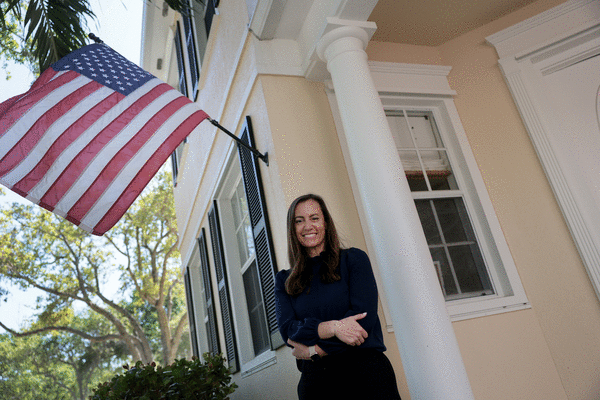
In the South Florida race, Emily Gregory sent shock waves through Florida politics, defeating Republican Jon Maples in House District 87, a coastal area running from Lake Worth Beach to Jupiter. The district includes Mar-a-Lago, adding rich partisan symbolism — a victory by an underdog Democrat in Donald Trump’s backyard.
Meanwhile, what was meant to be a smoothly gliding two-step replacement for former state Sen. Jay Collins — appointed last August to the lieutenant governor vacancy by Gov. Ron DeSantis — turned into a jaw-dropper. State Rep. Josie Tomkow, R-Polk City, lost the Tampa-area seat by a narrow margin to Democrat Brian Nathan, despite holding major advantages, including a campaign war chest that dwarfed Nathan’s (though both were well-funded enough to get their message out).
At 30, Tomkow has been considered a rising star in the GOP, but that status will likely be re-evaluated after her loss in a district that Collins won by a 10% margin in 2022. Republicans should look deeper than that, however.
The GOP managed to hold on to the House District 51 seat Tomkow vacated, with former legislative aide Hilary Holley (like Tomkow, a scion of a Polk County farming family) defeating a Haines City Democrat, Edwin Perez. But Holley’s 54% victory was not as resounding as the 57% of the vote that Tomkow landed in 2024.
Put the two Central Florida races together, and it refutes the narrative that Democrats can take special elections through intense fundraising and focus. Both Perez and Nathan were obviously saying things voters wanted to hear about the increasing unaffordability of life in Florida, and GOP failures to address priorities like property insurance.. But Nathan had enough money to ensure that his message was heard, and Perez didn’t.
The same dynamic seemed to be at work in the Palm Beach-anchored House race. It might never have happened, but for the fact that Gregory filed a lawsuit last year to force Gov. Ron DeSantis to call a special election.
Like the Tampa Bay Senate seat, this one looked like an easy GOP win. Trump carried this district by 11 percentage points in 2024. The district’s former representative, Republican Mike Caruso, coasted to 20-point back-to-back victories in 2022 and 2024 against a weak Democrat.
By the looks of it, Gregory outworked her opponent, emphasizing kitchen table issues like the cost of property insurance — and voters took notice.
“I just bet on my community — that my neighbors want a fair kind of Florida that really works for all of us,” Gregory told the Sun Sentinel Editorial Board Wednesday. “I’m really humbled, and I feel so honored.”
The many Republican denials notwithstanding, something unusual is surely happening in Florida. People are demanding change — and in this case, they got it.
Maples had far more money than Gregory. He highlighted Trump’s endorsement. Maples previously held public office in Lake Clarke Shores. Gregory was a first-time candidate who started out with zero name recognition.
The turnout of 29% was extremely high for a special election, which was held at an odd time, two weeks after several towns in the district held municipal elections.
Republicans were probably comforting themselves Wednesday morning by recalling the brief legislative career of former state Rep. Tom Keen. The Orlando Democrat pulled off an upset in a Jan. 2024 special election in House District 35, which covers parts of Orange and Osceola counties, only to lose the same seat to the same opponent (Erika Booth, a former School Board member) in November of that year. It’s true that Democrats have a much stronger track record in special elections, but in this case there’s reason to look more deeply into what happened — particularly in Tomkow’s old House seat. By any rational expectation, Holley should have smashed Perez to smithereens: She raised more than $250,000 in cash and in-kind contributions, while Perez had less than $17,000, including a $2,000 loan from himself.
The two victories gave Democrats a strong jolt of confidence heading into the midterm elections. She won by a narrow margin — two percentage points — but pulled it off in deep-red Republican territory, so she obviously had Republican support, and that should send shock waves through Mar-a-Lago and the MAGA base.
There’s one more startling fact to consider. In all three districts, far more Republicans than Democrats voted. There will surely be deeper analysis of this race, but there’s certainly reason to think that a shift ight already be underway in Florida politics.
Gregory and Nathan will be treated like folk heroes when they join their colleagues for anticipated special session. With good reason — they accomplished what many thought was absolutely impossible.
“Change is coming,” Gregory told reporters on a Zoom call Wednesday. “And we deserve it.”
For Democrats, and for everyone desperate for a new direction for Florida and America, these victories — along with the other Democratic pickups — send a powerful message all over the country, but especially in Trump’s backyard. The question is whether he’s listening.
____
The Orlando Sentinel Editorial Board includes Executive Editor Roger Simmons, Opinion Editor Krys Fluker and Viewpoints Editor Jay Reddick. The Sun Sentinel Editorial Board consists of Executive Editor Gretchen Day-Bryant, Editorial Page Editor Steve Bousquet, Deputy Editorial Page Editor Dan Sweeney and editorial writers Pat Beall and Martin Dyckman. Send letters to insight@orlandosentinel.com.
©2026 Orlando Sentinel. Visit at orlandosentinel.com. Distributed by Tribune Content Agency, LLC.





















































Comments