Supreme Court sounds ready to limit counts of late-arriving ballots
Published in Political News
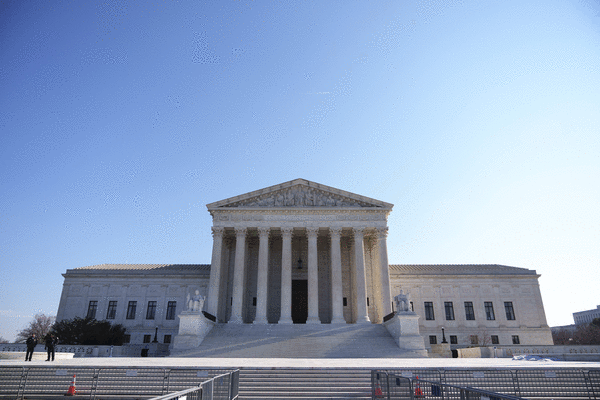
WASHINGTON — The Supreme Court appeared ready during oral arguments Monday to restrict state laws allowing the counting of late-arriving ballots, in a challenge to Mississippi’s state law on absentee ballots.
Mississippi allows state officials to count mail ballots that were postmarked on or before Election Day but arrive up to five business days late, and more than half of states count late-arriving votes in at least some circumstances.
The state in the arguments asked the justices to overturn a decision by the U.S. Court of Appeals for the 5th Circuit, which ruled that the state law violates a federal law that sets Election Day as the first Tuesday after the first Monday in November.
But a majority of the court raised concerns about what state laws that allow late-arriving ballots mean for the finality of an election. Justice Samuel A. Alito Jr. brought up concerns about the potential appearance of fraud from counting late-arriving ballots, similar to claims President Donald Trump has made without evidence on voter fraud in the 2020 election.
Alito asked whether “confidence in outcomes can be seriously undermined if the apparent outcome of the election on the day after the polls close is radically flipped by the acceptance later of a big stash of ballots that flip the election?”
Mississippi Solicitor General Scott G. Stewart responded that Congress passed the Election Day statute to address specific problems, such as staggered election dates across the country, not concerns about the appearance of fraud.
Stewart said that without specific limits on Election Day in the federal law, states should be allowed to govern their own processes to receive ballots.
“This is an area where states get to go first and make these decisions. Congress can step in,” Stewart said.
Stewart also pointed out that upholding the lower-court decision would also imperil those state laws allowing late-arriving ballots for military members and Americans overseas, which Congress has specifically allowed in another statute.
Justices Clarence Thomas, Neil M. Gorsuch and Amy Coney Barrett also pressed Stewart on whether the state law would allow late submission of ballots from neighbors, notaries or the like. Gorsuch also said that under Mississippi law, voters may be able to cancel their mail-in ballots after Election Day and alter the result.
“As soon as something is allowed it will happen eventually,” Gorsuch said.
The case began when state political parties and the Republican National Committee challenged Mississippi’s law. A federal trial judge ruled in favor of the state, but a three-judge panel of the 5th Circuit disagreed and found that federal law requires states stop accepting ballots on Election Day.
More than a dozen states have laws similar to Mississippi that allow for the counting of late-arriving ballots. More than half of states allow ballots from military members and Americans overseas to be counted late.
Paul Clement, arguing on behalf of the Republican National Committee, said that Congress never meant to allow state laws accepting late receipt of ballots. The proverbial “ballot box” is meant to close when the polls do on Election Day.
“That reality gives the lie to the idea that we have a uniform national Election Day,” Clement said.
Several justices took issue with the arguments from the Trump administration and RNC against the Mississippi statute. Chief Justice John. G. Roberts Jr. and Justice Elena Kagan both focused on the impact their position could have on early voting.
“If Election Day is the voting and taking, then it has to be that day,” Roberts said.
Kagan also pointed out that the argument from the Republicans would also preempt numerous changes to voting processes since the 1800s, including early voting and registering to vote in advance.
“I mean, once we go down this road, once we say that these statutes which don’t say anything, actually, have some significant preemptive effect, where are we going to end up?” Kagan said.
Trump has railed against the counting of late-arriving ballots since before his loss in the 2020 election and has targeted the practice anew in his second administration.
That includes an executive order to block funding to states that allow late-ballot counting, which has been blocked by the courts, and encouraging legislation in Congress to stop the practice.
Justice Ketanji Brown Jackson also pointed out that Congress has a pending bill that would specifically prohibit states from accepting late-arriving ballots. To her, that meant Congress itself may not think the current law bans the practice.
“The worry is that you want this court to decide the case rather than have Congress do it,” Jackson said to Clement.
Clement pushed back that Congress may be considering the legislation because it does not know how the justices may rule.
The justices will likely issue a decision in the case before the close of the court’s term at the end of June.
At one point in the argument, Justice Brett M. Kavanaugh questioned whether a decision would disrupt state preparations for this fall’s elections, which Clement argued it would not.
The case is Watson v. Republican National Committee et al.
_____
©2026 CQ-Roll Call, Inc., All Rights Reserved. Visit cqrollcall.com. Distributed by Tribune Content Agency, LLC.



















































Comments