Mail-in ballot deadlines put Supreme Court in 2026 election fray
Published in Political News
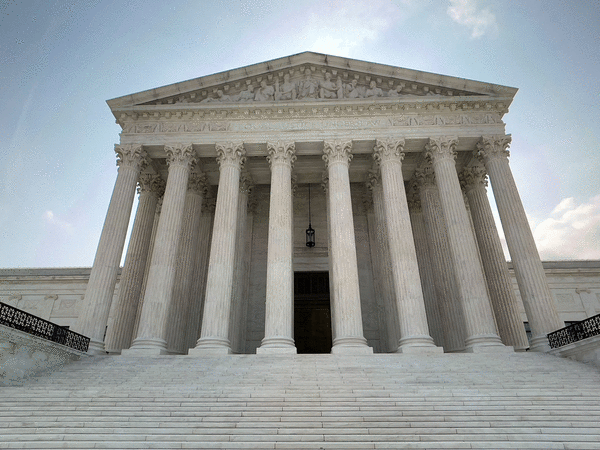
The U.S. Supreme Court will consider upending key election deadlines in as many as 29 states with a case that draws the justices into President Donald Trump’s campaign against mail-in ballots.
The justices hear arguments Monday in a Mississippi clash over laws that allow ballots to be counted even if they don’t arrive until shortly after Election Day. The Republican Party and the Trump administration say grace periods across the country are incompatible with federal law.
The dispute is part of a multipronged GOP effort to transform federal election rules in advance of a November election that could see the party lose control of Congress. Trump separately is pushing congressional Republicans to enact a sweeping law that would largely outlaw mail ballots, which he insists lead to widespread fraud despite studies and court decisions rejecting such claims.
“Mail-in ballots are corrupt,” Trump said in August. “You can never have a real democracy with mail-in ballots.”
Critics say Republicans are trying to suppress the votes of people likely to support Democrats. “They’re trying to kick out of the electorate voters who they would rather not have participate in the election,” Marc Elias, a lawyer who often represents the Democratic Party and is helping defend the Mississippi law, said in a call with reporters.
It isn’t clear how much, if at all, Republicans would be helped by a ruling that tightens deadlines for mail-in ballots given that the party increasingly depends on voters who use that option.
The rules governing mail ballots have been a recurring topic in recent elections, with Republicans generally arguing for strict deadlines and Democrats for more flexibility. Mail voting accounted for 30% of the turnout in the 2024 election, according to the U.S. Election Assistance Commission.
Mississippi was among a number of states that extended their ballot-receipt deadlines for the 2020 election, which took place during the pandemic, and the state later made the change permanent. Mississippi’s five-day rule applies as long as ballots are postmarked by Election Day.
In an unusual twist, the Supreme Court case features Republicans on both sides of the debate, with Mississippi Attorney General Lynn Fitch defending the law against arguments by the Republican National Committee, the Trump administration and the Mississippi Libertarian Party. The justices rejected Elias’ request to argue alongside Mississippi on behalf of organizations that represent military veterans and senior voters.
Mississippi is now one of 29 states, along with the District of Columbia, that allow at least some ballots to arrive after Election Day. About half of those do so only for members of the military or overseas voters, according to the National Conference of State Legislatures.
The Supreme Court clash could upend all those laws, though the Trump administration is urging the justices to rule in a way that wouldn’t affect late-arriving military and overseas ballots.
Election Day
The 5th U.S. Circuit Court of Appeals said the Mississippi grace period runs afoul of federal laws that set the Tuesday after the first Monday in November as the “day for the election.” In a first-of-its-kind ruling, the appeals court said that phrase means that ballots need to be received by that date, not simply that voters drop them in the mail by then.
Critics say a Supreme Court ruling adopting that approach could plunge states into Election Day chaos. Because such a ruling would apply only to voting for federal offices, many states could end up with different deadlines for congressional and presidential elections than for state and local races.
States would have to come up with a way to count only some votes on ballots that arrive after Election Day, says Chris Thomas, who oversaw elections in Michigan for 36 years and served twice as president of the National Association of State Election Directors. That would probably entail either doing a hand count or reprogramming vote tabulators for post-Election Day ballots, all at a time when vote-counting is already under intense partisan scrutiny, he said.
“It just adds a level of confusion at a time when basically, election officials are under a timeline crunch to get some very important, detailed work done,” Thomas said.
Supporters say any administrative difficulties could be addressed through corresponding changes in state laws – and would be offset by the public confidence that a firm deadline would foster.
“The idea that the election needs to obviously have some kind of definitive end date is a pretty powerful notion for most people, right?” said Jason Torchinsky, a Washington lawyer who often represents Republicans in election litigation. “And so this notion that Election Day is over, and it’s five days later and I’m still waiting to see how many ballots the Postal Service might return to my registrar is really a challenge.”
The clash comes as the Postal Service implements changes in its processing system that could complicate mail-in voting this year by delaying the postmarking of some items.
‘Avoid the chaos’
The Supreme Court in January ruled 7-2 that a Republican congressman had legal standing to challenge Illinois’ ballot-receipt grace period and didn’t have to first show that the rule was likely to undercut his chances of winning reelection.
The Supreme Court considered ballot-receipt deadlines in other contexts in the run-up and aftermath to the 2020 election. In an October 2020 decision involving Wisconsin, Justice Brett Kavanaugh said that states could decide whether to extend their deadlines in response to the pandemic.
“The variation in state responses reflects our constitutional system of federalism,” Kavanaugh wrote. “Different state legislatures may make different choices.”
But Kavanaugh also said states that set Election Day as the firm deadline have “important reasons” for doing so. “Those states want to avoid the chaos and suspicions of impropriety that can ensue if thousands of absentee ballots flow in after Election Day and potentially flip the results of an election,” he wrote.
The case is Watson v. Republican National Committee, 24-1260.
_____
©2026 Bloomberg L.P. Visit bloomberg.com. Distributed by Tribune Content Agency, LLC.




















































Comments