Election-law changes include a key Trump demand -- and may stop some Florida citizens from voting
Published in Political News
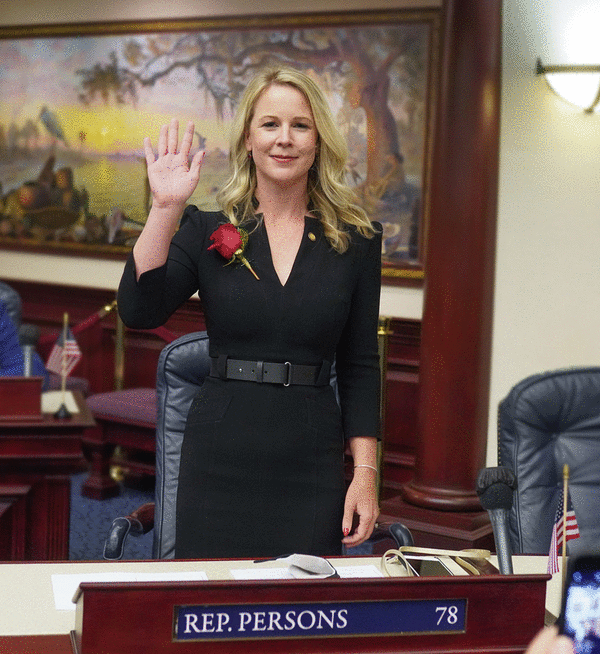
The selling point, from state Rep. Jenna Persons-Mulicka, was simple and direct.
The Fort Myers Republican told colleagues they needed to pass a suite of election-law changes — including verifying the citizenship of registered voters and reducing the kinds of ID voters could use to verify themselves at the polls — to ensure that “Florida continues to lead the nation in election integrity.”
There is another reason for the legislation — which Gov. Ron DeSantis said Friday he’s enthusiastically ready to sign into law — and which is guaranteed to face immediate court challenges. Hovering, figuratively, in the background was Florida’s most prominent resident and, perhaps, most outspoken critic of the way elections are run: President Donald Trump.
Trump’s wishes were periodically invoked during the weeks of deliberations and debate about the legislation, including by Persons-Mulicka. She cited his State of the Union address the day after. And she’s described the state bill as the Florida version of Trump’s proposed election law, the SAVE America Act.
The central element, verifying the citizenship of Florida voters, was a big Trump policy win. Still, the Florida House and Senate, which passed the measure on Thursday, didn’t go along with another major Trump goal: ending widespread voting-by-mail.
Is it needed?
DeSantis, at a Jacksonville news conference on Friday, declared that Florida is “really the envy of the nation” and “the best on election integrity.” The changes, he said, would make it even better.
Senate President Ben Albritton said Friday it was all about “wanting to make sure that the elections process in Florida is as pristine as possible, it is as accountable as possible, and that Floridian citizens are the ones doing the voting. It really is just that simple.”
Persons-Mulicka and state Sen. Erin Grall, R-Vero Beach, the sponsors of the legislation, brushed aside warnings that the legislation sounds good on the surface — after all, who opposes integrity in elections — but could snare thousands of people who are citizens and prevent them from exercising their right to vote.
“Election integrity does matter to all of us here. We all can agree on that,” state Rep. Jervonte “Tae” Edmonds, D-West Palm Beach, said during the final debate on the legislation. “But protecting elections should never come at the cost of constitutional voting rights.”
Voting rights activists said the cumulative effect of the changes could be to prevent thousands of U.S citizens living in Florida from voting, or make them jump over time-consuming, expensive hurdles to exercise their right to vote — all on the basis of scant evidence there’s a problem that needed solving.
“This bill is anti-American. It’s anti-American citizen. It’s anti-Floridian. It’s anti-senior citizen. It’s anti-student. It’s anti-rural communities. It’s sexist,” said state Sen. LaVon Bracy Davis, an Orange County Democrat. “It’s elitist,” she added, because it would disproportionately hurt people who can’t afford documents they might be told to produce.
Bracy Davis said she could get caught up because, like many other women, she added her husband’s name when she got married, and name changes are one of the areas that can trigger a review.
Opponents argued the real motivation is a desire to throw political red meat to the Republican claims that Trump lost the 2020 election because of irregularities, including non-citizens voting and fraudulent mail voting. Brad Ashwell, Florida director of the advocacy organization All Voting is Local, said it was an attempt to deal with “an imaginary problem that they’ve created.”
Citizenship
Citizenship verification, which mirrors what Trump wants on the national level, is the most prominent feature of the bill.
It would set up a system to match the state voter registration database in the Secretary of State’s office and the driver’s license database at the Department of Highway Safety and Motor Vehicles. Because the vast majority have proven their citizenship to renew their licenses as part of the federal REAL ID rules, verification likely would be invisible for most voters.
But there are some 872,000 people with licenses or state ID that are not REAL ID compliant. And others who have never had a driver’s license or state ID.
Citing research published by the Brennan Center for Justice that found more than 9% of American citizens of voting age don’t have readily available proof of citizenship, the League of Women Voters said that would work out to about 1.4 million people in Florida.
They would be required to verify citizenship, by showing a birth certificate, passport or naturalization paperwork. Ashwell and other advocates said that is a high hurdle for many people, some of whom don’t have the money to get copies of the documents, or were born in other states decades ago and may never have been issued birth certificates.
People who change their party affiliations, or have changed their names, usually when getting married or divorce, would have to present proof. Just how that will work is unclear, Ashwell said. “The bill is very short on details about how it is going to work. It doesn’t detail the steps about how those checks will happen.”
State Sen. Rosalind Osgood, D-Fort Lauderdale, told colleagues that she has been married and divorced twice, keeping her second ex-husband’s name. The name-changing life changes came so long ago that Osgood said she wasn’t sure where or how to locate documentation.
State Sens. Lori Berman of Palm Beach County and Barbara Sharief of Broward, both Democrats, said residents of the half-dozen Century Village and Kings Point condominium communities in the two counties are home to many older seniors who no longer drive so haven’t renewed driver’s licenses. They don’t have a REAL ID.
Berman sought to add “the Century Village-Kings Point amendment” to the bill. It would have exempted voters from the citizenship requirement if they were at least 80 years old, been continuously registered to vote in the state, and voted in four general elections.
Republicans rejected the amendment after Grall said it “could grandfather in noncitizens who have been voting improperly.”
It’s already illegal for non-citizens to vote, and violations appear rare.
Pressed for details, Persons-Mulicka has cited a state report about 2025 election investigations that referred to 198 “likely noncitizens who illegally registered and/or voted in Florida.” That works out to less than 1 possible noncitizen for every 70,000 registered voters.
ID
The legislation would change identification rules for voters. The issue isn’t whether voters should be required to show identification. That’s a national controversy but long been a requirement in Florida.
Almost all voters use their driver’s licenses or state ID cards.
State law has long allowed other picture identification. The legislation would no longer allow use of student IDs and retirement center identifications though several other forms of ID would still be accepted, including military identification and concealed weapons permits.
Voting rights advocates and Democrats said removing student and retirement IDs would prevent some people from voting. DeSantis on Friday said he’s long considered the use of student IDs as voting identification as a “loophole.”
Other provisions
The legislation has several other elements.
Driver’s licenses: Beginning next year, newly issued driver’s licenses and state ID cards will get an extra marking — in addition to the verification that they are REAL ID compliant — specifically indicating if the person is a U.S. Citizen.
Democrats warned that could lead to discrimination against non-citizens in non-voting situations in which people use licenses as ID. Republicans said that wouldn’t happen.
Dual citizenship: Any candidate for any elected office would have to disclose if they hold dual citizenship with another country.
State Rep. Christine Hunschofsky, D-Parkland, the daughter and wife of immigrants, said that provision suggests that someone with dual citizenship isn’t loyal to the U.S. Hunschofsky said it said it was “targeting” certain people. Persons-Mulicka said it was designed to add “transparency.”
Stock sales: Anyone running for Congress would have to disclose if they intend to trade stocks while in office, or if they have done so while serving in previous congressional terms.
Legislators are not implementing the requirement to themselves, Persons-Mulicka said, because they don’t have the potential access to the same kind of valuable inside information accessible to some members of Congress.
Not in the bill
Florida lawmakers didn’t give Trump one of his big national priorities: eliminating vote-by-mail balloting for anyone who wants it.
The president has long claimed, without evidence, that mail voting is rife with fraud. Despite those presidential assertions, widespread mail voting that replaced the old absentee voting system after the 2000 presidential election has been good for Florida Republicans.
Mail ballots have helped Republicans increase their dominance in the state, including Trump winning Florida in 2016, 2020 and 2024.
Axed from an earlier version of the bill was a provision that would have scrapped recounts in close elections and implemented a new system of auditing elections.
Also not included in the final bill was a provision that would have stopped Palm Beach, Duval and Lee counties from continuing to use systems designed to shorten wait times at early voting sites.
Under Palm Beach County’s ExpressVote system, people have been given the option of getting a traditional paper ballot or using a system that allows them to mark their choices on a screen. The voter then prints a card with their choices that they could review before casting the ballot. The system has aroused suspicions among some people who doubt the integrity of election systems.
Becoming law
House Bill 991 received final legislative approval on Thursday, 27-12 in the Senate and 77-28 in the House.
All Republicans voted “yes,” except state Sen. Alexis Calatayud of Miami-Dade County. All Democrats voted “no.”
State Sen. Jason Pizzo, who represents most of coastal Broward County and northwest Miami-Dade county, voted “yes.” Pizzo used to be a Democrat, but quit the party last spring and became a no party affiliation/independent.
DeSantis, whose signature is required for the bill to become law, said Friday that the measure is “going to fortify our already robust protections.”
Marc Elias, a prominent national election lawyer aligned with Democrats, promised a legal challenge was coming. “If this is enacted, Florida will be sued,” Elias wrote on social media.
Even without the threat of litigation, voters won’t see immediate effects. An earlier version of the legislation would have implemented key provisions on July 1, just weeks before the Aug. 18 primaries and months before the Nov. the general elections.
After repeated warnings from voting advocates and elections administrators about possible chaos from an attempted speedy implementation, sponsors postponed the effective date for key provisions until Jan. 1, after this year’s midterm elections.
_____
©2026 South Florida Sun-Sentinel. Visit sun-sentinel.com. Distributed by Tribune Content Agency, LLC.




















































Comments