Congress still has ways to throttle back Trump’s war with Iran – and to ask questions
Published in Political News


Despite the scale of its military assault on Iran, the Trump administration’s reasons for entering into war have been inconsistent and vague, from regime change to the destruction of nuclear weapons, preempting military action by Israel, or the more chilling decree of following “God’s divine plan.”
Politicians, pundits and even social media users have been quick to point out the contradictions of these justifications – regime change is impossible from the air, especially when you kill the alternatives, and weren’t those nuclear weapons already destroyed?
But the “why” for entering into war matters beyond scoring political points.
Why, and how, a president engages in military action has serious implications for the constitutional authority of any wartime action and, specifically, whether Congress has any hope of checking the warmaking of a president.
Under Article 1, Section 8, of the U.S. Constitution, only Congress has the authority to declare war.
One way around this, as the Trump administration and congressional Republicans have half-heartedly attempted, is to avoid calling this conflict a “war.” The messaging didn’t stick. In fact, President Donald Trump has already used the term repeatedly.
The more viable option for sidestepping the need to have Congress declare a war is for the president to claim authority under the War Powers Resolution of 1973, which grants a president the power to involve the armed forced in “hostilities” or “potential hostilities” without congressional approval only under extraordinary conditions of “imminent threat.”
At least one member of the administration appears to understand this nuance: Secretary of State Marco Rubio – notably, a former member of Congress himself. Rubio used the specific terminology “imminent threat” when discussing why the Trump administration began the bombing.
Absent a truly imminent threat, the president is required by the resolution to “consult regularly” with Congress before and after engaging in military action. Importantly, the military action is limited to 60 days, during which the president must “report to the Congress periodically” with updates to keep the legislative branch informed.
After 60 days, the president must, the resolution says, “terminate any use of United States Armed Forces.” If a president wants to wage a war longer than that, that requires an additional declaration by Congress. Such a declaration would require votes similar to a bill being passed.
In 2002, for example, after initiating a “war on terror,” President George W. Bush eventually turned to Congress to pass the Authorization for the Use of Military Force Against Iraq. This permitted Bush to send troops into Iraq and further pursue a war that would last a decade.
In today’s case, by claiming that the Iranian regime was posing an imminent threat to the United States, the president can more easily circumvent congressional approval for military action and then turn to Congress after the fact if further action is needed.
As we recently discussed on our podcast about Congress, “Highway to Hill,” Congress has been continually ceding its power to the executive branch for decades. Deflection on military authority goes back even further: Congress hasn’t formally declared war since World War II – yes, despite involvement in Korea, Vietnam, Afghanistan and many other places. But the Constitution doesn’t mince words on who’s responsible for entering the U.S. into war: Congress.
And how this war is ultimately framed by the White House has implications for the types of oversight Congress can perform to limit or curtail military action.
Congress, seemingly caught off guard by the Trump administration’s actions in Iran, has responded in a few ways. Perhaps unsurprisingly, responses have fallen largely along party lines.
Following the initial bombings, U.S. Sen. Tim Kaine, a Democrat from Virginia, introduced a war powers resolution to prevent further military action in Iran. In the House, U.S. Reps. Ro Khanna, a California Democrat, and Thomas Massie, a Republican from Kentucky, introduced a similar bipartisan resolution. The votes failed in both chambers despite overwhelming support from Democrats.
On the Republican side, Rubio’s explanation for the military action seemed to appease many key members of Congress. Senate Majority Leader John Thune, a South Dakota Republican, claimed the president had the authority to move forward with military action in Iran.
Speaker of the House Mike Johnson, a Louisiana Republican, said that any congressional attempt to limit the president’s warmaking power would be “frightening” and “dangerous.”
But Congress has two more traditional and frequently used oversight tools at its disposal: oversight hearings and the power of the purse.
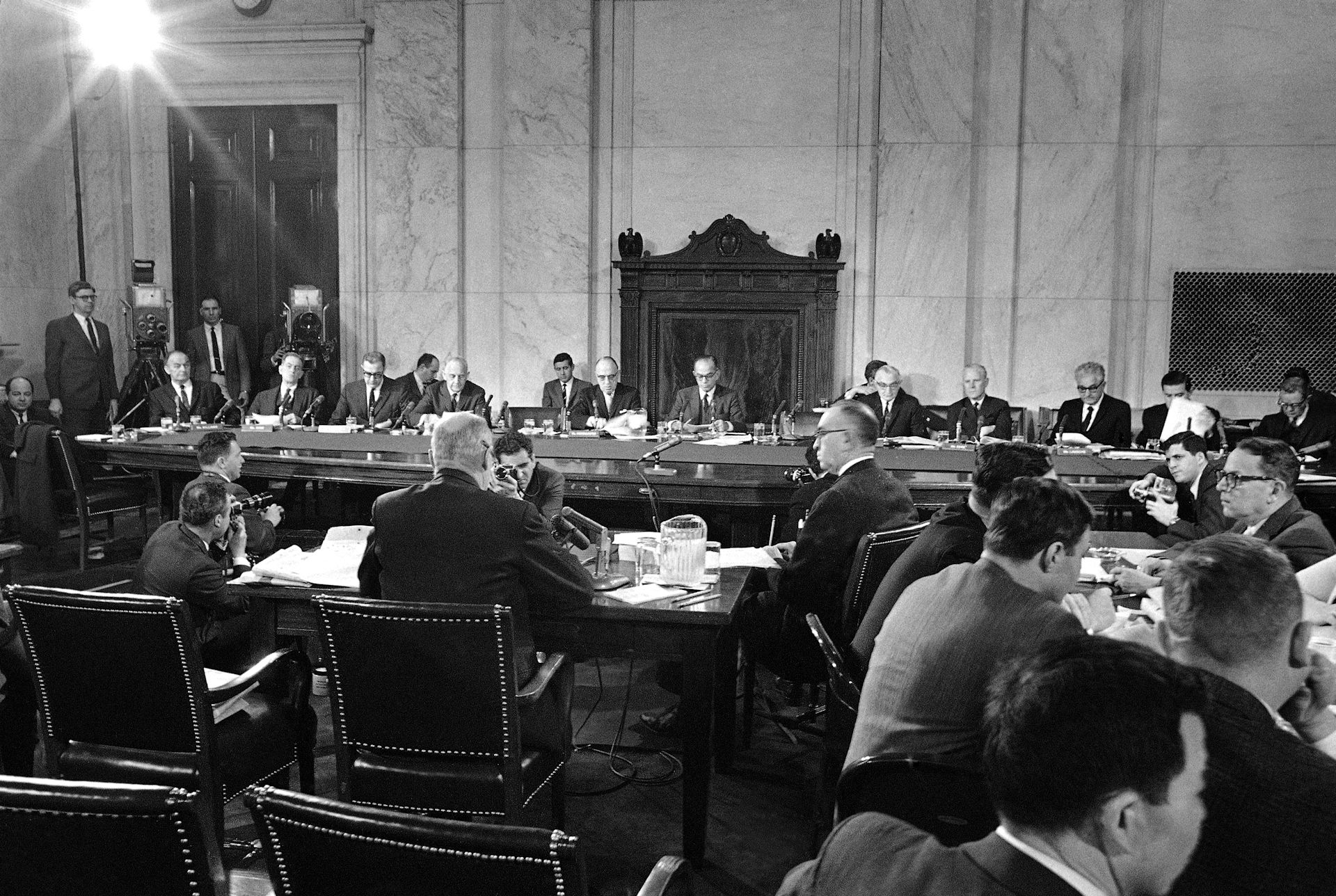
Oversight hearings provide members of Congress an opportunity to not only question and investigate the executive branch’s activity, but also to provide their constituents with this fact-finding work and draw attention to policy issues. As some recent oversight hearings indicate, these can also be opportunities for partisan jabs and “made for TV” moments.
But there is evidence that they produce results.
Following tense oversight hearings on excessive spending in the Department of Homeland Security, Secretary Kristi Noem was fired from her position in early March 2026.
In the 1970s, the Church Committee – named for its formidable chair, U.S. Sen. Frank Church of Idaho – held extensive hearings that included eye-opening testimony about clandestine U.S. intelligence activities abroad and domestically. The Church Committee recommended, and Congress subsequently enacted, dozens of sweeping reforms to foreign intelligence collection activities, as well as restraints on future efforts by the U.S. government to assassinate people.
Although the Trump administration has provided closed-door briefings to members of Congress, Democratic senators are asking for more. They are calling for Department of Defense Secretary Pete Hegseth and Secretary of State Rubio to come before congressional committees to explain their reasoning and plans for the Iran war.
Not only do oversight hearings provide members of Congress with an opportunity to investigate and question an administration’s actions, but they bring that discussion to the public. This transparency provides constituents with information about how their tax dollars are being spent, what their members of Congress think, and may even sway public opinion.
But perhaps the most powerful tool that Congress has is its power of the purse, outlined in Article 1 of the Constitution.
Military actions in Iran are already costing an estimated US$1 billion a day, or as U.S. Rep. Tom Cole of Oklahoma, the Republican House Appropriations Committee chair, put it: “a lot.”
As the war drags on, the Trump administration will need more money – money that only Congress can dole out. Unlike war powers resolutions, which in this case would limit military action after the fact, new spending cannot occur until Congress writes and passes legislation appropriating additional funds.
But this would constitute a blank check for a foreign war. And that might be too much to ask of members of Congress in both parties, particularly as the U.S. faces a historic deficit and cuts to safety net programs.
And as public opinion on both military action in Iran and the state of the economy continues to sour, a vote for more military spending might well overtax any remaining goodwill of voters and members of Congress alike.
In fact, the political pressure on Congress to put its foot down could become so immense that lawmakers may have to do something – like their job.
This article is republished from The Conversation, a nonprofit, independent news organization bringing you facts and trustworthy analysis to help you make sense of our complex world. It was written by: SoRelle Wyckoff Gaynor, University of Virginia and Charlie Hunt, Boise State University
Read more:
Congress began losing power decades ago − and now it’s giving away what remains to Trump
Speaker Johnson’s choice to lead by following the president goes against 200 years of House speakers building up the office’s power
A brief history of congressional oversight, from Revolutionary War financing to Pam Bondi
The authors do not work for, consult, own shares in or receive funding from any company or organization that would benefit from this article, and have disclosed no relevant affiliations beyond their academic appointment.






















































Comments