Labor-HHS-Education earmarks are back in House, with limits
Published in Political News
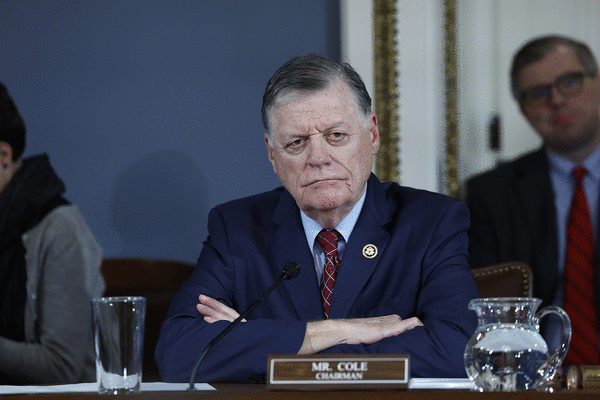
WASHINGTON — House GOP appropriators are allowing earmarks back into their chamber’s Labor-HHS-Education bill after barring them for the past three years, according to guidance that House Appropriations Chairman Tom Cole, R-Okla., released Wednesday for the upcoming fiscal 2027 cycle.
Cole’s guidance opens up only the bill’s Health Resources and Services Administration account for “community project funding,” however, which is largely used to provide funding to hospitals.
House Republicans had barred earmarks from the Labor-HHS-Education measure after they took back control of the House in the 2022 midterm elections. But the Senate has maintained the bill’s earmark eligibility, and the fiscal 2026 Labor-HHS-Education law includes just under $1.4 billion within those accounts, all from the Senate.
The Health Resources and Services Administration is the largest of the seven accounts eligible in the Senate, and that chamber included $844.5 million in HRSA earmarks for the current fiscal year.
For example, Labor-HHS-Education Appropriations Subcommittee Chair Shelley Moore Capito, R-W.Va., delivered three earmarks worth $15 million each, for renovation of the West Virginia University School of Dentistry, Charleston Area Medical Center technological upgrades and construction of a Marshall University Medical Simulation Center.
House Labor-HHS-Education Appropriations Subcommittee Chairman Robert B. Aderholt, R-Ala., led the push to return House earmarks to the bill, arguing that rural hospitals in his state could really benefit.
“Right now, I can’t do anything to help out … a rural hospital,” he said. “I’ve got a lot of rural hospitals. We’re in areas that an earmark could be very beneficial to them.”
Some House conservatives, who oppose all earmarks, are likely to be unhappy about the expansion. But appropriators may have lessened pushback by only opening up the HRSA account, and not matching the Senate’s more wide-ranging eligibility which includes earmarks within the Labor and Education departments as well as additional HHS accounts.
Lawmakers will also be able to request 20 projects each, up from 15. Cole said earlier this month that increasing the number of projects would give lawmakers “more options,” though the overall cap on earmarked spending for House lawmakers is remaining at 0.5% of total federal funding.
Cole also released guidance for “programmatic” funding requests, or member asks involving overall funding for individual programs in fiscal 2027 spending bills, as well as for language in explanatory reports.
Senate appropriators haven’t released their own guidance yet for the upcoming spending bills.
---------
—Aris Folley contributed to this report.
©2026 CQ-Roll Call, Inc., All Rights Reserved. Visit cqrollcall.com. Distributed by Tribune Content Agency, LLC.




















































Comments