Trump ups pressure on Iran to 'make a deal' as US fleet nears
Published in Political News
U.S. President Donald Trump intensified pressure on Iran, imposing fresh sanctions and urging the regime to “make a deal,” after Tehran signaled it was ready for talks if the White House ceased its threats.
“If we do make a deal, that’s good. If we don’t make a deal, we’ll see what happens,” Trump said Friday at the White House.
The “armada” headed to Iran exceeds the fleet sent to support the operation to capture Venezuelan leader Nicolas Maduro, Trump said. “We’re now sending, actually, a larger number of ships to Iran, and hopefully we’ll make a deal.”
Trump’s comments followed the Treasury Department’s announcement of new sanctions, largely targeting those who helped suppress recent protests, including Iranian Interior Minister Eskandar Momeni and several Islamic Revolutionary Guard Corps commanders.
Still, any diplomatic breakthrough between the United States and Iran appeared far off. The renewed tensions have triggered fears of an armed conflict that could shatter the relative calm in the Middle East that was brought about by the truce between Israel and Hamas.
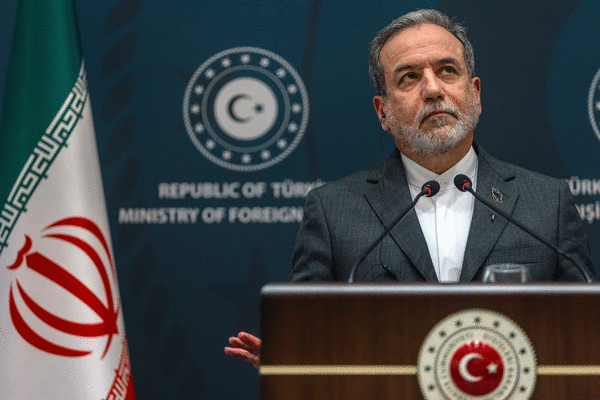
Iranian Foreign Minister Abbas Araghchi earlier Friday called on Trump to tone down his rhetoric and accused Israel of encouraging the U.S. president to attack his country. He warned that military strikes could trigger a wide conflagration, though he said Iran is “as ready for war” as it is ready to engage in negotiations with the U.S.
Iran is “even more prepared than before the 12-day war,” Araghchi told reporters in Istanbul, referring to last June’s conflict with Israel that culminated in the United States’ bombing of key Iranian nuclear sites.
Tensions between Washington and Tehran have escalated dramatically since Trump ordered a U.S. aircraft carrier strike group to the Middle East and threatened to attack the Islamic Republic. His stated motivations have shifted from wanting to punish Iran’s leadership for a brutal crackdown on recent protests to extracting a new nuclear deal.
On Friday, Trump renewed his claim that he had convinced Iran’s leadership to stand down from mass executions of demonstrators. He asserted that he believes Iran is interested in making a deal to avert future military strikes.
“They were going to hang 837 people. And I told them, ‘if you do it, you’re going to pay a price like nobody’s ever paid before.’ And they pulled back,” Trump said. “I appreciated that a lot of people are being killed, so we’ll see what happens. I can say this, they do want to make a deal.”
Fears of a fresh war in the oil-rich Persian Gulf fueled a spike in crude prices this week, with Brent rising almost 7% to more than $70 a barrel. It pared gains on Friday after Trump said overnight he’d had discussions with Iran and indicated he expected them to continue.
As part of the U.S. sanctions on Friday, Treasury’s Office of Foreign Assets Control also imposed penalties on two digital asset exchanges linked to Babak Morteza Zanjani, a local investor.
“Treasury will continue to target Iranian networks and corrupt elites that enrich themselves at the expense of the Iranian people,” Treasury Secretary Scott Bessent said in a statement. “Like rats on a sinking ship, the regime is frantically wiring funds stolen from Iranian families to banks and financial institutions around the world.”
Araghchi said if the U.S. carries out another military attack on Iran, “the situation will be very different” from the conflict with Israel and “unfortunately may go beyond the scope of a bilateral war.”
“Provided that it is fair and equitable, the Islamic Republic of Iran is ready to participate in these talks and negotiations,” Araghchi said, adding that Iran would never negotiate over its missile program, which the Trump administration has demanded it stop.
“Under no circumstances are we willing to accept diktats or coercion,” Araghchi said.
Araghchi’s trip to Istanbul follows a flurry of diplomatic activity over the past few days that has seen various key powers in the Middle East — including U.S. allies Qatar, Saudi Arabia and the UAE — emphasize the need to reduce tensions and find a diplomatic solution to the standoff between Tehran and Washington.
_____
(With assistance from Eltaf Najafizada, Magdalena Del Valle, Meghashyam Mali, Golnar Motevalli and Iain Marlow.)
©2026 Bloomberg L.P. Visit bloomberg.com. Distributed by Tribune Content Agency, LLC.
















































Comments