Voting rights at risk after Supreme Court makes it harder to challenge racial gerrymandering
Published in Political News
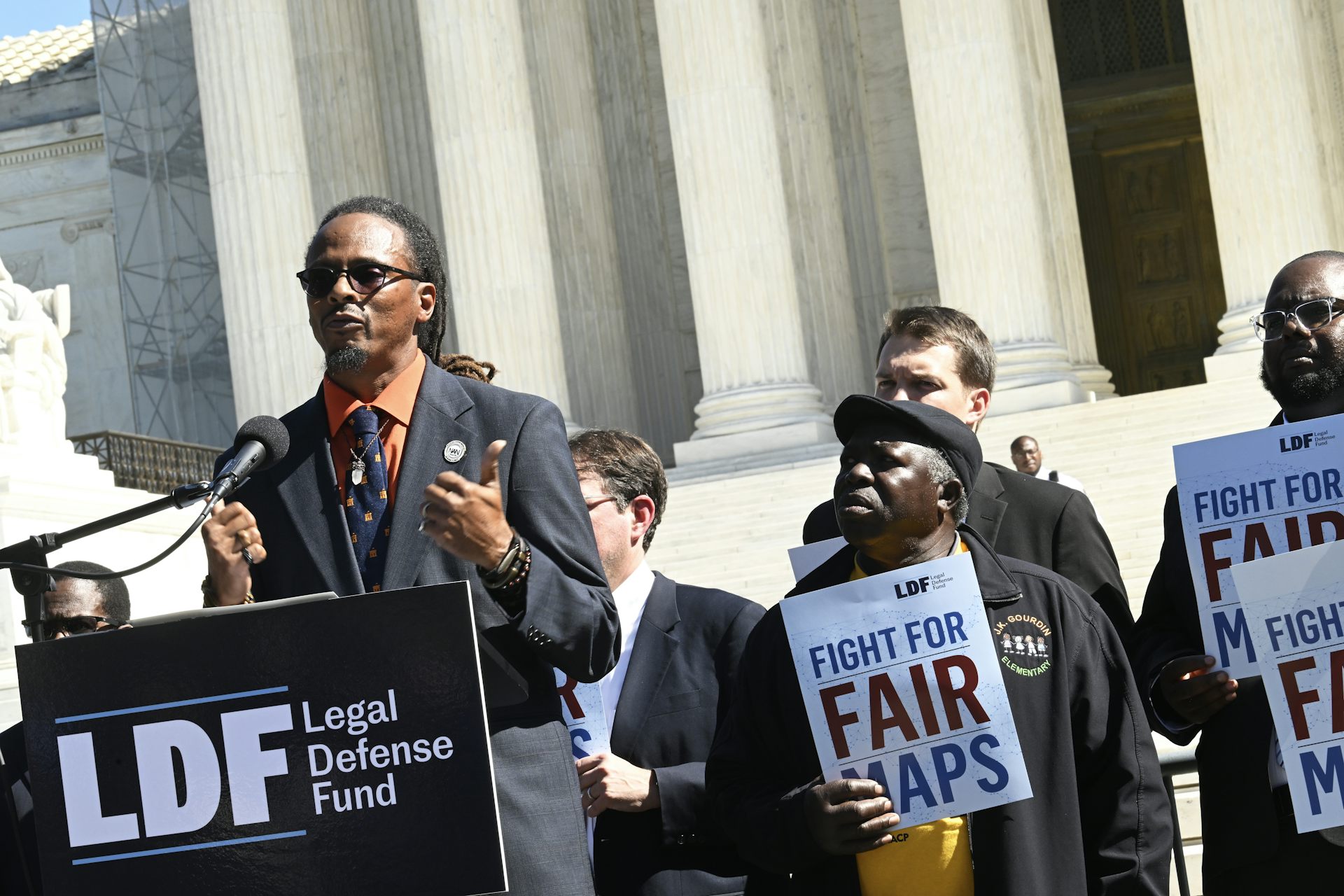
Two recent Supreme Court rulings on congressional redistricting will have starkly different consequences for Black voters in the 2024 election.
One ruling boosted Black voting power in Louisiana, while another decision upheld a South Carolina congressional map that the lower court had declared “illegal racial gerrymandering.”
Despite these seemingly contradictory outcomes, there is a through line.
In both cases, the justices gave partisan state legislatures more power to craft congressional districts and overruled the lower federal courts that had ordered state legislatures to draw new maps.
Together, these decisions represent a conservative shift in the Supreme Court’s approach to redistricting that could have major effects on American democracy.
Every 10 years, U.S. states must redraw their legislative districts to account for population changes. Redistricting is typically completed by a state legislature or commission. When the districts are drawn for political goals, often in unusual shapes, this is considered “gerrymandering.”
Gerrymandering is not necessarily illegal. In 2019, the Supreme Court declared that partisan gerrymandering, or drawing districts that advantage one party over the other, could no longer be challenged in federal courts, making it much more permissible.
However, racial gerrymandering – drawing districts in a way that reduces minority voting power – is illegal, because it violates the Voting Rights Act and the U.S. Constitution.
The question at the heart of the Supreme Court’s May 2024 case about South Carolina’s congressional districts, which were changed in 2022, is whether the new lines were drawn based on race or partisanship.
In Alexander v. South Carolina State Conference of the NAACP, the NAACP and a Black voter, Taiwan Scott, argued that the state legislature had illegally used race to determine the new district boundaries. The new map excluded Black-majority areas from the coastal 1st District, moving 62% of its Black voters to other districts.
In South Carolina, Black voters are overwhelmingly Democrats. Republican lawmakers in Columbia insisted that they had been focused on party, not race, when they created new congressional districts that benefited Republicans.
In January 2023, a federal district court agreed with the NAACP. Ruling that the 1st District was an illegal racial gerrymander aimed at diluting Black voting power, a three-judge panel ordered the state to redraw its map.
The Supreme Court quickly took up the case. On May 23, 2024, the justices decided 6-3 along ideological lines, with the conservatives prevailing, to overrule the lower court because it had not shown conclusively that race was the legislature’s primary consideration when it made the map.
Read more:
The majority opinion, written by Justice Samuel Alito, argued the state legislature should be given the “presumption of good faith” in the redistricting process. Alito set out a conservative perspective on judicial action on redistricting based on the separation of powers and federalism, which decrees that states run elections, not the federal government.
“Redistricting constitutes a traditional domain of state legislative authority,” Alito wrote, while “federal-court review of districting legislation represents a serious intrusion on the most vital of local functions.”
As a result, Republicans are now likely to win six out of seven congressional seats in South Carolina in November’s general election. Black South Carolinians will cast their ballots in districts that limit their overall voting power.
In her dissent, Justice Elena Kagan, a Democratic appointee, wrote that legal precedent requires the Supreme Court to defer to the lower court – not to the legislature. She specifically questioned the presumption of good faith for the legislature given the lower court’s finding that South Carolina’s new congressional map reflected race-based decision-making.
Lower federal courts have been actively involved in the redistricting process since the 1960s. As my research has shown, they have played an important role in promoting voting rights.
The South Carolina ruling articulated the conservative court majority’s view that lower courts should be less active in certain redistricting cases and more deferential to state legislatures. The justices reinforced this view in another race-and-redistricting decision from this term, this time in Louisiana.
Louisiana’s 2024 Republican-drawn congressional redistricting plan boosted Black voting power. It increased Black-majority congressional districts from one to two, out of six total.
Just as in South Carolina, a federal court declared this redistricting plan to be an illegal racial gerrymander. And again the Supreme Court overruled that lower court’s decision.
In a brief and unsigned order, the court allowed Louisiana to keep its new congressional map, giving the state’s Black voters more electoral power come November – and beyond.
Justice Ketanji Brown Jackson dissented. She would have allowed the lower court case to play out, she wrote. Further, she argued against the majority’s use of the “Purcell Principle” to overrule the lower court.
The Purcell Principle, established in 2006, holds that courts should not change electoral rules just before an election because it could create confusion. This principle contradicts much of the history of federal court decisions on redistricting, potentially endangering voting rights by curbing judicial oversight of state lawmakers.
The effect of the court’s rulings is potentially significant. By providing more deference to state legislatures and limiting lower federal court involvement in redistricting, the Supreme Court has in recent months given states increased opportunity to gerrymander.
Meanwhile, voters have less power than ever to fight back when they believe a new congressional map unfairly limits their power at the ballot box.
The court’s conservative majority has already allowed partisan gerrymandering. Now, racial gerrymandering may be harder to challenge in court – and voting rights harder to enforce.
This article is republished from The Conversation, a nonprofit, independent news organization bringing you facts and analysis to help you make sense of our complex world.
Read more:
When it comes to explaining elections in Congress, gerrymandering is overrated
Is partisan gerrymandering illegal? The Supreme Court will decide
Sam D. Hayes does not work for, consult, own shares in or receive funding from any company or organization that would benefit from this article, and has disclosed no relevant affiliations beyond their academic appointment.





















































Comments