Commentary: Will Iran become a two-front war?
Published in Op Eds
When U.S. Treasury Secretary Scott Bessent announced a new economic pressure campaign on Iran last month, the goal was simple: Keep the squeeze on Tehran’s economy without resorting to the return of a full-scale war that would send the Middle East back into turmoil. The strategy was designed to play to Washington’s strengths as the world’s paramount financial power while chipping away at Iran’s ability to hold the Strait of Hormuz hostage. This, combined with the U.S. Navy’s program to guide tankers along the Omani coast, would dissolve Tehran’s leverage over time.
That was the theory. But putting it into practice depended on Iran withholding its fire as long as the U.S. military stopped dropping bombs. That didn’t come to pass. The notion that Iran would sit back as its economy moved ever closer to implosion was not grounded in reality.
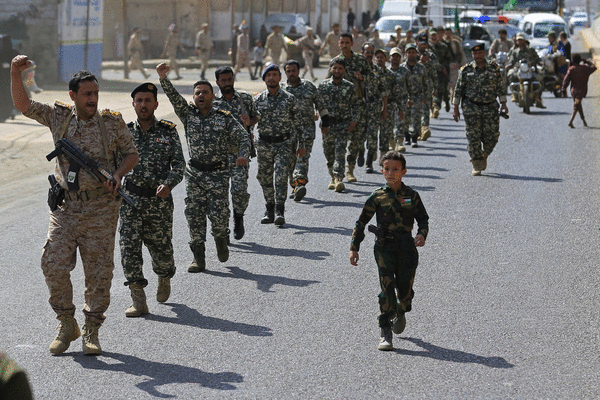
Instead of acting the way we would like them to act, the Iranians have escalated. Last week, Iran’s Revolutionary Guard took aim at U.S. Navy ships patrolling the Persian Gulf and enforcing the U.S. blockade on Iranian ports, compelling the U.S. military to retaliate by striking Iranian oil tankers. Iran’s proxies are also stepping up in a big way, targeting some of the region’s most critical energy infrastructure and rattling Saudi Arabia, which risks being dragged into the U.S.-Iran confrontation against its will.
The Gulf’s largest energy provider is now staring at the possibility of a two-front war. Although Iranian fire into Saudi territory stopped months ago, the Houthis in Yemen next door are increasingly striking Saudi-affiliated tankers in the Red Sea.
Unlike Iraq, Kuwait, Bahrain and Qatar, Saudi Arabia has been able to maintain about two-thirds of its prewar oil exports by diverting oil shipments away from the Strait of Hormuz and through the Bab el-Mandeb Strait on its west coast. The roughly 750-mile east-west pipeline has been a godsend to the Saudis, who still rely predominately on oil revenue to finance their budget and fund the massive economic transformation plan their crown prince, Crown Prince Mohammed bin Salman, is working to complete in the coming years.
Yet even this route is being disrupted. On Friday, Iraqi Shia militias affiliated with Iran struck the east-west pipeline, shutting it down temporarily. Some oil industry insiders say it will take the Saudis five to six weeks to make repairs, a timeline that will empty out the kingdom’s spare capacity. To make matters worse, the Houthis have captured new terrain in Yemen and acquired Perim Island, a speck of land inside the Bab el-Mandeb chokepoint that better positions the Yemeni militia to intercept oil tankers.
All of this compounds the miseries of the global oil market. The International Energy Agency estimates that oil flows out of the Gulf won’t return to normal until 2027, and even this date is a projection that could shift further into the future based on how the regional situation develops.
Despite these setbacks, President Donald Trump’s administration is still talking as if the war will be over by Christmas — or, as Trump has suggested frequently of late, after the midterm elections in November. Vice President JD Vance doesn’t even think the United States is at war right now. Defense Secretary Pete Hegseth seems more preoccupied with posting juvenile memes about the Canadian military than with the conflict.
Meanwhile, back in the real world, U.S. military deployments in the Middle East are being extended into next year, and senior U.S. officials are practically begging defense contractors to churn out more air defense missiles to make up for the shortfall the Pentagon now faces courtesy of a “little excursion” that was supposed to end in four to six weeks. Seven months in, we’re no closer to an end.
The latest Houthi offensive and the shutdown of one of Saudi Arabia’s most important pipelines add to the long list of questions the Trump administration is already struggling to answer. Some of those questions are monumental and go to the core of U.S. grand strategy in the Middle East as well as Washington’s credibility to see this strategy through. The strike in Saudi Arabia, a country whose defense relationship with the United States traces to the 1940s, is exposing the increasingly thin reeds that have upheld U.S.-Saudi relations for so long. The Carter Doctrine, which states that the United States will treat attacks on Persian Gulf oil supplies as an attack on America’s core interests, is wasting away nearly 50 years after it was first established. The U.S. defense umbrella no longer looks as solid as it did before the war with Iran started, a fact last week’s events only reinforce.
As a consequence, states such as Saudi Arabia and Kuwait are signing security agreements with other countries such as Pakistan to reduce their dependence on a security partner that doesn’t provide much security at all.
For Trump, all of these big-picture items are much less vital than the war itself. To state the obvious, Trump has dug a deep hole for the country and is having a devil of a time figuring out how to climb out of it. None of his choices are inherently good, only degrees of bad. Further escalation will instigate more escalation on the Iranian side. Returning to talks runs up against Tehran’s complete distrust of Trump as an honorable negotiator who will implement what he signs. And ceding the Strait of Hormuz to Iranian control would forever ruin his self-professed image as a dealmaker.
Those are the consequences of heading head-first into a war that didn’t need to be fought in the first place.
____
Daniel DePetris is a fellow at Defense Priorities and a foreign affairs columnist for the Tribune.
___
©2026 Chicago Tribune. Visit at chicagotribune.com. Distributed by Tribune Content Agency, LLC.
















































Comments