Mary Ellen Klas: Vance's childcare plan pits parents against each other
Published in Op Eds
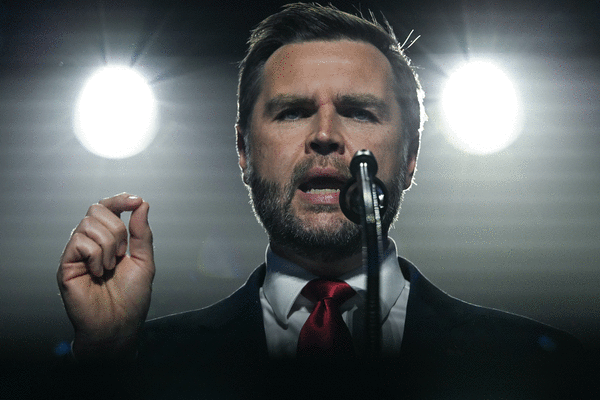
Should the federal government give subsidies to parents who stay home to care for their young kids? Absolutely. Should it also subsidize childcare for working parents? For sure. This shouldn’t be an either-or question, but the Trump administration’s new childcare subsidy plan makes it one.
Under the draft proposal, as previewed in a leaked report to the New York Times, stay-at-home parents in low-income households could get up to $9,000 a year to help supplant lost earnings. The money would come from the existing $12 billion fund in the Child Care and Development Block Grant Act. That law provides childcare subsidies to eligible working parents in households making below 85% of the state’s median income.
The policy is a top priority for Vice President JD Vance and is patterned after a proposal drafted by Secretary of State Marco Rubio when he was in the Senate. The concept was promoted by the Heritage Foundation in its Project 2025 blueprint. And Heritage president Kevin Roberts is touting the idea as needed to “reward family foundation, not subsidize its decline.”
It’s an ideological trap. My guess is that the idea has surfaced two months before the midterm elections to revive the “Mommy Wars” debates of the 1980s and 1990s, which wrongly pitted mothers who stay home against those who earn a paycheck. It’s a culture-war issue that agitates leftists and excites right-wing pronatalists in an effort to distract voters from Trump’s policy failures.
Except the proposal won’t work.
If the idea is implemented as described, it’s both impractical and irresponsible. It would force working parents already in the program to compete with married, at-home parents for the same pool of funds.
Under the current program, the federal subsidy is given to working parents and covers only about 1 in 7 of eligible families, or about 870,000 parents. The Trump plan would divide the pie into smaller pieces, promising subsidies to some married couples who want to keep a parent home. That would make it harder for the parents already in the program to keep both their jobs and their childcare.
Americans know the country needs to do better for its kids. More than half of Americans say that it’s better for children and society for kids to be raised in two-parent households. And millions of families may genuinely prefer to have a parent stay home when their children are young. That shouldn’t be a choice that carries the risk of long-term financial vulnerability.
But the cost of raising kids is growing. According to a 2025 Lending Tree survey of parents with young children, 46% said they have fewer kids than they’d like due to financial constraints. Meanwhile, childcare costs in the U.S. have risen by a third over the last 15 years. Half of all families live in childcare deserts, driving young families out of rural towns. And according to the U.S. Census, there are 10.9 million one-parent households in the country, of which 80% are led by women.
While the U.S. has the highest rate of children living in single-parent households, we also have none of the social infrastructure offered by many other wealthy countries: universal paid family leave, childcare starting at birth and universal investments in early childhood education.
This is an indictment of existing U.S. policies, not a rationale for cutting off funds to already-struggling single parents.
Politicians of both parties have been watching the crisis mount for years, but have been unable to assemble the political will to address it. Former President Joe Biden proposed $400 billion in far-reaching childcare subsidies and universal pre-K under the first draft of his Build Back Better Act. Republicans accused Biden of socialism, blasted the subsidies as “welfare” and rejected the idea.
Now, a group of policy makers from both the Biden and Obama administrations have proposed Project 2029, a blueprint for a Democratic future that includes universal free childcare and a $1,000 monthly stipend for stay-at-home parents. U.S. Representative Ro Khanna of California has a 10-year plan to spend $780 billion on subsidizing traditional child-care centers, giving grants to stay-at-home parents, and compensating programs for “kin caregivers.”
Any of these plans would represent a vast increase in spending on childcare, but for the last 30 years, researchers who study childcare have learned that public investment in childcare pays for itself through increased workforce participation and tax revenue, higher business productivity and greater economic activity.
And an honest debate would acknowledge that for decades the U.S. has been trying to do childcare assistance on the cheap. If we really want to strengthen “family formation” and meet parents’ affordability needs, we’d recognize that families have diverse childcare needs. We’d supercharge our investment in workable childcare options and reject the Trump administration’s zero-sum illusion of choice.
____
This column reflects the personal views of the author and does not necessarily reflect the opinion of the editorial board or Bloomberg LP and its owners.
Mary Ellen Klas is a politics and policy columnist for Bloomberg Opinion. A former capital bureau chief for the Miami Herald, she has covered politics and government for more than three decades.
©2026 Bloomberg L.P. Visit bloomberg.com/opinion. Distributed by Tribune Content Agency, LLC.


















































Comments