Editorial: Illinois farmers are farming the government for cash
Published in Op Eds
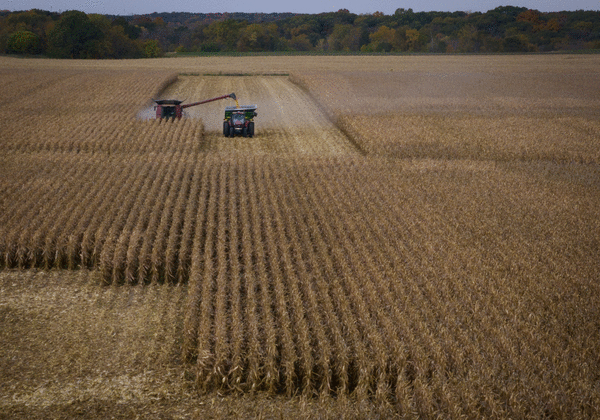
The fall harvest is looming, and you might think Illinois’ farmers and landowners would be preoccupied with bringing in the corn and soybean crops. But they’re also focused on reaping taxpayer money from a federal government that just keeps pouring it on.
The practice of farming the government for subsidies is thriving in the heartland.
The latest proposed infusion is an $11.1 billion supplemental farm-aid package the Trump administration requested from Congress in June, on top of tens of billions already flowing to agriculture this year. Meanwhile, the Senate Agriculture Committee is trying to revive a new five-year farm bill after an August committee vote failed amid a partisan fight over SNAP.
There is real financial stress in farm country, but there is no single “emergency” behind this latest request. Farmers have been squeezed by several years of high production costs and weaker commodity prices, and this year the Iran war sent fuel and fertilizer costs soaring. Those are serious problems. But increasingly, Washington’s answer to virtually every downturn or disruption in the farm economy is another round of taxpayer checks.
As it stands, an estimated $55 billion in federal subsidy payments already will flow to the agriculture sector this year — in a flurry of checks drawn on the U.S. Treasury that people on the prairie like to call “Trump money.” Most of it will go to about 150,000 of the largest farm operations, according to research from the American Enterprise Institute (AEI).
Those are multimillion-dollar businesses.
In a recent report, AEI documented how the Trump administration has turned “ad hoc payments” into a vehicle for massive giveaways, starting in 2018 during the president’s first term. It’s a “new era,” the center-right think tank declared.
Traditionally, Congress bundled farm subsidies, nutrition and conservation programs into a farm bill that forced urban and rural lawmakers into compromise. The last full farm bill passed in 2018; its successor has repeatedly stalled, most recently over SNAP.
Since the most recent farm bill expired in 2023, Congress approved temporary extensions. The Senate is expected to consider a new version of the farm bill this month, but it’s unlikely anything will advance before the November elections. And after that, all bets are off.
We’re not mourning the death of cynical compromises that resulted in massive overspending on past farm bills. But we’re wary of the economic whiplash that could result if today’s one-sided policies suddenly get reversed.
These fat one-time payouts badly distort the farm economy, driving up the price of land and rent, which raises production costs. That in turn poses a barrier to entry for any new farmers, in an increasingly aging and hidebound industry.
Illinois has a lot riding on the continued health of Big Agriculture. The typical farm operator in the Land of Lincoln today has a strong balance sheet with little debt. But if the government money went away, the consequences would be severe. Dysfunctional politics pose a real threat to a sector that has become way too dependent on handouts.
Other government actions also are hurting the long-term prospects of the farm economy. The war against Iran has raised the cost of energy, including diesel fuel used in most farm equipment. The war has put fertilizer supplies at risk as well.
Trump’s crackdown on immigrants, while most visible in Democrat-run cities like Chicago, has spread to farm country, too. Enforcement actions have targeted immigrant-heavy workforces for industries like meatpacking, dairy and trucking. That has prompted an unlikely backlash in some of the reddest parts of the country.
Trade wars dating to Trump’s first term have been even more damaging to the Grain Belt’s prospects. China retaliated against tariffs in Trump’s first term by cutting off imports of soybeans, a key Illinois cash crop, along with other commodities.
In the years between Trump’s two terms, Chinese agricultural companies made giant investments in expanding the production and export capacity of Brazil, which has become China’s No. 1 soybean supplier, by far. Once among the best customers for Illinois beans, the Chinese don’t need them anymore.
America’s farmers have always maintained that they’d much rather make money selling crops than collecting checks. They should worry that a day may come when the crops and the checks both dry up.
_____
©2026 Chicago Tribune. Visit chicagotribune.com. Distributed by Tribune Content Agency, LLC.
















































Comments