David M. Drucker: Trump's popularity has reached a critical point
Published in Op Eds
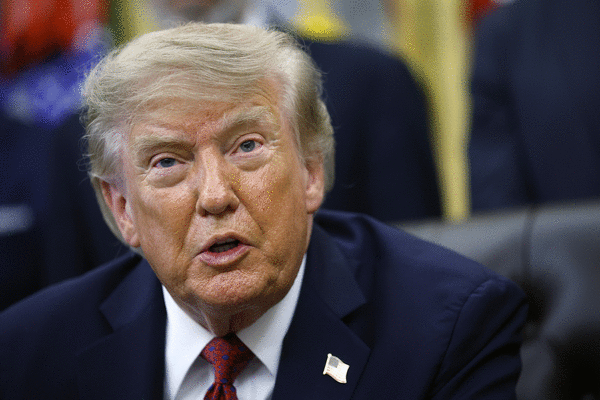
President Donald Trump can dismiss public opinion polls as “fake news” all he wants. That won’t change the fact that the commander-in-chief is in political distress — even according to survey outlets that usually give him more favorable ratings.
Perennially reliable RealClearPolitics, as of Monday, averaged Trump’s job approval rating a hair under 40% — dismal even for this polarizing, second-term president. Credible polling averages from The New York Times and Silver Bulletin, the Substack published by veteran political analyst Nate Silver, also show Trump drowning with American voters, both with ratings of around 38%. But if that’s not satisfactory proof of the president’s precarious political standing consider this:
Trump’s numbers have been cratering in data recently gathered by Morning Consult, Rasmussen Reports and RMG Research — all dependable polling outfits that regularly show higher job approval ratings than their competitors. In their three most recent polls, the Oval Office caretaker registers an average job approval rating of around 44% (Morning Consult), 42% (Rasmussen) and 43% (RMG Research). Those numbers are in line with the ones produced by firms and academies that Trump and Republicans often dismiss as biased or incompetent.
So why do some polling outlets typically show Trump with higher job approval ratings than competitors? And why isn’t that currently the case?
Rasmussen, whose pro-Trump messaging has caused Democrats to view its data suspiciously, generates presidential-approval tracking numbers from a “likely voter” screen that breaks down as follows: 35% Democrat, 33% Republican and 32% independent. “We are pretty confident that our likely voters-based numbers do, in fact, reflect national likely voter sentiment,” Ted Carroll, the firm’s president, told me. As for Trump’s drop in their daily surveying, Carroll blamed the Iran war: “When there is news that points toward a favorable resolution of Iran hostilities, we see single night jumps,” he explained. “When bad news comes, we see it reverse.”
In addition to measuring voters’ assessment of Trump’s job performance, RMG gauges his political strength broadly by asking them to focus on issues, presenting them with this question: Offered a choice between four candidates of “equal character and competence,” do you prefer candidates who advocate “Trump-like policies,” those associated with “traditional” Republicans, “traditional” Democrats or socialists New York Representative Alexandria Ocasio-Cortez? The plurality of voters RMG surveys have typically opted for the “Trump-like policies” candidate.
But that has steadily changed since Trump returned to the White House — and from the president’s perspective, for the worse. “ When President Trump took office in January 2025, 38% said they preferred Trump-like policies. It's down to 28% now. The number saying ‘traditional R’ is catching up,” RMG President Scott Rasmussen told me. (He founded Rasmussen Reports but left the company in 2013 and is no longer affiliated with the firm. Morning Consult did not respond to my queries.)
RMG’s findings track with what other pollsters and political analysts are seeing.
Trump’s loyal voting base is as invested in him as ever. That’s not insignificant. These are the Americans responsible for the 45th and 47th president’s unnaturally high floor of support in surveys dating to his first presidency. Yet Trump won twice (and lost once but only narrowly) because his electoral coalition coopted Republican regulars of all stripes: fiscal conservatives, free traders, foreign policy hawks, constitutionalists, voters who favor measured statesmen over bombastic provocateurs. In 2024, Trump’s breadth of support was particularly impressive, with backing from Hispanics and younger voters that was higher-than-usual for a GOP nominee.
But the numbers with all of them — not to mention independents and swing voters — are steadily eroding, leaving Trump and his party politically exposed as the midterm elections approach. “The biggest problem Trump faces is that he is losing support among the wealthier, more educated voters most likely to show up in November,” Paul Sracic, senior fellow at The Hudson Institute, a conservative think tank in Washington, DC, told me. The culprit, according to Scracic, is a familiar one. “Many former supporters are turned off by Trump’s decision to go to war against Iran,” he said.
Indeed, voters give the president’s handling of Iran a mark of 34%. That’s nearly 6 percentage points lower than his overall job approval rating. For that matter, nearly all of Trump’s job approval ratings on key issues fall below his 39.9% overall mark, including foreign policy generally (36.6%), his handling of the economy (34.5%) and inflation (27.9%). On crime and immigration , topics on which the president tends to score better, he also is underwater, although well above 40%.
Trump’s apparent solution is to air a major advertising campaign that puts him and his second-term record front and center for the voters to consider as they mull which party to support this fall — or, in the case of many apathetic GOP voters, whether to vote at all. Yet the president’s strategy presupposes that voters are only unhappy, as one congressional Republican recently claimed, because the “leftwing media” hoodwinked them into believing as much.
____
This column reflects the personal views of the author and does not necessarily reflect the opinion of the editorial board or Bloomberg LP and its owners.
David M. Drucker is a columnist covering politics and policy. He is also a senior writer for The Dispatch and the author of "In Trump's Shadow: The Battle for 2024 and the Future of the GOP."
©2026 Bloomberg L.P. Visit bloomberg.com/opinion. Distributed by Tribune Content Agency, LLC.
















































Comments