Editorial: At the CDC, damage control would be a big win
Published in Op Eds
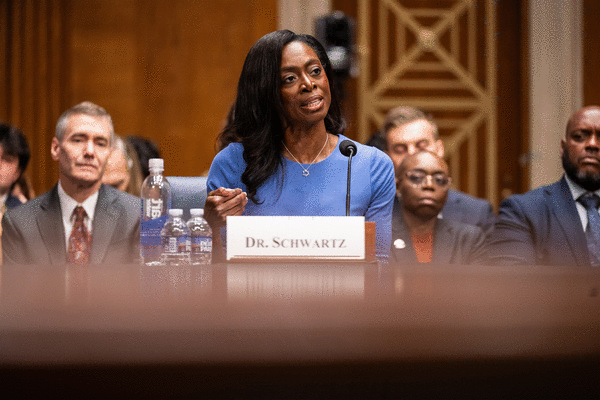
Through little fault of her own, the nation’s new head of the Centers for Disease Control and Prevention starts her job with low expectations. It’s not just her boss’s antipathy for the agency, which he has called a “cesspool of corruption.” Within days of Erica Schwartz’s confirmation as director, the president issued an executive order seeking to overhaul the childhood vaccine schedule — with no new supporting evidence.
It’s an unusually bad time for the CDC to be in disarray. Cases of measles have hit a 35-year high, with two deaths reported in Pennsylvania last week. A cyclospora outbreak has exposed vulnerabilities in the nation’s food-safety system, and some health officials worry that the spread of Ebola in Africa is close to becoming a pandemic. Meanwhile, the White House and Health and Human Services Secretary Robert F. Kennedy Jr. have limited access to vaccines, weakened disease surveillance, and reduced foreign aid.
A steady presence at the agency would thus be welcome. For months, Jay Bhattacharya, director of the National Institutes of Health, held a dual role that included CDC oversight. Amid concurrent public-health threats, more focused leadership is needed.
The first priority for Schwartz — a medical doctor, lawyer and former deputy surgeon general — ought to be damage control. After public excoriation, layoffs and a series of measures by the administration to undermine their work, career CDC staff are demoralized. Last year, a high-profile dispute between then-CDC Director Susan Monarez — who held the role for less than a month — and Kennedy led many to believe that no serious scientist could hold the job.
Although Schwartz is in a difficult position, she shouldn’t squander the opportunity to repair the CDC from within, starting with morale. Last year, a gunman fired almost 200 rounds of ammunition at the CDC headquarters in Atlanta, killing one police officer. At a recent memorial, employees said they felt leadership remained “out of touch.” Schwartz, to her credit, acknowledged the deteriorating environment in her first address to staff recently. She should spend her early days at the agency demonstrating her support.
She should also have some more ambitious goals. The CDC’s missteps during the COVID-19 pandemic — including its inconsistent and at times evasive communication — stoked public frustration and skepticism of the agency. Yet state leaders and health officials surely know collaboration with the CDC is critical: Some 80% of its budget flows to states, which helps fund labs, surveillance and extra workers when outbreaks overwhelm local resources. Schwartz could go some way toward repairing the agency’s reputation on the ground by communicating frequently and offering technical feedback to state leaders.
The main goal of any such outreach should be restoring trust in common vaccines. Not only have shots prevented millions of deaths in recent decades, they’ve also lowered costs to the health system: Researchers put the average cost per case of measles at more than $43,000, while according to the CDC, every dollar of investment in vaccines saves $11. To that end, the spreading measles outbreak — and concurrent dip in kindergarten vaccination rates — should be a wake-up call to local officials.
Kennedy nevertheless continues to pursue measures that reduce access to vaccines. The recent executive order likewise seeks to limit the number of shots given to children — which skeptics, led by the secretary, have blamed for the rise in autism. (Dozens of studies suggest this is false.) Schwartz has said she would not oppose the White House publicly but pledged to convey her staff’s views to senior leaders.
No doubt Schwartz has an unenviable job. Avoiding a full-blown crisis may be the best outcome from her tenure. Doing so could require more managerial skill than she’ll likely get credit for.
_____
The Editorial Board publishes the views of the editors across a range of national and global affairs.
_____
©2026 Bloomberg L.P. Visit bloomberg.com/opinion. Distributed by Tribune Content Agency, LLC.
















































Comments