Commentary: Healthcare is more badly broken than political leaders admit
Published in Op Eds
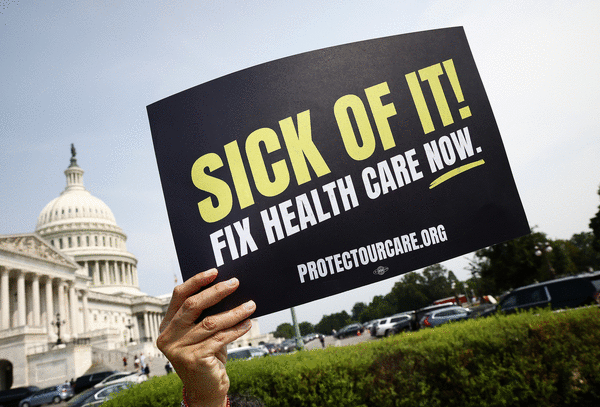
Raise your hand if you have affordable, accessible healthcare. Anyone? Yeah, that’s what I thought.
With independent studies showing that close to half of all Americans struggle to afford healthcare, I expect I got the rest of you with the addition of the word “accessible.” That’s because, while rising costs are a barrier for too many, even those who can afford comprehensive health insurance are finding money can’t buy you a timely appointment with most doctors.
New to a practice? Fewer and fewer doctors are accepting new patients, and many who do won’t have an opening for the remainder of this year.
Need to see a specialist? Sit back and stew over the test results that prompted you to seek more expertise because it likely will be months before any specialist can see you for follow-up.
Need surgery? Doctors are now so tightly scheduled that patients often won’t see them before or after the procedure. Recently, my family was only briefed by someone who wasn’t even in the room where it happened.
That’s the realistic state of medical care in this city where we are fortunate to have several of the country’s best hospital systems. Top-rated doctors in every specialty are within reach, but it can take many months to see them. In other words, we’re now in much the same bind as patients in rural areas who have long found limited doctors available for routine care, with specialists often a few hours’ drive away.
There are several reasons why we’re in this precarious situation. The Association of American Medical Colleges (AAMC) points to the aging baby boomer population as well as aging physicians retiring and others turning to more expensive concierge practice to spend more time with patients and dodge institutional paperwork.
The AAMC cites a report from the federal Health Resources and Services Administration, which designated 8,781 health professional shortage areas for primary care alone — areas in which 100 million residents are trying to access nonspecialty healthcare. The AAMC goes on to underscore the widening gap between the healthcare haves and the have-nots, noting: “If underserved populations were to experience the same healthcare use patterns as populations with fewer barriers to access, the United States would need up to 202,800 more physicians than it has just to meet current demand.”
The current administration has made it only harder to recruit more medical students with federal student loan caps that create new uncertainty for students considering tuition costs that are already topping the international charts. The government’s civil rights investigations into diversity, equity and inclusion admissions at medical schools also hinder recruitment of new students. These are just a few of the financial barriers that deter applicants and lead as many as one-quarter of the nation’s aspiring physicians to reconsider enrollment or to switch to nonclinical career paths. Throw in the increasing distrust of science in general and medical science specifically, and we face a truly disturbing trend.
Revoking student visas slashed the number of foreign students coming to our medical schools, and a new policy set to take effect in September will further discourage them by capping their visas at four years and not allowing any change of major during that time without applying for a new visa. And when fewer foreign students enroll, these policies also put medical schools in danger by cutting tuition revenue that is typically higher for foreign students.
This is the stark reality we must discuss as part of the push to establish affordable, accessible healthcare for all. Frankly, I’m baffled by the debate over “Medicare for All.” As a card-carrying Medicare member, I’m grateful for this comprehensive, affordable care and can only figure that those who oppose it for all haven’t yet been able to experience the benefits of coverage.
Even without personal experience, I fail to understand why anyone opposes this ultimate safety net program, with studies showing Medicare for All would add tens of millions to the ranks of fully insured and avert as many as 114,000 deaths annually.
Those statistics are compelling, and so are signs that the current doctor shortage is a nationwide crisis. New federal policies are rapidly shrinking the medical field. It’s time for political leaders to spell out a strategy to speed in the opposite direction, growing the medical field as they continue to pursue the elusive plan that would grant affordable, accessible healthcare for all.
____
Marj Halperin is an award-winning journalist and former Democratic analyst for WGN-Ch. 9. She can be heard on WGN Radio’s“Mincing Rascals” podcast.
___
©2026 Chicago Tribune. Visit at chicagotribune.com. Distributed by Tribune Content Agency, LLC.


















































Comments